

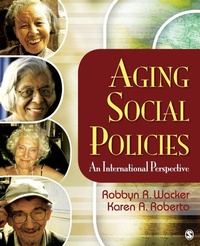
Aging Social Policies
An International Perspective
1st Edition
Published on 26. January 2011
Book
Paperback/Softback
304 pages
978-1-4129-3909-6 (ISBN)
Description
Our population is aging. What will we do about it?
Due to population explosion and a global increase in average life expectancies, an unprecedentedly high percentage of the world's population is aging. By the middle of this century there will be up to 2 billion individuals over the age of 65, a demographic shift never before experienced in our human history. In addition, declining birth rates in industrialized countries means a decrease in the number of adults under 64. In Aging Social Policies: An International Perspective the authors consider how policy - domestic and international - affects and will continue to affect the lives of our aging population.
Due to population explosion and a global increase in average life expectancies, an unprecedentedly high percentage of the world's population is aging. By the middle of this century there will be up to 2 billion individuals over the age of 65, a demographic shift never before experienced in our human history. In addition, declining birth rates in industrialized countries means a decrease in the number of adults under 64. In Aging Social Policies: An International Perspective the authors consider how policy - domestic and international - affects and will continue to affect the lives of our aging population.
More details
Language
English
Place of publication
Thousand Oaks
United States
Target group
College/higher education
Dimensions
Height: 235 mm
Width: 191 mm
Thickness: 17 mm
Weight
575 gr
ISBN-13
978-1-4129-3909-6 (9781412939096)
Copyright in bibliographic data and cover images is held by Nielsen Book Services Limited or by the publishers or by their respective licensors: all rights reserved.
Schweitzer Classification
Persons
Robbyn R. Wacker, Ph.D., is the Provost and Senior Vice President and Professor of Gerontology at the University of Northern Colorado. Her research interests include international aging social policy and psychosocial predictors of community service use among older adults. She has published over 65 refereed presentations, scholarly articles, books, and conference proceedings and has earned numerous university and professional awards, including UNC's Academic Leadership Excellence Award. Karen A. Roberto, Ph.D., is the Director of the Center for Gerontology, Founding Director of the Institute of Society, Culture, and Environment, and Professor of Human Development at Virginia Polytechnic Institute and State University. She also holds adjunct appointments in the Departments of Internal Medicine and Psychiatry and Behavioral Medicine at the Virginia Tech Carilion School of Medicine. She has published over 150 scholarly articles and book chapters, is the editor/author of ten books, and has earned numerous university and professional awards, including the Gerontological Society of America Behavioral and Social Science Distinguished Mentorship in Gerontology Award
Content
Part I: THE CONTEXT OF AGING SOCIAL POLICY
1. Our Aging Societies - The Setting for Aging Social Policy
2. The Aging Social Policy Process
PART II: AGING SOCIAL POLICY COMPARISONS
3. Retirement Income
4. Employment
5. Housing
6. Health Care
7. Mental Health Care
8. Community Resources
9. Family Care
PART III: THE FUTURE OF AGING SOCIAL POLICY
10. Aging Social Policy Challenges
References
About the Author
1. Our Aging Societies - The Setting for Aging Social Policy
2. The Aging Social Policy Process
PART II: AGING SOCIAL POLICY COMPARISONS
3. Retirement Income
4. Employment
5. Housing
6. Health Care
7. Mental Health Care
8. Community Resources
9. Family Care
PART III: THE FUTURE OF AGING SOCIAL POLICY
10. Aging Social Policy Challenges
References
About the Author