

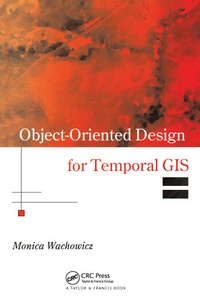
Object-Oriented Design for Temporal GIS
1st Edition
Published on 30. June 2020
Book
Paperback/Softback
132 pages
978-0-367-57917-3 (ISBN)
Description
There has been an increasing demand in GIS for systems that support historical data: time-series data as well as mobility information. From a modelling perspective, there are advantages in integrating object-oriented analysis and design to databases as well as to visualisation capabilities of GIS.
Object-Oriented Design for Temporal GIS explores the major components of the object-oriented analysis and design methods, how they can be used for modelling spatio-temporal data, and how these components are developed and maintained within a GIS. It also offers practical guidance to object-oriented methods by demonstrating the feasibility of applying such methods to issues involved in handling spatio-temporal data. The author demonstrates how this knowledge might be used in a wide range of applications such as political boundary record maintenance (historical data), disease incidence rate analysis in epidemics (diffusion rate), and environmental studies of climate change (time-series data). This understanding contributes to the development of theory in GIS and improves the design of GIS to support the modelling of semantics, space and time elements of geographical information.
Object-Oriented Design for Temporal GIS explores the major components of the object-oriented analysis and design methods, how they can be used for modelling spatio-temporal data, and how these components are developed and maintained within a GIS. It also offers practical guidance to object-oriented methods by demonstrating the feasibility of applying such methods to issues involved in handling spatio-temporal data. The author demonstrates how this knowledge might be used in a wide range of applications such as political boundary record maintenance (historical data), disease incidence rate analysis in epidemics (diffusion rate), and environmental studies of climate change (time-series data). This understanding contributes to the development of theory in GIS and improves the design of GIS to support the modelling of semantics, space and time elements of geographical information.
More details
Series
Language
English
Place of publication
London
United Kingdom
Publishing group
Taylor & Francis Ltd
Target group
Professional and scholarly
Professional
Dimensions
Height: 229 mm
Width: 152 mm
Weight
453 gr
ISBN-13
978-0-367-57917-3 (9780367579173)
Copyright in bibliographic data and cover images is held by Nielsen Book Services Limited or by the publishers or by their respective licensors: all rights reserved.
Schweitzer Classification
Other editions
Additional editions
Monica Wachowicz
Object-Oriented Design for Temporal GIS
Book
06/1999
1st Edition
Taylor & Francis
€160.94
Shipment within 15-20 days
Monica Wachowicz
Object-Oriented Design for Temporal GIS
E-Book
06/1999
CRC Press
€68.49
Available for download
Monica Wachowicz
Object-Oriented Design for Temporal GIS
E-Book
06/1999
1st Edition
CRC Press
€68.49
Available for download
Person
Wachowicz, Monica
Content
There has been an increasing demand in GIS for systems that support historical data: time-series data as well as mobility information. From a modelling perspective, there are advantages in integrating object-oriented analysis and design to databases as well as to visualisation capabilities of GIS.Object-Oriented Design for Temporal GIS explores the major components of the object-oriented analysis and design methods, how they can be used for modelling spatio-temporal data, and how these components are developed and maintained within a GIS. It also offers practical guidance to object-oriented methods by demonstrating the feasibility of applying such methods to issues involved in handling spatio-temporal data. The author demonstrates how this knowledge might be used in a wide range of applications such as political boundary record maintenance (historical data), disease incidence rate analysis in epidemics (diffusion rate), and environmental studies of climate change (time-series data). This understanding contributes to the development of theory in GIS and improves the design of GIS to support the modelling of semantics, space and time elements of geographical information.