

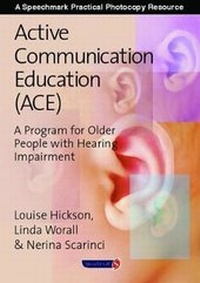
Active Communication Education (ACE)
A Program for Older People with Hearing Impairment
Published on 24. October 2007
Book
Paperback/Softback
104 pages
978-0-86388-614-0 (ISBN)
Description
"Active Communication Education (ACE)" is a group training program designed to help people over the age of 50 with hearing impairment to become more effective communicators in everyday life. Written for health professionals such as audiologists, speech & language therapists and nurses working in the community, this step-by-step program offers guidance and strategies that will help to: improve the person's communication abilities; reduce the hearing difficulties experienced; and, improve the person's quality of life. The small-group program is divided into a series of six modules based on everyday communication activities known to be problematic for older people with hearing impairments. These include using the telephone, listening to the television, going to a restaurant and conversing at mealtimes. Family and friends are also encouraged to attend. Each module includes photocopiable handouts that cover: a detailed discussion of the communication activity; possible solutions; practical exercises; home exercises; and, feedback on what has been covered. Successfully trialled as part of the National Health and Medical Research Council (NHMRC) grant in Brisbane, Australia, health professionals will find that "ACE" is a valuable rehabilitation option for older people, resulting in fewer communication difficulties, reduced social isolation and an improved quality of life and well-being.
Reviews / Votes
"A very well organized series of lessons with useful detailed handouts and feedback forms." Diane M. Bewer, George Washington UniversityMore details
Language
English
Place of publication
London
United Kingdom
Publishing group
Taylor & Francis Ltd
Target group
Professional and scholarly
ISBN-13
978-0-86388-614-0 (9780863886140)
Copyright in bibliographic data and cover images is held by Nielsen Book Services Limited or by the publishers or by their respective licensors: all rights reserved.
Schweitzer Classification
Persons
Louise Hickson is Deputy Head of the School of Health and Rehabilitation Sciences and Co-Director of the Communication Disability Centre at The University of Queensland, Australia. She is an audiologist who has published over 100 research articles and book chapters on communication disability in older people, in particular the effects of hearing impairment on the lives of older people. Linda Worrall is the Co-Director of the Communication Disability Centre at The University of Queensland, Australia. She is a speech pathologist who has published widely in communication disabilities associated with ageing. Nerina Scarinci is a Lecturer in the Division of Speech Pathology at The University of Queensland, Australia. She is completing her doctoral research in the area of age-related hearing impairment and third-party disability. Her professional interests centre on the rehabilitation of children and older adults with hearing impairment. Nerina has worked as a clinician in public hospitals and in private practice.
Content
Each module includes photocopiable handouts that cover: A detailed discussion of the communication activity Possible solutions Practical exercises Home exercises Feedback on what has been covered. List of handouts Preface Acknowledgements Introduction Running an ACE program Module 1: Communication needs analysis Module 2: Conversation in background noise Module 3: Conversation around the house Module 4: Communication with difficult speakers Module 5: Listening to other signals Module 6: Listening to PA Systems ACE: Final words of advice Appendix A ACE recruitment flyer and letter Appendix B Feedback from participants about the ACE program Appendix C Modified version of the Client Oriented Scale of Improvement (COSI) Appendix D International Outcome Inventory - Alternative Interventions (IOI-AI) Appendix E International Outcome Inventory - Alternative Interventions - Significant Other (IOI-AI-SO) References