

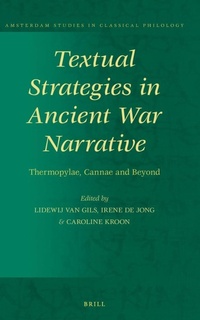
Textual Strategies in Ancient War Narrative
Thermopylae, Cannae and Beyond
Published on 10. January 2019
Book
Hardback
412 pages
978-90-04-38333-3 (ISBN)
Description
In this collected volume fourteen experts in the fields of Classics and Ancient History study the textual strategies used by Herodotus and Livy when recounting the disastrous battles at Thermopylae and Cannae. Literary, linguistic and historical approaches are used (often in combination) in order to enhance and enrich the interpretation of the accounts, which for obvious reasons confronted the authors with a special challenge. Chapters drawing a comparison with other battle narratives and with other genres help to establish genre-specific elements in ancient historiography, and draw attention to the particular techniques employed by Herodotus and Livy in their war narratives.
Reviews / Votes
"[T]his volume contains many substantial papers and reflects high standards of scholarship: in addition to examining their chosen themes, many of the papers offer wider reflection on methodological questions. The introduction likewise introduces methodological considerations, providing a short introduction to narratology and discourse linguistics. (...) this volume, which will prove useful to scholars examining the Thermopylae and Cannae narratives from a large variety of perspectives." Edith Foster, BMCR, 2019.11.15.More details
Series
Language
English
Place of publication
Leiden
Netherlands
Target group
Professional and scholarly
College/higher education
Product notice
sewn/stitched
Cloth over boards
Dimensions
Height: 236 mm
Width: 157 mm
Thickness: 28 mm
Weight
703 gr
ISBN-13
978-90-04-38333-3 (9789004383333)
Copyright in bibliographic data and cover images is held by Nielsen Book Services Limited or by the publishers or by their respective licensors: all rights reserved.
Schweitzer Classification
Persons
Lidewij van Gils obtained her PhD in 2009 with an analysis of the narrationes in Cicero's speeches. Currently, her focus is on Latin historiography and the linguistic aspects of common ground. She is assistant professor of Latin at the Vrije Universiteit Amsterdam.
Irene de Jong is professor of Ancient Greek at the University of Amsterdam. She specializes in the analysis and interpretation of the forms and functions of narrative (Homer, Herodotus, and Greek narrative at large), making use of the modern theory of narratology. Publications include A narratological commentary on the Odyssey (Cambridge 2001), Homer Iliad Book XXII (Cambridge 2012), and Narratology and Classics. A Practical Guide (Oxford 2014).
Caroline Kroon, Ph.D. (1995), is professor of Latin at the University of Amsterdam. She is author of the monograph Discourse Particles in Latin (Gieben/Brill, 1995), and of many articles on discourse linguistic topics. Her current research is characterized by an interdisciplinary approach crossing the border between linguistics and literary studies.
Irene de Jong is professor of Ancient Greek at the University of Amsterdam. She specializes in the analysis and interpretation of the forms and functions of narrative (Homer, Herodotus, and Greek narrative at large), making use of the modern theory of narratology. Publications include A narratological commentary on the Odyssey (Cambridge 2001), Homer Iliad Book XXII (Cambridge 2012), and Narratology and Classics. A Practical Guide (Oxford 2014).
Caroline Kroon, Ph.D. (1995), is professor of Latin at the University of Amsterdam. She is author of the monograph Discourse Particles in Latin (Gieben/Brill, 1995), and of many articles on discourse linguistic topics. Her current research is characterized by an interdisciplinary approach crossing the border between linguistics and literary studies.
Content
Preface
Notes on Contributors
1 Introduction
?Lidewij van Gils, Irene de Jong and Caroline Kroon
Part 1 Thermopylae
2 Thermopylae: Herodotus versus the Legend
?Hans van Wees
3 A Narratological Comparison of Herodotus and Diodorus on Thermopylae
?Mathieu de Bakker
4 Narrative and Identity in Thermopylae (Herodotus 7.201-7.239)
?Antonis Tsakmakis
5 Herodotus' Handling of (Narratological) Time in the Thermopylae Passage
?Irene J.F. de Jong
6 Herodotus and Thucydides: Distance and Immersion
?Rutger Allan
Part 2 Cannae
7 Livy on Cannae: a Literary Overview
?Stephen Oakley
8 Discourse-Linguistic Strategies in Livy's Account of the Battle at Cannae
?Lidewij van Gils and Caroline Kroon
9 Who Knows What Will Happen Next? Livy's fraus Punica from a Literary Point of View
?Dennis Pausch
10 Livy's Use of Spatial References in the Cannae Episode: from Structure to Strategy
?Lidewij van Gils
11 ET RATIO ET RES: Characterization of Roman Conduct through Speech Representation in the Battle of Cannae
?Michel Buijs
12 Words When It's Time for Action: Representations of Speech and Thought in the Battles of Cannae and Zama
?Suzanne Adema
Part 3 Beyond Thermopylae and Cannae
13 Thermopylae and Cannae: How One Battle Narrative Enriches Another
?Mathieu de Bakker and Michiel van der Keur
14 The Great and the Small: Thermopylae and Sphacteria
?Adriaan Rademaker
15 Force, Frequency and Focalisation: the Function of Similes in the Battle Narrative of Vergil, Aeneid 10
?Stephen Harrison
16 Parallel Plotlines: the Function of Similes in the Battle-Narrative of Vergil, Aeneid 10 (2)
?Michiel van der Keur
Index
Notes on Contributors
1 Introduction
?Lidewij van Gils, Irene de Jong and Caroline Kroon
Part 1 Thermopylae
2 Thermopylae: Herodotus versus the Legend
?Hans van Wees
3 A Narratological Comparison of Herodotus and Diodorus on Thermopylae
?Mathieu de Bakker
4 Narrative and Identity in Thermopylae (Herodotus 7.201-7.239)
?Antonis Tsakmakis
5 Herodotus' Handling of (Narratological) Time in the Thermopylae Passage
?Irene J.F. de Jong
6 Herodotus and Thucydides: Distance and Immersion
?Rutger Allan
Part 2 Cannae
7 Livy on Cannae: a Literary Overview
?Stephen Oakley
8 Discourse-Linguistic Strategies in Livy's Account of the Battle at Cannae
?Lidewij van Gils and Caroline Kroon
9 Who Knows What Will Happen Next? Livy's fraus Punica from a Literary Point of View
?Dennis Pausch
10 Livy's Use of Spatial References in the Cannae Episode: from Structure to Strategy
?Lidewij van Gils
11 ET RATIO ET RES: Characterization of Roman Conduct through Speech Representation in the Battle of Cannae
?Michel Buijs
12 Words When It's Time for Action: Representations of Speech and Thought in the Battles of Cannae and Zama
?Suzanne Adema
Part 3 Beyond Thermopylae and Cannae
13 Thermopylae and Cannae: How One Battle Narrative Enriches Another
?Mathieu de Bakker and Michiel van der Keur
14 The Great and the Small: Thermopylae and Sphacteria
?Adriaan Rademaker
15 Force, Frequency and Focalisation: the Function of Similes in the Battle Narrative of Vergil, Aeneid 10
?Stephen Harrison
16 Parallel Plotlines: the Function of Similes in the Battle-Narrative of Vergil, Aeneid 10 (2)
?Michiel van der Keur
Index