

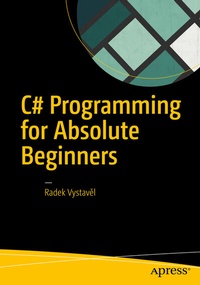
C# Programming for Absolute Beginners
Published on 8. January 2018
Book
Paperback/Softback
XXIX, 356 pages
978-1-4842-3317-7 (ISBN)
Description
Get started using the C# programming language. Based on the author's 15 years of experience teaching beginners, the book provides you with a step-by-step introduction to the principles of programming, or rather, how to think like a programmer. The task-solution approach will get you immersed, with minimum theory and maximum action.
What You Will Learn
Those with very little or no experience in computer programming, who know how to use a computer, install a program, and navigate the web.
What You Will Learn
-
Understand what programming is all about
-
Write simple, but non-trivial, programs
-
Become familiar with basic programming constructs such as statements, types, variables, conditions, and loops
-
Learn to think like a programmer and combine these programming constructs in new ways
- Get to know C# as a modern, mainstream programming language, and Visual Studio as one of the world's most popular programming tools
Those with very little or no experience in computer programming, who know how to use a computer, install a program, and navigate the web.
More details
Edition
1st ed.
Language
English
Place of publication
CA
United States
Illustrations
90 s/w Abbildungen, 93 farbige Abbildungen
93 Illustrations, color; 90 Illustrations, black and white; XXIX, 356 p. 183 illus., 93 illus. in color.
Dimensions
Height: 25.4 cm
Width: 17.8 cm
Weight
7264 gr
ISBN-13
978-1-4842-3317-7 (9781484233177)
DOI
10.1007/978-1-4842-3318-4
Schweitzer Classification
Other editions
New editions
Radek Vystave?l
C# Programming for Absolute Beginners
Learn to Think Like a Programmer and Start Writing Code
Book
08/2021
2nd Edition
APress
€80.24
Shipment within 15-20 days
Additional editions

Radek Vystave?l
C# Programming for Absolute Beginners
E-Book
12/2017
APress
€39.99
Available for download
Person
Radek Vystavel
started programming at a young age and has been doing it ever since, as well as sharing it with others. Greatly inspired by Lev Landau and Richard Feynman, Radek has been influenced by their desire to always search for what is the most fundamental in any given situation, and by their courage to be different. Having worked as both a programming teacher in college and privately, and as a programmer, Radek started writing books on programming because many of his students had no previous knowledge of programming and he had difficulty finding a suitable textbook for them. During the years he has gained a unique insight into what is important when teaching beginners.
Content
Chapter 1: Getting ReadyPart I: Data
Chapter 2: First Program Chapter 3: Outputs Chapter 4: Variables Chapter 5: Objects Chapter 6: Object and Actions Chapter 7: More on ObjectsPart II. Calculations
Chapter 8: InputsChapter 9: NumbersChapter 10: Economic Calculations Chapter 11: Calculations with Dates Chapter 12: Understanding Different Kinds of Numbers Chapter 13: Accumulating ValuesPart III: Conditionals
Chapter 14: Essential ToolsChapter 15: Starting with Conditions Chapter 16: Practical Conditions Chapter 17: Compound Conditions Chapter 18: Multiple Conditions Chapter 19: Advanced ConditionsPart IV: Loops
Chapter 20: First LoopsChapter 21: Improving LoopsChapter 22: Number SeriesChapter 23: Unknown Number of Repetitions Chapter 24: Accumulating Intermediate Result Chapter 25: Advanced Loops
Chapter 2: First Program Chapter 3: Outputs Chapter 4: Variables Chapter 5: Objects Chapter 6: Object and Actions Chapter 7: More on ObjectsPart II. Calculations
Chapter 8: InputsChapter 9: NumbersChapter 10: Economic Calculations Chapter 11: Calculations with Dates Chapter 12: Understanding Different Kinds of Numbers Chapter 13: Accumulating ValuesPart III: Conditionals
Chapter 14: Essential ToolsChapter 15: Starting with Conditions Chapter 16: Practical Conditions Chapter 17: Compound Conditions Chapter 18: Multiple Conditions Chapter 19: Advanced ConditionsPart IV: Loops
Chapter 20: First LoopsChapter 21: Improving LoopsChapter 22: Number SeriesChapter 23: Unknown Number of Repetitions Chapter 24: Accumulating Intermediate Result Chapter 25: Advanced Loops