

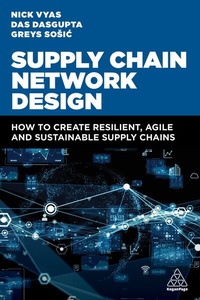
Supply Chain Network Design
How to Create Resilient, Agile and Sustainable Supply Chains
1st Edition
Published on 3. May 2024
Book
Paperback/Softback
384 pages
978-1-3986-1491-8 (ISBN)
Description
The traditional linear supply chain is no longer fit for purpose, and organizations must redesign their supply chains to become more customer-driven, agile, resilient and sustainable.
Supply Chain Network Design
shows how to design intelligent, agile supply chain networks in the age of geopolitical disruptions, fast-paced technological innovation and drive for more sustainable business. It outlines how to incorporate international relations and a global perspective into supply chain planning and actions and how to embed ESG and circular economy goals. It surveys the rapidly evolving technology landscape and how it impacts some companies and provides a competitive advantage to others. It also explores how to harness technologies such as robotic process automation, AI and machine-driven intelligence and the evolution of forecasting to demand sensing to enhance network design.
Taking a global perspective,
Supply Chain Network Design
is supported by practical cases and examples and provides a consumer-driven lens that will help organizations evolve their networks from a traditional B2B to a B2B2C workflow. Covering both lessons learned and how to move forward, this will be an must-read for supply chain, logistics and distribution leaders, managers and analysts.
Reviews / Votes
"With the recent disruptions that tested traditional supply chain strategies fresh in our rearview mirror, we can all benefit from a new, innovative approach to network design that supports supply chains that are resilient, agile, and sustainable. Supply Chain Network Design offers practitioners and academics alike the insight and tools they need to develop supply chain strategies that meet the risks and challenges of today's and tomorrow's global supply chain. This insight will help to inform and transform the global supply chain."More details
Other editions
Additional editions
Nick Vyas | Das Dasgupta | Greys Sosic
Supply Chain Network Design
How to Create Resilient, Agile and Sustainable Supply Chains
Book
05/2024
1st Edition
Kogan Page Ltd
€216.10
Shipment within 10-20 days
Nick Vyas | Das Dasgupta | Greys Sosic
Supply Chain Network Design
How to Create Resilient, Agile and Sustainable Supply Chains
E-Book
05/2024
1st Edition
Kogan Page Ltd
€61.49
Available for download
Persons
Author
Assistant Professor of Clinical Data Sciences and Operations
Nick Vyas is the executive director and co-founder of USC Marshall's Center for Global Supply Chain Management and Academic Director of the M.S. Global Supply Chain program. He teaches GSCM and Lean Six Sigma and global supply chain management to leaders from various industries at Cal Polytechnic University, Pomona. Previously Vyas managed global operations for Duty Free International, Sears, Federated Stores, and Toys R Us, where he integrated technology, directed teams, and oversaw strategic transformation initiatives that both optimized speed-to-market and managed cost and quality. He was awarded the Supply Chain Leader Award of Excellence by APICS, the premier professional association for supply chain management for his contributions to the development of the next generation supply chain ecosystem.
Nick Vyas is the executive director and co-founder of USC Marshall's Center for Global Supply Chain Management and Academic Director of the M.S. Global Supply Chain program. He teaches GSCM and Lean Six Sigma and global supply chain management to leaders from various industries at Cal Polytechnic University, Pomona. Previously Vyas managed global operations for Duty Free International, Sears, Federated Stores, and Toys R Us, where he integrated technology, directed teams, and oversaw strategic transformation initiatives that both optimized speed-to-market and managed cost and quality. He was awarded the Supply Chain Leader Award of Excellence by APICS, the premier professional association for supply chain management for his contributions to the development of the next generation supply chain ecosystem.
Dr. Das Dasgupta is Chief Data Officer at Saatchi & Saatchi, where he leads Data Science Operations and Advanced Analytics. Prior to this, he held leadership roles at Amazon, McKinsey, EY and Viacom. He has over 20 years of experience in helping organizations with their Strategy, Operations, and Data Analytics initiatives. He is an Adjunct Professor of Data Sciences and Operations at the USC Marshall School of Business, where he teaches Logistics and Business Analytics. He is based in Irvine, USA.
Greys Sosic is the E. Morgan Stanley Chair in Business Administration and Professor of Data Sciences and Operations at USC Marshall School of Business, where she teaches courses on supply chain management, sustainability and sourcing. Her research interests include supply chain management, sustainability, competition and cooperation in supply chains, with emphasis on coalition stability. She is based in Los Angeles, USA.
Content
-
- Chapter - 01: Introduction- the supply chain landscape: disruptions, threats and key trends to watch;
- Chapter - 02: Principles of network design and how to optimize supply chains;
- Chapter - 03: Intelligent supply chain network design: Integrating people, environment and economy
- Chapter - 04: Intelligent supply chain network design models (multi-dimensional models);
- Chapter - 05: Harnessing emerging technologies in supply chain network design;
- Chapter - 06: Integrating sustainability in the supply chain DNA;
- Chapter - 07: Circular economy and its influence on supply chain network design;
- Chapter - 08: Smart Cities, Smart Infrastructure, Smart Nations (new perspective on infrastructure);
- Chapter - 09: Implementing Effective Network Design Change within Your Organization;
- Chapter - 10: Lessons learned from three supply chain network design case studies;