

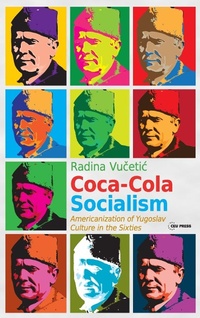
Coca-Cola Socialism
Americanization of Yugoslav Culture in the Sixties
Published on 20. June 2018
Book
Hardback
362 pages
978-963-386-200-1 (ISBN)
Description
This book is about the Americanization of Yugoslav culture and everyday life during the nineteen-sixties. After falling out with the Eastern bloc, Tito turned to the United States for support and inspiration. In the political sphere the distance between the two countries was carefully maintained, yet in the realms of culture and consumption the Yugoslav regime was definitely much more receptive to the American model. For Titoist Yugoslavia this tactic turned out to be beneficial, stabilising the regime internally and providing an image of openness in foreign policy.
Coca-Cola Socialism addresses the link between cultural diplomacy, culture, consumer society and politics. Its main argument is that both culture and everyday life modelled on the American way were a major source of legitimacy for the Yugoslav Communist Party, and a powerful weapon for both USA and Yugoslavia in the Cold War battle for hearts and minds.
Radina Vucetic explores how the Party used American culture in order to promote its own values and what life in this socialist and capitalist hybrid system looked like for ordinary people who lived in a country with communist ideology in a capitalist wrapping. Her book offers a careful reevaluation of the limits of appropriating the American dream and questions both an uncritical celebration of Yugoslavia's openness and an exaggerated depiction of its authoritarianism.
Coca-Cola Socialism addresses the link between cultural diplomacy, culture, consumer society and politics. Its main argument is that both culture and everyday life modelled on the American way were a major source of legitimacy for the Yugoslav Communist Party, and a powerful weapon for both USA and Yugoslavia in the Cold War battle for hearts and minds.
Radina Vucetic explores how the Party used American culture in order to promote its own values and what life in this socialist and capitalist hybrid system looked like for ordinary people who lived in a country with communist ideology in a capitalist wrapping. Her book offers a careful reevaluation of the limits of appropriating the American dream and questions both an uncritical celebration of Yugoslavia's openness and an exaggerated depiction of its authoritarianism.
Reviews / Votes
"The red thread of Vucetic's argument is the metaphor of the Roman god Janus' double-face which she uses to describe Yugoslav positioning in-between the Blocs - looking at both sides, showing to each a different facet of itself, saying 'no' to both while never uttering an explicit 'yes'. Consequently, the relatively unrestrained import of American cultural products to Yugoslavia proved to be a win-win situation for both regimes. Washington would happily watch the distance between Tito and other socialist leaders steadily increase, whereas Yugoslav communists would foster Yugoslav population's sense of freedom and superiority over other socialist societies, but also strengthen the regime's desired external image of 'socialism with a human face'. This pattern was applied with contextual specificities in such diverse spheres of culture as film production, contemporary art, theatre, the jazz and rock music scenes, television and comics, eventually oxymoronically producing a decidedly Americanized socialist youth. Through its symbiosis of cultural, diplomatic and history of everyday life, this book provides a very important contribution not just to historiography of socialist Yugoslavia and Yugoslav-American relations, but more generally offers a welcome enrichment for the research on cultural diplomacy and Cold War Studies, further advancing the scholarly 'thirding' of Cold War dichotomies." * KULT_online *More details
Language
English
Place of publication
Oxford
Hungary
Target group
Professional and scholarly
Academic
Product notice
sewn/stitched
Cloth over boards
Dimensions
Height: 235 mm
Width: 157 mm
Thickness: 24 mm
Weight
675 gr
ISBN-13
978-963-386-200-1 (9789633862001)
Copyright in bibliographic data and cover images is held by Nielsen Book Services Limited or by the publishers or by their respective licensors: all rights reserved.
Schweitzer Classification
Other editions
Additional editions
Book
03/2023
Central European University Press
€72.50
Available (delivery time upon request)
E-Book
06/2018
1st Edition
Central European University Press
€98.99
Available for download
Persons
Radina Vucetic is Associate Professor at the General Modern History Department of History at the University of Belgrade.
John K. Cox is professor at North Dakota State University in Fargo.
John K. Cox is professor at North Dakota State University in Fargo.
Content
Foreword
Introduction
Chapter 1. Between Pink Hollywood and the Black Wave
Chapter 2. A Change in Rhythm
Chapter 3. Modernism and the Avant-garde in the Struggle for Socialism
Chapter 4. Life, American Style
Chapter 5. Conclusion
Bibliography
Index
Introduction
Chapter 1. Between Pink Hollywood and the Black Wave
Chapter 2. A Change in Rhythm
Chapter 3. Modernism and the Avant-garde in the Struggle for Socialism
Chapter 4. Life, American Style
Chapter 5. Conclusion
Bibliography
Index