

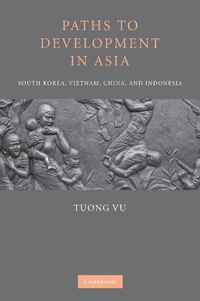
Paths to Development in Asia
South Korea, Vietnam, China, and Indonesia
Published on 2. January 2014
Book
Paperback/Softback
314 pages
978-1-107-61810-7 (ISBN)
Description
Why have some states in the developing world been more successful at facilitating industrialization than others? Challenging theories that privilege industrial policy and colonial legacies, this book focuses on state structure and the politics of state formation, arguing that a cohesive state structure is as important to developmental success as effective industrial policy. Based on a comparison of six Asian cases, including both capitalist and socialist states with varying structural cohesion, Tuong Vu proves that it is state formation politics rather than colonial legacies that have had decisive and lasting impacts on the structures of emerging states. His cross-national comparison of South Korea, Vietnam, Republican and Maoist China, and Sukarno's and Suharto's Indonesia, which is augmented by in-depth analyses of state formation processes in Vietnam and Indonesia, is an important contribution to understanding the dynamics of state formation and economic development in Asia.
Reviews / Votes
'... the main strength of Paths to Development in Asia is its careful attention to how political organization and political discourse operated in the decade-and-a-half after the Second World War in Vietnam and Indonesia. In doing so, Vu demonstrates convincingly how accommodation, mass incorporation and elite compromise impeded the creation of effective developmental sates in these two countries.' South East Asia Research 'Paths to Development in Asia stands out for its attention to history and belief in its importance; for incorporating socialist states into the concept of developmental states, a valuable move; and for its depressing lessons - above all that successful developmental states are born in bloodbaths. It makes clear the contingency of democracy and the importance of a comparative historical approach.' Scott L. Greer, DemocratizationMore details
Language
English
Place of publication
Cambridge
United Kingdom
Target group
Professional and scholarly
College/higher education
Product notice
Paperback (trade)
Illustrations
6 Tables, unspecified; 1 Line drawings, unspecified
Dimensions
Height: 229 mm
Width: 152 mm
Thickness: 19 mm
Weight
512 gr
ISBN-13
978-1-107-61810-7 (9781107618107)
Copyright in bibliographic data and cover images is held by Nielsen Book Services Limited or by the publishers or by their respective licensors: all rights reserved.
Schweitzer Classification
Other editions
Additional editions
E-Book
06/2010
1st Edition
Cambridge University Press
€38.49
Available for download
Book
03/2010
Cambridge University Press
€140.10
Shipment within 15-20 days
Person
Tuong Vu is an Assistant Professor of Comparative Politics in the Department of Political Science at the University of Oregon. He co-edited (with Erik Kuhonta and Dan Slater) Southeast Asia in Political Science: Theory, Region and Qualitative Analysis (2008) and (with Wasana Wongsurawat) Dynamics of the Cold War in Asia: Ideology, Identity, and Culture (2010). His articles have appeared in numerous scholarly journals, including World Politics, the Journal of Southeast Asian Studies, Studies in Comparative International Development, and Theory and Society, and he is a member of the editorial board of the Journal of Vietnamese Studies.
Content
Part I. Divergent National Paths of State Development: 1. State formation dynamics and developmental outcomes; 2. South Korea: confrontation and the formation of a cohesive state; 3. Indonesia: from accommodation to confrontation; 4. Rival state formations in China: the republican and Maoist states; 5. Vietnam: accommodation and arrested revolution; Part II. Variants of Accommodation: Vietnam and Indonesia Compared: 6. Organizing accommodation in Vietnam: coalition government, united front, and the Leninist party; 7. Organizing accommodation in Indonesia: parliament and status-based parties; 8. Talking accommodation in Vietnam: nation, the people, and class struggle; 9. Talking accommodation in Indonesia: nation, the people, God, and Karl Marx; 10. Rethinking developmental states; Bibliography.