

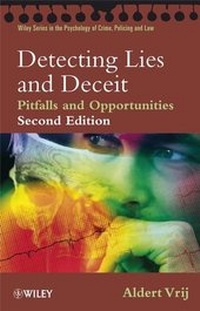
Detecting Lies and Deceit
Pitfalls and Opportunities
2nd Edition
Published on 11. January 2008
Book
Hardback
504 pages
978-0-470-51624-9 (ISBN)
Description
Why do people lie? Do gender and personality differences affect how people lie? How can lies be detected?
Detecting Lies and Deceit provides the most comprehensive review of deception to date. This revised edition provides an up-to-date account of deception research and discusses the working and efficacy of the most commonly used lie detection tools, including:
* Behaviour Analysis Interview
* Statement Validity Assessment
* Reality Monitoring
* Scientific Content Analysis
* Several different polygraph tests
* Voice Stress Analysis
* Thermal Imaging
* EEG-P300
* Functional Magnetic Resonance Imaging (fMRI)
All three aspects of deception are covered: nonverbal cues, speech and written statement analysis and (neuro)physiological responses. The most common errors in lie detection are discussed and practical guidelines are provided to help professionals improve their lie detection skills.
Detecting Lies and Deceit is a must-have resource for students, academics and professionals in psychology, criminology, policing and law.
Published in the Wiley Series in the Psychology of Crime, Policing and Law
Seried Editors:
Professor Graham Davies and Professor Ray Bull, University of Leicester, UK
More details
Product info
gebunden
Series
Edition
2. Auflage
Language
English
Place of publication
United States
Publishing group
John Wiley & Sons Inc
Target group
Professional and scholarly
Edition type
New edition
Product notice
sewn/stitched
Cloth over boards
Dimensions
Height: 235 mm
Width: 157 mm
Thickness: 34 mm
Weight
963 gr
ISBN-13
978-0-470-51624-9 (9780470516249)
Schweitzer Classification
Other editions
Additional editions
E-Book
08/2011
2nd Edition
Wiley
€53.99
Available for download
E-Book
08/2008
2nd Edition
Wiley
€53.99
Available for download
Book
01/2008
2nd Edition
Wiley
€62.50
Shipment within 10-20 days
Person
Aldert Vrij is a Professor of Applied Social Psychology in the Department of Psychology the University of Portsmouth (UK). He has Published more than 300 articles and book chapters to date, mainly on the subjects of nonverbal and verbal cues to deception and lie detection. He also advises the police about conducting interviews with suspects, acts as an Expert Witness in court, and gives invited talks and workshops on lie detection to practitioners and scholars across the world. he is at present Editor of Legal and Criminological Psychology, a forensic journal published by the British Psychological Society.
Content
About the Author
Series Preface
Preface
Acknowledgements
1 Introduction
2 Lying: A Selfish Act and a Social Lubricant
3 Nonverbal Behaviour and Deception
4 Individual Verbal Cues to Deception
5 Beliefs about Nonverbal and Verbal Cues to Deception
6 Lie Detection Without Using Specialised Tools
7 The Behaviour Analysis Interview
>8 Statement Validity Assessment
9 Reality Monitoring
10 Scientific Content Analysis
11 Physiological Lie Detection: The Concern Approach
12 Physiological Lie Detection: The Orienting Reflex Approach
13 Physiological Lie Detection: Functional Magnetic Resonance Imaging (fMRI)
14 Pitfalls: Why People Fail to Catch Liars
15 Opportunities: How People Can Improve Their Lie Detection Skills
Epilogue
References
Index