

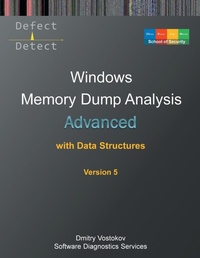
Advanced Windows Memory Dump Analysis with Data Structures
Training Course Transcript and WinDbg Practice Exercises with Notes, Fifth Edition
5th Edition
Published on 7. May 2025
Book
Paperback/Softback
342 pages
978-1-912636-95-2 (ISBN)
Description
Learn how to use WinDbg to navigate memory space and Windows data structures to diagnose structural and behavioral patterns in the 64-bit kernel and complete (physical) memory dumps.
More details
Series
Edition
5th ed.
Language
English
Product notice
Paperback (trade)
Unsewn / adhesive bound
Dimensions
Height: 279 mm
Width: 216 mm
Thickness: 23 mm
Weight
1098 gr
ISBN-13
978-1-912636-95-2 (9781912636952)
Copyright in bibliographic data and cover images is held by Nielsen Book Services Limited or by the publishers or by their respective licensors: all rights reserved.
Schweitzer Classification
Persons
Dmitry Vostokov is an internationally recognized expert, speaker, educator, scientist, inventor, and author. He founded the pattern-oriented software diagnostics, forensics, and prognostics discipline (Systematic Software Diagnostics) and Software Diagnostics and Observability Institute. Vostokov has also authored over 50 books on software diagnostics, anomaly detection and analysis, software and memory forensics, root cause analysis and problem solving, memory dump analysis, debugging, software trace and log analysis, reverse engineering, and malware analysis. He has over 30 years of experience in software architecture, design, development, and maintenance in various industries, including leadership, technical, and people management roles. Dmitry founded OpenTask Iterative and Incremental Publishing and Software Diagnostics Technology and Services (former Memory Dump Analysis Services). In his spare time, he explores Software Narratology and Quantum Software Diagnostics. His interest areas are theoretical software diagnostics and its mathematical and computer science foundations, application of formal logic, semiotics, artificial intelligence, machine learning, and data mining to diagnostics and anomaly detection, software diagnostics engineering and diagnostics-driven development, diagnostics workflow and interaction. Recent interest areas also include functional programming, cloud native computing, monitoring, observability, visualization, security, automation, applications of category theory to software diagnostics, development and big data, and diagnostics of artificial intelligence.