

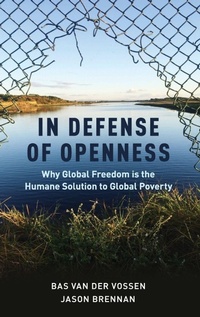
In Defense of Openness
Why Global Freedom Is the Humane Solution to Global Poverty
Published on 27. September 2018
Book
Hardback
240 pages
978-0-19-046295-6 (ISBN)
Description
The topic of global justice has long been a central concern within political philosophy and political theory, and there is no doubt that it will remain significant given the persistence of poverty on a massive scale and soaring global inequality. Yet, virtually every analysis in the vast literature of the subject seems ignorant of what developmental economists, both left and right, have to say about the issue.
In Defense of Openness illuminates the problem by stressing that that there is overwhelming evidence that economic rights and freedom are necessary for development, and that global redistribution tends to hurt more than it helps. Bas van der Vossen and Jason Brennan instead ask what a theory of global justice would look like if it were informed by the facts that mainstream development and institutional economics have brought to light. They conceptualize global justice as global freedom and insist we can help the poor-and help ourselves at the same time-by implementing open borders, free trade, the strong protection of individual freedom, and economic rights and property for all around the world. In short, they work from empirical, consequentialist grounds to advocate for the market society as a model for global justice.
A spirited challenge to mainstream political theory from two leading political philosophers, In Defense of Openness offers a new approach to global justice: We don't need to "save" the poor. The poor will save themselves, if we would only get out of their way and let them.
In Defense of Openness illuminates the problem by stressing that that there is overwhelming evidence that economic rights and freedom are necessary for development, and that global redistribution tends to hurt more than it helps. Bas van der Vossen and Jason Brennan instead ask what a theory of global justice would look like if it were informed by the facts that mainstream development and institutional economics have brought to light. They conceptualize global justice as global freedom and insist we can help the poor-and help ourselves at the same time-by implementing open borders, free trade, the strong protection of individual freedom, and economic rights and property for all around the world. In short, they work from empirical, consequentialist grounds to advocate for the market society as a model for global justice.
A spirited challenge to mainstream political theory from two leading political philosophers, In Defense of Openness offers a new approach to global justice: We don't need to "save" the poor. The poor will save themselves, if we would only get out of their way and let them.
Reviews / Votes
Van der Vossen (Chapman) and Brennan (Georgetown) have written a lively, cogently argued work that will be of interest to anyone who cares about global justice, and will be particularly valuable for college courses... Summing Up: Essential. * CHOICE * Must the poor in means and spirit always be with us? Read this book and discover why poverty and oppression is most effectively addressed by championing world-wide freedom of expression, association and trade, thus helping the poor to help themselves to entrenchment." -Vernon Smith, Professor of Economics, Finance, and Law, Chapman University Most global-justice writers favor a regulatory model to address global issues such as poverty. This model is significantly flawed because it overlooks the role of free markets in the reduction of poverty. This brilliant book, in contrast, shows that global justice should center on global freedom and economic growth. It rejects proposals of a world welfare agency and recommends instead lifting unjust barriers to global trade and mobility. I predict that this beautifully-written and tightly-argued book will make a lasting contribution to the global justice debate." -Fernando R. Teson, Tobias Simon Eminent Scholar and Professor of Law, Florida State University College of Law Bas van der Vossen and Jason Brennan have done a superb job bringing economic theory and moral analysis to bear on the some of the most pressing issues in contemporary political philosophy. Everyone working on the ethics of immigration, foreign aid and/or global justice should pay close attention to this very important and timely book." -Christopher Heath Wellman, Professor of Philosophy, Washington University in St. LouisMore details
Language
English
Place of publication
New York
United States
Illustrations
15 illustrations
Dimensions
Height: 240 mm
Width: 161 mm
Thickness: 17 mm
Weight
526 gr
ISBN-13
978-0-19-046295-6 (9780190462956)
Copyright in bibliographic data and cover images is held by Nielsen Book Services Limited or by the publishers or by their respective licensors: all rights reserved.
Schweitzer Classification
Other editions
Additional editions
Bas van der Vossen | Jason Brennan
In Defense of Openness
Why Global Freedom Is the Humane Solution to Global Poverty
E-Book
08/2018
OUP eBook
€30.49
Available for download
Bas van der Vossen | Jason Brennan
In Defense of Openness
Why Global Freedom Is the Humane Solution to Global Poverty
E-Book
08/2018
OUP eBook
€30.49
Available for download
Persons
Bas van der Vossen is an Associate Professor of Philosophy at Chapman University. He's the author of Debating Humanitarian Intervention (OUP, 2017), together with Fernando Teson, and has edited the Routledge Handbook of Libertarianism (Routledge, 2017), together with Jason Brennan and David Schmidtz.
Jason Brennan is the Flanagan Family Professor at Georgetown University. He is the author or co-author of nine books, including Against Democracy and When All Else Fails: Resistance, Violence, and State Injustice.
Jason Brennan is the Flanagan Family Professor at Georgetown University. He is the author or co-author of nine books, including Against Democracy and When All Else Fails: Resistance, Violence, and State Injustice.
Content
- Preface
- 1. Zero vs. Positive-Sum Global Justice
- 2. The Moral and Economic Case for Free Immigration
- 3. Economic Objections to Open Borders
- 4. Philosophers' Objections to Open Borders
- 5. The Moral and Economic Case for Free Trade
- 6. Philosophers' Objections to Free Trade
- 7. Productive Human Rights
- 8. Correcting the Past: Imperialism and Colonialism
- 9. Improving the Present: Justice and the Global Order
- 10. Towards a Better Future: International Aid and Global Charity
- 11. The Climate Change Objection to Economic Growth
- Postscript