

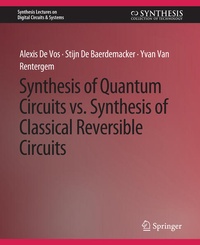
Synthesis of Quantum Circuits vs. Synthesis of Classical Reversible Circuits
Published on 3. July 2018
Book
Paperback/Softback
XV, 109 pages
978-3-031-79894-8 (ISBN)
Description
At first sight, quantum computing is completely different from classical computing. Nevertheless, a link is provided by reversible computation.
Whereas an arbitrary quantum circuit, acting on ?? qubits, is described by an ?? × ?? unitary matrix with ??=2??, a reversible classical circuit, acting on ?? bits, is described by a 2?? × 2?? permutation matrix. The permutation matrices are studied in group theory of finite groups (in particular the symmetric group ????); the unitary matrices are discussed in group theory of continuous groups (a.k.a. Lie groups, in particular the unitary group U(??)).
Both the synthesis of a reversible logic circuit and the synthesis of a quantum logic circuit take advantage of the decomposition of a matrix: the former of a permutation matrix, the latter of a unitary matrix. In both cases the decomposition is into three matrices. In both cases the decomposition is not unique.
More details
Series
Language
English
Place of publication
Cham
Switzerland
Publishing group
Springer International Publishing
Target group
Professional and scholarly
Illustrations
XV, 109 p.
Dimensions
Height: 235 mm
Width: 191 mm
Thickness: 8 mm
Weight
255 gr
ISBN-13
978-3-031-79894-8 (9783031798948)
DOI
10.1007/978-3-031-79895-5
Schweitzer Classification
Other editions
Additional editions
Alexis De Vos | Stijn De Baerdemacker | Yvan Van Rentergem
Synthesis of Quantum Circuits vs. Synthesis of Classical Reversible Circuits
E-Book
05/2022
Springer
€64.19
Available for download
Persons
Alexis De Vos is an electrical engineer, physicist, and doctor in applied sciences and graduated from the Universiteit Gent (Belgium). He is currently a part-time professor in the Department of Electronics of the Universiteit Gent. His research is concerned with material science (polymers, semiconductors, metals, liquid crystals), microelectronics (thin films, chips, neural networks, reversible circuits), and energy sciences (thermodynamics, solar energy, endoreversible engines). He is author of the books Thermodynamics of Solar Energy Conversion (Wiley-VCH, 2008) and Reversible Computing (Wiley-VCH, 2010). He designed and produced several prototype integrated circuits for reversible computers such as adders, multipliers, and linear transformers. He currently investigates quantum computing.Stijn De Baerdemacker is a physicist and doctor in sciences and graduated from the Universiteit Gent (Belgium). He has been a visiting scientist at the University of Toronto (ON, Canada), University of Notre Dame (IN, USA) and Universiteit Amsterdam (The Netherlands). He is currently a post-doctoral researcher in the Department of Physics and Astronomy of the Universiteit Gent. His research is concerned with the development of accurate quantum many-body methods in quantum physics, quantum chemistry and quantum computing. For this, he uses and develops techniques from Lie algebra theory and notions from (quantum) integrability. In his free time, he is a painter and explores the boundaries between science and art.Yvan Van Rentergem is an electrical engineer and doctor in applied sciences and graduated from the Universiteit Gent (Belgium). He obtained his Ph.D. in 2008 in the subject of reversible computing. During his research, he developed algorithms for the synthesis of reversible circuits. These methods were applied for real-life prototype chips. His research led to ten articles presented at international conferences or published in international journals. After earning his Ph.D., he went to work at ArcelorMittal Gent as operations research specialist, developing models to optimize the logistical flow of the steel shop. These models are successfully applied at ArcelorMittal Gent and several other sites of ArcelorMittal. He currently is slab yard support manager at ArcelorMittal Gent.
Content
Acknowledgments.- Introduction.- Bottom.- Bottom-Up.- Top.- Top-Down.- Conclusion.- Bibliography.- Authors' Biographies.- Index.