

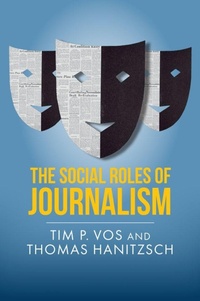
The Social Roles of Journalism
1st Edition
Will be published approx. on 17. December 2026
Book
Hardback
224 pages
978-1-5095-4260-4 (ISBN)
Description
Journalism is valued, contested, and sometimes attacked, because of the role it plays or potentially plays in society. Journalists collectively develop a sense of what social good they provide in the world, partly to provide direction in their daily work and partly to defend their authority in the face of competing visions of what journalism should be and do.
The Social Roles of Journalism explores how journalism's place in the world is in near constant (re)creation, (re)interpretation, appropriation, and contestation. It investigates how journalism's roles have been created, conceived and practiced around the world and why journalists often struggle to perform the roles they value. The book identifies the characteristics, types, and levels of roles - in doing so, it develops a model of how roles are internalized, enacted, reflected upon, normalized, and negotiated. Ultimately, the book intends to bring greater clarity to the broad and often fragmented work on journalistic roles, introducing a novel and integrative theoretical framework on which future research can build.
This book is an essential resource for advanced students and scholars of journalism.
The Social Roles of Journalism explores how journalism's place in the world is in near constant (re)creation, (re)interpretation, appropriation, and contestation. It investigates how journalism's roles have been created, conceived and practiced around the world and why journalists often struggle to perform the roles they value. The book identifies the characteristics, types, and levels of roles - in doing so, it develops a model of how roles are internalized, enacted, reflected upon, normalized, and negotiated. Ultimately, the book intends to bring greater clarity to the broad and often fragmented work on journalistic roles, introducing a novel and integrative theoretical framework on which future research can build.
This book is an essential resource for advanced students and scholars of journalism.
More details
Language
English
Place of publication
Oxford
United Kingdom
Publishing group
John Wiley and Sons Ltd
Target group
College/higher education
ISBN-13
978-1-5095-4260-4 (9781509542604)
Copyright in bibliographic data and cover images is held by Nielsen Book Services Limited or by the publishers or by their respective licensors: all rights reserved.
Schweitzer Classification
Other editions
Additional editions
Tim P. Vos | Thomas Hanitzsch
The Social Roles of Journalism
Book
approx. 12/2026
1st Edition
Polity Press
€22.50
Not yet published
Persons
Tim P. Vos is Professor and Director of the Michigan State University School of Journalism.
Thomas Hanitzsch is Professor of Communication at LMU Munich.
Thomas Hanitzsch is Professor of Communication at LMU Munich.
Content
Preface
Introduction: Why Journalistic Roles Matter
Section I: An Institutional Understanding of Roles
1. A Genealogy of Studying Journalistic Roles
2. Thinking About Roles and Institutions
3. Journalistic Roles as Communicative Constructs
4. Who Speaks for Journalism?
Section II: The Roles Journalists Perform
5. Foundations of Journalistic Roles in Political Life
6. Mapping Journalistic Roles and Political Life
7. Foundations of Journalistic Roles in Everyday Life
8. Mapping Journalistic Roles and Everyday Life
Section III: Journalistic Roles and Change
9. Journalistic Roles as a Dynamic Process
10. A Process Model of Journalistic Roles
11. The Temporal Properties of Journalistic Roles
Conclusion: Final Thoughts
Notes
References
Index
Introduction: Why Journalistic Roles Matter
Section I: An Institutional Understanding of Roles
1. A Genealogy of Studying Journalistic Roles
2. Thinking About Roles and Institutions
3. Journalistic Roles as Communicative Constructs
4. Who Speaks for Journalism?
Section II: The Roles Journalists Perform
5. Foundations of Journalistic Roles in Political Life
6. Mapping Journalistic Roles and Political Life
7. Foundations of Journalistic Roles in Everyday Life
8. Mapping Journalistic Roles and Everyday Life
Section III: Journalistic Roles and Change
9. Journalistic Roles as a Dynamic Process
10. A Process Model of Journalistic Roles
11. The Temporal Properties of Journalistic Roles
Conclusion: Final Thoughts
Notes
References
Index