

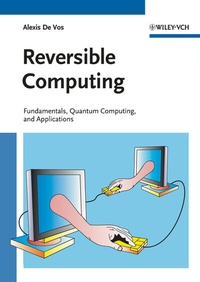
Reversible Computing
Fundamentals, Quantum Computing, and Applications
1st Edition
Published on 13. October 2010
Book
Hardback
X, 251 pages
978-3-527-40992-1 (ISBN)
Description
Written by one of the few top internationally recognized experts in the field, this book concentrates on those topics that will remain fundamental, such as low power computing, reversible programming languages, and applications in thermodynamics. It describes reversible computing from various points of view: Boolean algebra, group theory, logic circuits, low-power electronics, communication, software, quantum computing. It is this multidisciplinary approach that makes it unique.
Backed by numerous examples, this is useful for all levels of the scientific and academic community, from undergraduates to established academics.
Backed by numerous examples, this is useful for all levels of the scientific and academic community, from undergraduates to established academics.
Reviews / Votes
"It describes reversible computing from various points of view: Boolean algebra, group theory, logic circuits, low-power electronics, communication, software, quantum computing. It is this multidisciplinary approach that makes it unique." (Storage, 15 February 2011)More details
Other editions
Additional editions
E-Book
08/2011
1st Edition
Wiley-VCH
€124.99
Available for download
E-Book
11/2010
1st Edition
Wiley-VCH
€124.99
Available for download
Person
Alexis De Vos received his Ph.D. degree in applied sciences from the University of Ghent, Belgium, in 1979. He currently holds posts as part-time system engineer at the Flemish Interuniversity Microelectronics Research Centre (Imec), and as part-time professor at the epartment of Electronics and Information Systems (Elis) of the University of Ghent (UGent). His research focuses
on material science (polymers, semiconductors, metals, liquid crystals), microelectronics (thin films and chips), and energy sciences (thermodynamics, solar energy, endoreversible engines, reversible and quantum computing). He has authored numerous papers and articles. He is author, co-author and coeditor of several books, e.g. the book Thermodynamics of solar energy conversion (Wiley-VCH, 2008).
on material science (polymers, semiconductors, metals, liquid crystals), microelectronics (thin films and chips), and energy sciences (thermodynamics, solar energy, endoreversible engines, reversible and quantum computing). He has authored numerous papers and articles. He is author, co-author and coeditor of several books, e.g. the book Thermodynamics of solar energy conversion (Wiley-VCH, 2008).
Content
1 Boolean algebra
2 Group theory
3 Reversible computing
4 Low-power computing
5 Analog computing
6 Computing modulo 2b
7 Quantum computing
8 Reversible programming languages
APPENDICES
A The number of linear reversible gates
B Bounds for the q -factorial
C A theorem about universal reversible gates
D Optimal syntheses
E A remarkable theorem from combinatorics
F Micro and macro entropy
2 Group theory
3 Reversible computing
4 Low-power computing
5 Analog computing
6 Computing modulo 2b
7 Quantum computing
8 Reversible programming languages
APPENDICES
A The number of linear reversible gates
B Bounds for the q -factorial
C A theorem about universal reversible gates
D Optimal syntheses
E A remarkable theorem from combinatorics
F Micro and macro entropy