

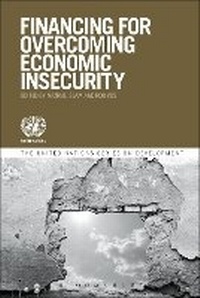
Financing for Overcoming Economic Insecurity
Published on 12. March 2015
Book
Paperback/Softback
264 pages
978-1-84966-534-6 (ISBN)
Description
This book is available as open access through the Bloomsbury Open Access programme and is available on bloomsburycollections.com.
The world is witnessing the paradox of simultaneous increase in income and insecurity. According to available data, global average per capita income has increased in recent decades, while at the same time actual and perceived insecurity has also increased. This paradox is true for both developed and developing countries. However, the concrete form and causes of insecurity differs across these two groups of countries. To the extent that income levels in many developing countries are very low, economic insecurity in these countries takes a starker and chronic form.
In Financing for Overcoming Economic Insecurity, leading experts examine the causes and consequences of rising economic insecurity and policy measures that can be adopted to overcome insecurity. The volume contains papers addressing issues of economic insecurity pertaining to both developed and developing countries and caused by both economic factors and natural hazards. It also discusses the issues at both macro and micro levels. The volume's focus on policy measures, such as redistribution and reinvestment of profit income in developed countries and imposition of capital control and promotion of micro insurance in developing countries, should be of much help to policymakers as well as researchers.
The world is witnessing the paradox of simultaneous increase in income and insecurity. According to available data, global average per capita income has increased in recent decades, while at the same time actual and perceived insecurity has also increased. This paradox is true for both developed and developing countries. However, the concrete form and causes of insecurity differs across these two groups of countries. To the extent that income levels in many developing countries are very low, economic insecurity in these countries takes a starker and chronic form.
In Financing for Overcoming Economic Insecurity, leading experts examine the causes and consequences of rising economic insecurity and policy measures that can be adopted to overcome insecurity. The volume contains papers addressing issues of economic insecurity pertaining to both developed and developing countries and caused by both economic factors and natural hazards. It also discusses the issues at both macro and micro levels. The volume's focus on policy measures, such as redistribution and reinvestment of profit income in developed countries and imposition of capital control and promotion of micro insurance in developing countries, should be of much help to policymakers as well as researchers.
More details
Series
Language
English
Place of publication
London
United Kingdom
Publishing group
Bloomsbury Publishing PLC
Target group
College/higher education
Product notice
Unsewn / adhesive bound
Dimensions
Height: 233 mm
Width: 154 mm
Thickness: 25 mm
Weight
429 gr
ISBN-13
978-1-84966-534-6 (9781849665346)
Copyright in bibliographic data and cover images is held by Nielsen Book Services Limited or by the publishers or by their respective licensors: all rights reserved.
Schweitzer Classification
Other editions
Additional editions
Rob Vos | United Nations Publications | Nazrul Islam
Financing For Overcoming Economic Insecurity
E-Book
03/2015
1st Edition
Bloomsbury Academic
€37.49
Available for download
Persons
Nazrul Islam is the Chief of the Global Economic Monitoring Unit of the Development Policy Analysis Division (DPAD) of the Department of Economic and Social Affairs (DESA) of the United Nations and a Research Fellow of the International Centre for the Study of East Asian Development (ICSEAD), Kitakyushu, Japan.
Rob Vos is currently the Director of Director of the Gender, Equity and Rural Employment Division of the Food and Agriculture Organization (FAO) in Rome. Previously he was the Director of the Development Policy and Analysis Division (DPAD) at the Department of Economic and Social Affairs (DESA) of the United Nations.
Rob Vos is currently the Director of Director of the Gender, Equity and Rural Employment Division of the Food and Agriculture Organization (FAO) in Rome. Previously he was the Director of the Development Policy and Analysis Division (DPAD) at the Department of Economic and Social Affairs (DESA) of the United Nations.
Content
List of Tables and Figures
Preface
About the Editors
About the Contributors
Chapter 1 Introduction
Rob Vos and Nazrul Islam
Chapter 2 Globalization, Offshoring and Economic Insecurity
in Industrialized Countries
William Milberg and Deborah Winkler
Chapter 3 Managing Financial Instability in Developing Countries: Why Prudence is not Enough
Yilmaz Akyuez
Chapter 4 Insurance, Credit and Safety Nets for the Poor in a World of Risk
Daniel Clarke and Stefan Dercon
Chapter 5 Assessing the Success of Microinsurance Programmes in Meeting the Insurance Needs of the Poor
Paul Mosley
Chapter 6 Assessing the Insurance Role of Microsavings
David Hulme, Karen Moore and Armando Barrientos
Chapter 7 Can Microfinance Reduce Economic Insecurity and Poverty? By How Much and How?
Nazrul Islam
Chapter 8 Insurance against Losses from Natural Disasters in Developing Countries
Joanne Linnerooth-Bayer and Reinhard Mechler
Index
Preface
About the Editors
About the Contributors
Chapter 1 Introduction
Rob Vos and Nazrul Islam
Chapter 2 Globalization, Offshoring and Economic Insecurity
in Industrialized Countries
William Milberg and Deborah Winkler
Chapter 3 Managing Financial Instability in Developing Countries: Why Prudence is not Enough
Yilmaz Akyuez
Chapter 4 Insurance, Credit and Safety Nets for the Poor in a World of Risk
Daniel Clarke and Stefan Dercon
Chapter 5 Assessing the Success of Microinsurance Programmes in Meeting the Insurance Needs of the Poor
Paul Mosley
Chapter 6 Assessing the Insurance Role of Microsavings
David Hulme, Karen Moore and Armando Barrientos
Chapter 7 Can Microfinance Reduce Economic Insecurity and Poverty? By How Much and How?
Nazrul Islam
Chapter 8 Insurance against Losses from Natural Disasters in Developing Countries
Joanne Linnerooth-Bayer and Reinhard Mechler
Index