

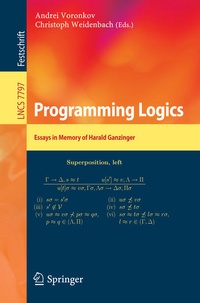
Programming Logics
Essays in Memory of Harald Ganzinger
Published on 3. April 2013
Book
Paperback/Softback
X, 447 pages
978-3-642-37650-4 (ISBN)
Description
This Festschrift volume, published in memory of Harald Ganzinger, contains 17 papers from colleagues all over the world and covers all the fields to which Harald Ganzinger dedicated his work during his academic career.
The volume begins with a complete account of Harald Ganzinger's work and then turns its focus to the research of his former colleagues, students, and friends who pay tribute to him through their writing. Their individual papers span a broad range of topics, including programming language semantics, analysis and verification, first-order and higher-order theorem proving, unification theory, non-classical logics, reasoning modulo theories, and applications of automated reasoning in biology.
More details
Series
Edition
2013 ed.
Language
English
Place of publication
Berlin
Germany
Publishing group
Springer Berlin
Target group
Professional and scholarly
Research
Illustrations
69 s/w Abbildungen
X, 447 p. 69 illus.
Dimensions
Height: 235 mm
Width: 155 mm
Thickness: 25 mm
Weight
692 gr
ISBN-13
978-3-642-37650-4 (9783642376504)
DOI
10.1007/978-3-642-37651-1
Schweitzer Classification
Other editions
Additional editions
E-Book
04/2013
Springer
€53.49
Available for download
Content
Harald Ganzinger's Legacy: Contributions to Logics and Programming.- Bio-Logics: Logical Analysis of Bioregulatory Networks.- Canonical Ground Horn Theories.- Generic Functional Representation of Sorted Trees Supporting Attribution (Haskell Can Do It).- The Blossom of Finite Semantic Trees.- Functional Logic Programming: From Theory to Curry.- From Search to Computation: Redundancy Criteria and Simplification at Work.- Elimination Techniques for Program Analysis.- Narrowing Based Inductive Proof Search.- Inst-Gen - A Modular Approach to Instantiation-Based Automated Reasoning.- Common Knowledge Logic in a Higher Order Proof Assistant.- Constructing Bachmair-Ganzinger Models.- Planning with Effectively Propositional Logic.- The Relative Power of Semantics and Unification.- First-Order Resolution Methods for Modal Logics.- On Combinations of Local Theory Extensions.- Interprocedural Shape Analysis for Effectively Cutpoint-Free Programs.