

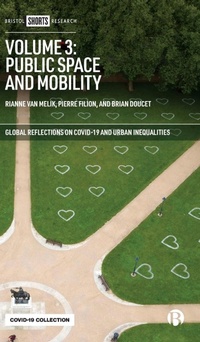
Volume 3: Public Space and Mobility
Public Space and Mobility
Bristol University Press
1st Edition
Published on 22. July 2021
Book
Hardback
254 pages
978-1-5292-1900-5 (ISBN)
Description
COVID-19 is an invisible threat that has hugely impacted cities and their inhabitants. Yet its impact is very visible, perhaps most so in urban public spaces and spaces of mobility.
This international volume explores the transformations of public space and public transport in response to COVID-19 across the world, both those resulting from official governmental regulations and from everyday practices of urban citizens. The contributors discuss how the virus made urban inequalities sharper and clearer, and redefined public spaces in the 'new normal'. Offering crucial insights for reforming cities to be more resilient to future crises, this is an invaluable resource for scholars and policy makers alike.
This international volume explores the transformations of public space and public transport in response to COVID-19 across the world, both those resulting from official governmental regulations and from everyday practices of urban citizens. The contributors discuss how the virus made urban inequalities sharper and clearer, and redefined public spaces in the 'new normal'. Offering crucial insights for reforming cities to be more resilient to future crises, this is an invaluable resource for scholars and policy makers alike.
More details
Series
Edition
First Edition
Language
English
Place of publication
United Kingdom
Target group
Professional and scholarly
Illustrations
17 s/w Abbildungen
17 Illustrations, black and white
Dimensions
Height: 209 mm
Width: 132 mm
Thickness: 17 mm
Weight
368 gr
ISBN-13
978-1-5292-1900-5 (9781529219005)
Copyright in bibliographic data and cover images is held by Nielsen Book Services Limited or by the publishers or by their respective licensors: all rights reserved.
Schweitzer Classification
Other editions
Additional editions
E-Book
07/2021
1st Edition
Bristol University Press
€28.99
Available for download
Persons
Rianne van Melik is Assistant Professor in Urban Geography at the Institute for Management Research (IMR), Radboud University, Nijmegen, the Netherlands.
Pierre Filion is Professor at the School of Planning, University of Waterloo, Canada.
Brian Doucet is Associate Professor and Canada Research Chair in Urban Change and Social Inclusion at the School of Planning, University of Waterloo, Canada.
Pierre Filion is Professor at the School of Planning, University of Waterloo, Canada.
Brian Doucet is Associate Professor and Canada Research Chair in Urban Change and Social Inclusion at the School of Planning, University of Waterloo, Canada.
Content
Introduction ~ Rianne van Melik, Pierre Filion & Brian Doucet
Part 1: What Constitutes Public Space?
Public Space and COVID-19: New Social Practices, Intensified Inequalities ~ Loren March and Ute Lehrer
Pandemic Pop-Ups and the Performance of Legality ~ Alexandra Flynn and Amelia Thorpe
Lessons From the Lockdown: Foregrounding Non-Privileged Perspectives Into the (Post-)COVID-19 City Debate ~ Luce Beeckmans and Stijn Oosterlynck
"Everybody Has To Move, You Can't Stand Still": Policing of Vulnerable Urban Populations During the COVID-19 Pandemic in Brussels ~ Mattias De Backer and Lucas Melgaco
Parks in a Pandemic: Attachments, Absences and Exclusions ~ Julian Dobson
Failure by Design? Neoliberalism, Public Space and the (Im)possibility of Lockdown Compliance in the UK ~ Conor Wilson
A Place for Life: Striving Towards Accessible and Equitable Public Spaces for Times of Crisis and Beyond ~ Anaid Yerena and Ruben Casas
Part 2: Public Space and Human Well-Being
How Can Inequalities in Access to Green Space Be Addressed in a Post-Pandemic World? Lessons From London ~ Meredith Whitten and Peter Massini
America Under COVID-19: The Plight of the Old ~ Setha Low and Anastasia Loukaitou-Sideris
Exploring Older Adults' Experiences of Urban Space in the COVID-19 Lockdowns: Dutch and British Perspectives ~ Tess Osborne, Arlinde Dul and Louise Meijering
Public Libraries in Crises: Between Spaces of Care and Information Infrastructures ~ Alice Corble and Rianne Van Melik
The City and the Park in Times of Pandemic: Children's Practices in Public Spaces Before and After the Lockdown in Porto, Portugal ~ Julia Rodrigues, Ligia Ferro, Joao Teixeira Lopes and Eunice Castro Seixas
The Mundane and (Extra)ordinary Public Spaces in India: Examining the Impact of COVID-19 Pandemic Through an Everyday Lens in Chennai City ~ Lakshmi Priya Rajendran and Aamstrong Anjumuthu
The Resilience of Street Vendors in Surviving COVID-19 Crisis in Hanoi, Vietnam ~ Ha Minh Hai Thai, Phuong Quoc Dinh and Phuong Thu Nguyen
Part 3: Public Space and Mobility
City Cycling After COVID-19 for Interspecies Mobility Justice ~ Nicholas Scott
Mobility Justice and Social Inequality During the COVID-19 Pandemic in Jakarta ~ Harya S. Dillon and Deden Rukmana
Pandemic and Future-Proofing Cities: Pedestrian-Oriented Development as an Alternative Model to Transit-Based Intensification Centres ~ Neluka Leanage and Pierre Filion
Mercurial Images of the COVID-19 City ~ Emma Arnold
Conclusion ~ Rianne Van Melik, Brian Doucet and Pierre Filion
Part 1: What Constitutes Public Space?
Public Space and COVID-19: New Social Practices, Intensified Inequalities ~ Loren March and Ute Lehrer
Pandemic Pop-Ups and the Performance of Legality ~ Alexandra Flynn and Amelia Thorpe
Lessons From the Lockdown: Foregrounding Non-Privileged Perspectives Into the (Post-)COVID-19 City Debate ~ Luce Beeckmans and Stijn Oosterlynck
"Everybody Has To Move, You Can't Stand Still": Policing of Vulnerable Urban Populations During the COVID-19 Pandemic in Brussels ~ Mattias De Backer and Lucas Melgaco
Parks in a Pandemic: Attachments, Absences and Exclusions ~ Julian Dobson
Failure by Design? Neoliberalism, Public Space and the (Im)possibility of Lockdown Compliance in the UK ~ Conor Wilson
A Place for Life: Striving Towards Accessible and Equitable Public Spaces for Times of Crisis and Beyond ~ Anaid Yerena and Ruben Casas
Part 2: Public Space and Human Well-Being
How Can Inequalities in Access to Green Space Be Addressed in a Post-Pandemic World? Lessons From London ~ Meredith Whitten and Peter Massini
America Under COVID-19: The Plight of the Old ~ Setha Low and Anastasia Loukaitou-Sideris
Exploring Older Adults' Experiences of Urban Space in the COVID-19 Lockdowns: Dutch and British Perspectives ~ Tess Osborne, Arlinde Dul and Louise Meijering
Public Libraries in Crises: Between Spaces of Care and Information Infrastructures ~ Alice Corble and Rianne Van Melik
The City and the Park in Times of Pandemic: Children's Practices in Public Spaces Before and After the Lockdown in Porto, Portugal ~ Julia Rodrigues, Ligia Ferro, Joao Teixeira Lopes and Eunice Castro Seixas
The Mundane and (Extra)ordinary Public Spaces in India: Examining the Impact of COVID-19 Pandemic Through an Everyday Lens in Chennai City ~ Lakshmi Priya Rajendran and Aamstrong Anjumuthu
The Resilience of Street Vendors in Surviving COVID-19 Crisis in Hanoi, Vietnam ~ Ha Minh Hai Thai, Phuong Quoc Dinh and Phuong Thu Nguyen
Part 3: Public Space and Mobility
City Cycling After COVID-19 for Interspecies Mobility Justice ~ Nicholas Scott
Mobility Justice and Social Inequality During the COVID-19 Pandemic in Jakarta ~ Harya S. Dillon and Deden Rukmana
Pandemic and Future-Proofing Cities: Pedestrian-Oriented Development as an Alternative Model to Transit-Based Intensification Centres ~ Neluka Leanage and Pierre Filion
Mercurial Images of the COVID-19 City ~ Emma Arnold
Conclusion ~ Rianne Van Melik, Brian Doucet and Pierre Filion