

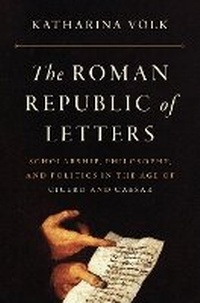
The Roman Republic of Letters
Scholarship, Philosophy, and Politics in the Age of Cicero and Caesar
Published on 9. November 2021
Book
Hardback
400 pages
978-0-691-19387-8 (ISBN)
Description
An intellectual history of the late Roman Republic-and the senators who fought both scholarly debates and a civil war
In The Roman Republic of Letters, Katharina Volk explores a fascinating chapter of intellectual history, focusing on the literary senators of the mid-first century BCE who came to blows over the future of Rome even as they debated philosophy, history, political theory, linguistics, science, and religion.
It was a period of intense cultural flourishing and extreme political unrest-and the agents of each were very often the same people. Members of the senatorial class, including Cicero, Caesar, Brutus, Cassius, Cato, Varro, and Nigidius Figulus, contributed greatly to the development of Roman scholarship and engaged in a lively and often polemical exchange with one another. These men were also crucially involved in the tumultuous events that brought about the collapse of the Republic, and they ended up on opposite sides in the civil war between Caesar and Pompey in the early 40s. Volk treats the intellectual and political activities of these "senator scholars" as two sides of the same coin, exploring how scholarship and statesmanship mutually informed one another-and how the acquisition, organization, and diffusion of knowledge was bound up with the question of what it meant to be a Roman in a time of crisis.
By revealing how first-century Rome's remarkable "republic of letters" was connected to the fight over the actual res publica, Volk's riveting account captures the complexity of this pivotal period.
In The Roman Republic of Letters, Katharina Volk explores a fascinating chapter of intellectual history, focusing on the literary senators of the mid-first century BCE who came to blows over the future of Rome even as they debated philosophy, history, political theory, linguistics, science, and religion.
It was a period of intense cultural flourishing and extreme political unrest-and the agents of each were very often the same people. Members of the senatorial class, including Cicero, Caesar, Brutus, Cassius, Cato, Varro, and Nigidius Figulus, contributed greatly to the development of Roman scholarship and engaged in a lively and often polemical exchange with one another. These men were also crucially involved in the tumultuous events that brought about the collapse of the Republic, and they ended up on opposite sides in the civil war between Caesar and Pompey in the early 40s. Volk treats the intellectual and political activities of these "senator scholars" as two sides of the same coin, exploring how scholarship and statesmanship mutually informed one another-and how the acquisition, organization, and diffusion of knowledge was bound up with the question of what it meant to be a Roman in a time of crisis.
By revealing how first-century Rome's remarkable "republic of letters" was connected to the fight over the actual res publica, Volk's riveting account captures the complexity of this pivotal period.
Reviews / Votes
"Winner of the Charles J. Goodwin Award of Merit, Society for Classical Studies" "Volk's? argument - that the story of the Roman republic of letters is messier and more variable than it has generally been presented - is a compelling one."---Nora Goldschmidt, London Review of Books "Fascinating. . . . An engrossing guide to an epoch-making decade of western history. The Roman Republic of Letters is an important intervention, and it deserves to be debated widely."---Michael Fontaine, New Criterion "An excellent history of late Republican intellectual life that surveys a wide range of Latin prose literature. . . . Volk deeply scrutinizes her subjects in a way that is sensitive to prior studies yet free from their strictures. Her own scholarship tells lively stories, which are not digressive but structured around clear arguments. The result is a book that may be enjoyed by specialists and general readers alike.-Peter Osorio, Bryn Mawr Classical Review" "Volk's lucid prose handles much-debated issues with admirable clarity and balance. . . . [Her] unapologetic passion for Latin language and literature is refreshing, and so is her ability to portray the protagonists of the intellectual revival of the end of the republic as human beings embedded and invested in a specific cultural and historical milieu.-Luca Grillo, Classical Association of Canada
" "A valuable and welcome guide to the intellectual world of the final years of the Republic, which will provide stimuli for further, deeper reflection."---Alexander Nice, Religious Studies Review
More details
Language
English
Place of publication
New Jersey
United States
Target group
College/higher education
Professional and scholarly
Product notice
Trade binding
Dimensions
Height: 235 mm
Width: 156 mm
ISBN-13
978-0-691-19387-8 (9780691193878)
Copyright in bibliographic data and cover images is held by Nielsen Book Services Limited or by the publishers or by their respective licensors: all rights reserved.
Schweitzer Classification
Other editions
Additional editions
Katharina Volk
The Roman Republic of Letters
Scholarship, Philosophy, and Politics in the Age of Cicero and Caesar
E-Book
11/2021
1st Edition
Princeton University Press
€27.49
Available for download
Person
Katharina Volk is professor of classics at Columbia University. She is the author of Ovid; Manilius and His Intellectual Background; and The Poetics of Latin Didactic: Lucretius, Vergil, Ovid, Manilius.