

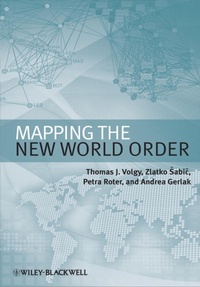
Mapping the New World Order
1st Edition
Published on 29. July 2009
Book
Paperback/Softback
296 pages
978-1-4051-6962-2 (ISBN)
Description
This groundbreaking study maps out and analyzes the development of a global intergovernmental (IGO) institutional architecture in the post World War II era.
Systematically traces similarities and differences between the institutional architecture of the Cold War and post-Cold War eras
Examines the range of reasons why states join IGOs, identifies patterns of participation within these organizations, and examines the effects of membership on states
Considers the impact of the EU on other regional organizations and developments outside Europe
Provides a strong contribution to the study of international organization and IGO development combining both quantitative and qualitative methodologies
Systematically traces similarities and differences between the institutional architecture of the Cold War and post-Cold War eras
Examines the range of reasons why states join IGOs, identifies patterns of participation within these organizations, and examines the effects of membership on states
Considers the impact of the EU on other regional organizations and developments outside Europe
Provides a strong contribution to the study of international organization and IGO development combining both quantitative and qualitative methodologies
More details
Language
English
Place of publication
Hoboken
United Kingdom
Publishing group
John Wiley and Sons Ltd
Target group
Professional and scholarly
Product notice
Paperback (trade)
sewn/stitched
Dimensions
Height: 226 mm
Width: 150 mm
Thickness: 23 mm
Weight
417 gr
ISBN-13
978-1-4051-6962-2 (9781405169622)
Copyright in bibliographic data and cover images is held by Nielsen Book Services Limited or by the publishers or by their respective licensors: all rights reserved.
Schweitzer Classification
Other editions
Additional editions
Thomas J. Volgy | Zlatko Sabic | Petra Roter
Mapping the New World Order
E-Book
08/2009
Wiley-Blackwell
€37.99
Available for download
Thomas J. Volgy | Zlatko Sabic | Petra Roter
Mapping the New World Order
Book
07/2009
Wiley
€106.78
Article exhausted; check different version
Persons
Thomas J. Volgy is Professor of Political Science at the University of Arizona, and Executive Director of the International Studies Association. He has previously worked for USAID, USIA, and the National Democratic Institute in Central Asia, Eastern Europe, and Central America, and was recently an Atlantic Fellow. Zlatko Sabic is Professor of International Relations at the University of Ljubljana and Senior Research Fellow at the Centre of International Relations.
Petra Roter is Assistant Professor of International Relations at the University of Ljubljana and Research Fellow at the Centre of International Relations. She is also GARNET Visiting Fellow at the Centre for the Study of Globalisation and Regionalisation at the University of Warwick.
Andrea K. Gerlak is Director of Academic Development for the International Studies Association and Visiting Professor in the Department of Political Science at the University of Arizona.
Petra Roter is Assistant Professor of International Relations at the University of Ljubljana and Research Fellow at the Centre of International Relations. She is also GARNET Visiting Fellow at the Centre for the Study of Globalisation and Regionalisation at the University of Warwick.
Andrea K. Gerlak is Director of Academic Development for the International Studies Association and Visiting Professor in the Department of Political Science at the University of Arizona.
Content
Preface. 1. In Search of the Post-Cold War World Order: Questions, Issues, and Perspectives (Thomas J. Volgy, Zlatko Sabic, Petra Roter, Elizabeth Fausett, and Stuart Rodgers).
2. Mapping the Architecture of the New World Order: Continuity and Change in the Constellation of Post-Cold War Formal Intergovernmental Organizations (Thomas J. Volgy, Keith A. Grant, Elizabeth Fausett, and Stuart Rodgers).
3. Accounting for the New World Order of FIGO Architecture and Its Effectiveness (Keith A. Grant, Thomas J. Volgy, Elizabeth Fausett, and Stuart Rodgers).
4. Intergovernmental Organizations and Interstate Conflict: Parsing Out IGO Effects for Conflict in Post-Communist Space (Elizabeth Fausett and Thomas J. Volgy).
5. The Correlates of Cooperative Institutions for International Rivers (Andrea K. Gerlak and Keith A. Grant).
6. Substituting for Democratization: A Comparative Analysis of Involvement in Regional Intergovernmental Organizations (Stuart Rogers and Thomas J. Volgy).
7. State Support for Human Rights Treaties (Petra Roter, Anuska Ferligoj and Andrej Mrvar).
8. The Mediterranean As A Region in the Making (Ana Bojinovic).
9. Conclusions (Thomas J. Volgy, Zlatko Sabic, Petra Roter, Andrea Gerlak, Elizabeth Fausett, Keith A. Grant, and Stuart Rodgers).
Index.
2. Mapping the Architecture of the New World Order: Continuity and Change in the Constellation of Post-Cold War Formal Intergovernmental Organizations (Thomas J. Volgy, Keith A. Grant, Elizabeth Fausett, and Stuart Rodgers).
3. Accounting for the New World Order of FIGO Architecture and Its Effectiveness (Keith A. Grant, Thomas J. Volgy, Elizabeth Fausett, and Stuart Rodgers).
4. Intergovernmental Organizations and Interstate Conflict: Parsing Out IGO Effects for Conflict in Post-Communist Space (Elizabeth Fausett and Thomas J. Volgy).
5. The Correlates of Cooperative Institutions for International Rivers (Andrea K. Gerlak and Keith A. Grant).
6. Substituting for Democratization: A Comparative Analysis of Involvement in Regional Intergovernmental Organizations (Stuart Rogers and Thomas J. Volgy).
7. State Support for Human Rights Treaties (Petra Roter, Anuska Ferligoj and Andrej Mrvar).
8. The Mediterranean As A Region in the Making (Ana Bojinovic).
9. Conclusions (Thomas J. Volgy, Zlatko Sabic, Petra Roter, Andrea Gerlak, Elizabeth Fausett, Keith A. Grant, and Stuart Rodgers).
Index.