

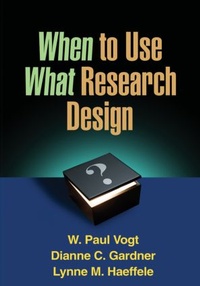
When to Use What Research Design
1st Edition
Published on 17. April 2012
Book
Hardback
378 pages
978-1-4625-0360-5 (ISBN)
Description
Systematic, practical, and accessible, this is the first book to focus on finding the most defensible design for a particular research question. Thoughtful guidelines are provided for weighing the advantages and disadvantages of various methods, including qualitative, quantitative, and mixed methods designs. The book can be read sequentially or readers can dip into chapters on specific stages of research (basic design choices, selecting and sampling participants, addressing ethical issues) or data collection methods (surveys, interviews, experiments, observations, archival studies, and combined methods). Many chapter headings and subheadings are written as questions, helping readers quickly find the answers they need to make informed choices that will affect the later analysis and interpretation of their data. Useful features include: *Easy-to-navigate part and chapter structure. *Engaging research examples from a variety of fields. *End-of-chapter tables that summarize the main points covered. *Detailed suggestions for further reading at the end of each chapter.
*Integration of data collection, sampling, and research ethics in one volume. *Comprehensive glossary.
See also Vogt et al.'s Selecting the Right Analyses for Your Data, which addresses the next steps in coding, analyzing, and interpreting data.
*Integration of data collection, sampling, and research ethics in one volume. *Comprehensive glossary.
See also Vogt et al.'s Selecting the Right Analyses for Your Data, which addresses the next steps in coding, analyzing, and interpreting data.
Reviews / Votes
A masterful and thorough presentation of 'when to use what.' From beginning to end, it is clear that you are reading the work of very accomplished researchers and educators. The authors use a particularly rich, colorful, and practical set of examples, including classic and contemporary research studies as well as wonderful day-to-day illustrations such as TV channel surfing to introduce the notion of sampling. Readers can pick and choose individual chapters or read straight through the entire book, depending on their needs. The summary tables are extraordinarily useful and can serve as a quick reference to chapter structure and content.--Karen M. Staller, PhD, School of Social Work, University of MichiganI am recommending this book as the core text for our required methods course at the graduate level. The reader is taken on a tour of the main research designs employed by social scientists, including various quantitative and qualitative, experimental and observational, and primary and secondary data designs. Highlighting how decisions about research design should be influenced by the nature of the research question, the authors also acknowledge when other factors come into play, including financial and ethical considerations. The text helps researchers decide when to use a particular research design; teaches how to choose appropriate methods for sampling, recruiting, and assigning treatments (for experiments); and explores the implications of these decisions. I like how the authors talk about debates in the literature and how they point out typical/common shortcomings of different approaches. Their frank language gives the book the feel of a trusted advisor providing honest advice.--Tracey LaPierre, PhD, Department of Sociology, University of Kansas
This book is on an essential topic--the questions it tackles are incredibly important in the social sciences. It reads like a field guide to conducting good research. I would recommend it to advanced undergraduates who need a handy reference or to graduate students who want one resource for their basic design, sampling, and ethics questions. It is accessible and easy to read. The authors present the process of research as full of choices that are best tackled by an informed researcher--no choice is universally the best one. The book emphasizes the importance of careful thought and weighing of pros and cons prior to conducting research.--Theresa DiDonato, PhD, Department of Psychology, Loyola University Maryland
The book is very well written and readable, a real plus! I really like the authors' premise that the research question determines the choice of method, rather than vice versa.--Rosemary L. Hopcroft, PhD, Department of Sociology, University of North Carolina at Charlotte
The use of questions as subheads is an effective pedagogical technique. Teaching students to turn a heading into a question and then reading the textbook section to find the answer to the question has a rich history as an instructional strategy.--Susan Kushner Benson, PhD, College of Education, University of Akron
This has been an excellent text for my Advanced Research Methods course. Vogt et al. offer a well-rounded approach that addresses methods, sampling, and ethical issues for each research design. The book provides nice coverage that is relatively discipline neutral--appealing to the social sciences as well as business. Abundant references to key studies can be used as article reviews to further enhance each topic. The authors also incorporate statistical analysis tools that are appropriate for the designs, going beyond basic statistical procedures to explain a number of advanced procedures, as well.--Debbie L. Hahs-Vaughn, PhD, College of Education and Human Performance, University of Central Florida -Provides a hugely useful resource to navigate through the initial stages of research design, applicable to students and seasoned researchers alike....The layout of the book allows the reader to easily select those chapters that are most relevant to their interests, and is facilitated by signposting of additional resources to support the reader. The book is well written and accessible, posing questions throughout to guide the reader through the research process. A useful resource for any researcher.--The Psychologist, 1/1/2013??_x000D_"It is difficult to avoid a plethora of superlatives in reviewing this text. The writers....devote their space comprehensively and adequately to assisting any research reader at any level to decide what research method to use in dealing with a particular question, and to provide answers to many associated questions....Should be prescribed reading for everyone proposing to undertake educational research....Expect it to be a constant source of advice and inspiration."--British Journal of Educational Technology, 1/28/2014??_x000D_The book is organized in an easy access order of information from design to sampling to ethics. Having used the book while starting my own study, the book did help me to quickly locate the information I needed. I praise the book's emphasis on the design development process from the research question to the research design....The authors included wonderful research question examples for reach research design. The attention to detail was refreshing. I particularly liked the authors' lists of important works in each chapter for in-depth discussions on a research design, a sampling technique, etc.--Structural Equation Modeling: A Multidisciplinary Journal, 6/1/2014??_x000D_I praise the book's emphasis on the design development process from the research question to the research design, highlighting the fact that the research question always decides what steps will follow and what decisions will need to be made. The authors included wonderful research question examples for each research design. The attention to detail was refreshing. I particularly liked the authors' lists of important works in each chapter for in-depth discussions on a research design, a sampling technique, etc....[T]his book does what the authors have stated it should do, which is to describe various design packages and define the research designs involved in them....[T]he authors do a wonderful job at directing researchers towards appropriate literature for reading further details.--International Journal of Social Research Methodology, 11/13/2014
More details
Language
English
Place of publication
New York
United States
Publishing group
Guilford Publications
Target group
Professional and scholarly
Dimensions
Height: 254 mm
Width: 178 mm
Weight
852 gr
ISBN-13
978-1-4625-0360-5 (9781462503605)
Copyright in bibliographic data and cover images is held by Nielsen Book Services Limited or by the publishers or by their respective licensors: all rights reserved.
Schweitzer Classification
Other editions
Additional editions
W. Paul Vogt | Dianne C. Gardner | Lynne M. Haeffele
When to Use What Research Design
Book
04/2012
1st Edition
Guilford Press
€58.00
Shipment within 15-20 days
Persons
W. Paul Vogt, PhD, until his death in 2016, was Emeritus Professor of Research Methods and Evaluation at Illinois State University, where he received both teaching and research awards. Dr. Vogt's areas of specialization included research design and data analysis, with particular emphasis on combining qualitative, quantitative, and graphic approaches. His books include Selecting the Right Analyses for Your Data and When to Use What Research Design. Dianne C. Gardner, PhD, is Associate Professor of Educational Administration at Illinois State University. Dr. Gardner's research interests include assessment, organizational development, program evaluation, P20 systems, and qualitative research methodology. Lynne M. Haeffele, PhD, is Senior Research Associate in the Center for the Study of Education Policy at Illinois State University. Dr. Haeffele's research interests include combining research designs, applying research findings to policy and practice, program evaluation, and the topical areas of college readiness, organizational performance, and school-university partnerships.
Content
General Introduction: Design, Sampling, and Ethics _x000D_ I. Research Questions and Designs _x000D_ What Is the Role of Theory in Research Questions and Designs? _x000D_ 1. When to Use Survey Designs _x000D_ When Are Surveys Likely to Be a Wise Design Choice? _x000D_ When Should You Use Which Mode of Administering Your Survey? _x000D_ What Design Should You Use to Study Change over Time? _x000D_ What Question Formats Can You Use in a Survey Design? _x000D_ Conclusion on Survey Designs: So Many Questions, So Little Time _x000D_ 2. When to Use Interview Designs _x000D_ Comparing Interviews with Surveys _x000D_ Conclusion on Interview Designs in General _x000D_ Specific Interview Types, Approaches, and Procedures _x000D_ Conclusion _x000D_ 3. When to Use Experimental Designs _x000D_ What's Wrong with Gold-Standard Thinking? _x000D_ When Is an RCT a Good Option? _x000D_ When Is an Experimental Design a Good Option for Your Research? _x000D_ When Should You Use the Basic Types of Experimental Design? _x000D_ General Conclusion on When to Use Experimental Designs _x000D_ 4. When to Use Naturalistic and Participant Observational Designs _x000D_ Overview of Observational Designs _x000D_ When Is Observation a Good Design Choice? _x000D_ Further Distinguishing between Naturalistic and Participant Observational Designs _x000D_ When Should You Use a Naturalistic Observational Design? _x000D_ When Should You Use Participant Observational Designs? _x000D_ Conclusion: Characteristics of All Observational Designs _x000D_
5. When to Use Archival Designs: Literature Reviews and Secondary Analyses
_x000D_ What Kinds of Archival Data Are Available for Researchers? _x000D_ When Should You Collect and Use Preexisting Data Rather Than Produce Your Own? _x000D_ Types of Archival Research _x000D_ Database Archives _x000D_ Organizational Records _x000D_ Textual Studies of Documents _x000D_ New Media, Including Internet Sources _x000D_ Conclusion _x000D_ 6. When to Use Combined Research Designs _x000D_ Simple versus Multipart Research Questions _x000D_ When to Combine Research Designs _x000D_ Types and Qualities of Combined Designs _x000D_ Logistical Considerations in Combined Research Designs _x000D_ Conclusion and Summary _x000D_ II. Sampling, Selection, and Recruitment _x000D_ 7. Sampling for Surveys _x000D_ Probability Samples _x000D_ Nonprobability Samples _x000D_ When Should You Try to Improve Response Rates? _x000D_ How Big Should Your Sample Be? _x000D_ Conclusion _x000D_ 8. Identifying and Recruiting People for Interviews _x000D_ How Interview Strategies Are Shaped by Research Questions _x000D_ Making Basic Decisions about Interview Sampling _x000D_ Conclusions on Selecting People to Interview _x000D_ 9. Sampling, Recruiting, and Assigning Participants in Experiments _x000D_ Randomized Controlled Trials _x000D_ Alternatives to RCTs _x000D_ Controlling for Covariates _x000D_ Conclusion: Sampling, Recruiting, and Assigning Cases in Experiments _x000D_ 10. Searching and Sampling for Observations _x000D_ Overview of Searching and Sampling Concerns in Observational Research _x000D_ Appropriateness and Relevance of the Sample _x000D_ Accessing Observation Sites _x000D_ Decisions Influenced by Resources and Other Practical Considerations _x000D_ Four Basic Sampling Decisions _x000D_ Sampling and the Five Types of Research Questions _x000D_ Conclusion and Summary _x000D_ 11. Sampling from Archival Sources _x000D_ When Do You Search and When Do You Sample? _x000D_ Sampling Research Literature to Build Upon and Synthesize It _x000D_ Database Archives _x000D_ Organizational Records _x000D_ Textual Studies of Documents
5. When to Use Archival Designs: Literature Reviews and Secondary Analyses
_x000D_ What Kinds of Archival Data Are Available for Researchers? _x000D_ When Should You Collect and Use Preexisting Data Rather Than Produce Your Own? _x000D_ Types of Archival Research _x000D_ Database Archives _x000D_ Organizational Records _x000D_ Textual Studies of Documents _x000D_ New Media, Including Internet Sources _x000D_ Conclusion _x000D_ 6. When to Use Combined Research Designs _x000D_ Simple versus Multipart Research Questions _x000D_ When to Combine Research Designs _x000D_ Types and Qualities of Combined Designs _x000D_ Logistical Considerations in Combined Research Designs _x000D_ Conclusion and Summary _x000D_ II. Sampling, Selection, and Recruitment _x000D_ 7. Sampling for Surveys _x000D_ Probability Samples _x000D_ Nonprobability Samples _x000D_ When Should You Try to Improve Response Rates? _x000D_ How Big Should Your Sample Be? _x000D_ Conclusion _x000D_ 8. Identifying and Recruiting People for Interviews _x000D_ How Interview Strategies Are Shaped by Research Questions _x000D_ Making Basic Decisions about Interview Sampling _x000D_ Conclusions on Selecting People to Interview _x000D_ 9. Sampling, Recruiting, and Assigning Participants in Experiments _x000D_ Randomized Controlled Trials _x000D_ Alternatives to RCTs _x000D_ Controlling for Covariates _x000D_ Conclusion: Sampling, Recruiting, and Assigning Cases in Experiments _x000D_ 10. Searching and Sampling for Observations _x000D_ Overview of Searching and Sampling Concerns in Observational Research _x000D_ Appropriateness and Relevance of the Sample _x000D_ Accessing Observation Sites _x000D_ Decisions Influenced by Resources and Other Practical Considerations _x000D_ Four Basic Sampling Decisions _x000D_ Sampling and the Five Types of Research Questions _x000D_ Conclusion and Summary _x000D_ 11. Sampling from Archival Sources _x000D_ When Do You Search and When Do You Sample? _x000D_ Sampling Research Literature to Build Upon and Synthesize It _x000D_ Database Archives _x000D_ Organizational Records _x000D_ Textual Studies of Documents