

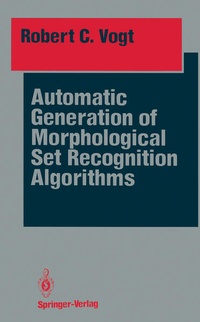
Automatic Generation of Morphological Set Recognition Algorithms
Published on 22. December 2011
Book
Paperback/Softback
V, 275 pages
978-1-4613-9654-3 (ISBN)
Description
Since the early days of computers, machine learning and automatic programming have attracted researchers in computer science and related fields, particularly pattern recognition and automatic control theory. Most of the learning concepts in machine perception have been inspired by pattern recognition approaches that rely on statistical techniques. These statistical techniques have applicability in limited recognition tasks. Automatic programming in perception systems has generally been limited to interfaces that allow easy specification of the task using natural language. Clearly, machine learning and automatic programming can make percep tion systems powerful and easy to use. Vogt's book addresses both these tasks in the context of machine vision. He uses morphological operations to implement his approach which was developed for solving the figure-ground problem in images. His system selects the correct se quence of operators to accept or reject pixels for fmding objects in an image. The sequence of operators is selected after a user specifies what the correct objects are. On the surface it may appear that the problem solved by the system is not very interesting, however, the contribution ofVogt' s work should not be judged by the images that the system can segment. Its real contribution is in demonstrat ing, possibly for'the frrst time, that automatic programming is possible in computer vision systems. The selection of morphological operators demonstrates that to implement an automatic programming-based approach, operators whose behavior is clearly defined in the image space are required.
More details
Series
Edition
Softcover reprint of the original 1st ed. 1989
Language
English
Place of publication
New York
United States
Target group
Professional and scholarly
Research
Illustrations
V, 275 p.
Dimensions
Height: 244 mm
Width: 156 mm
Thickness: 16 mm
Weight
454 gr
ISBN-13
978-1-4613-9654-3 (9781461396543)
DOI
10.1007/978-1-4613-9652-9
Schweitzer Classification
Other editions
Additional editions
E-Book
12/2012
Springer
€96.29
Available for download

Book
10/1989
Springer
€85.55
Article exhausted; check different version
Content
1 Introduction.- 1.1 Problem Definition and Characterization.- 1.2 Mathematical Morphology.- 1.3 Related Work.- 1.4 Goals and Objectives.- 1.5 Organization of the Book.- 2 Review of Mathematical Morphology.- 2.1 Types of Image Data.- 2.2 Images as Sets in Space.- 2.3 Operation Classes and Properties.- 2.4 Criteria.- 2.5 Set Operations.- 2.6 Positional Masking and Thresholding Operations.- 2.7 Translation-Based Morphology Operations.- 2.8 Structuring Element Decomposition.- 2.9 Common Structuring Elements.- 2.10 Erosions and Dilations.- 2.11 Openings and Closings.- 2.12 Residues.- 2.13 Band Operations.- 2.14 Particle and Hole Operations.- 2.15 Grey Level Operations.- 2.16 Summary of Problem Domain.- 3 Theory of Automatic Set Recognition.- 3.1 Basic Terminology.- 3.2 Example Problems.- 3.3 Formal Description of Problems.- 3.4 Algorithms as Graphs.- 3.5 The Algorithm Development Process.- 3.6 Search Strategies and Completeness.- 4 REM System Implementation.- 4.1 Representation of Algorithms.- 4.2 Overview of System Design.- 4.3 Search Management.- 4.4 Problem Solving.- 4.5 System Output.- 5 Results.- 5.1 Summary of System Capabilities.- 5.2 Examples of Problems Solved by REM.- 5.3 Example Program Run.- 6 Conclusion.- 6.1 Primary Accomplishments.- 6.2 Summary and Discussion.- 6.3 Future Directions.- A Partial List of Example Problems Solved by REM.- B Algebraic Definitions of IC Band Operations.- C Terminal Output for Example Problem 'TCODSK_RT'.- D Band Operators Defined in the IC Target Language.- E Selected Bibliography.