

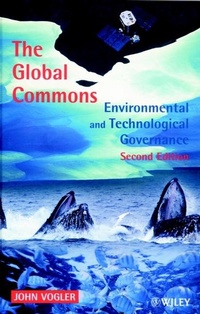
The Global Commons
Environmental and Technological Governance
2nd Edition
Will be published approx. on 24. March 2000
Book
Hardback
288 pages
978-0-471-98826-7 (ISBN)
Description
This new and updated edition is essential for those wanting tounderstand the limits to collective action on global environmentalproblems. It develops and applies the tools of regime analysis tothe question of how the various global commons are, or fail to be,governed effectively.
Since the publication of the first edition of The Global Commonsthere have been many developments particularly in the area ofclimate change and sustainable development e.g. Agenda 21. This newedition has been extensively re-written and expanded to take intoaccount recent developments and includes new conclusions on theconnections between global and local commons. Involving the firstsystematic comparative analysis of governance regimes, the bookcovers:
* The Third Law of the Sea Convention, the deep seabed, whaling andmarine pollution regimes
* Antarctica and the Madrid Protocol on EnvironmentalProtection
* Outer space regimes for weapons, the operation of satellites andthe emerging problem of orbital debris
* The global atmosphere, the Montreal Protocol for the protectionof the stratospheric ozone layer and the developing climate changeregime and the Kyoto Protocol.
The first edition received widespread praise eg "a comprehensiveand incisive review of much relevant scholarship and case studymaterial" (Area) and "a must for every reading list" (Progress inHuman Geography) and this latest volume will also be invaluable forresearchers and students of politics, environmental management,international relations and political geography.
Since the publication of the first edition of The Global Commonsthere have been many developments particularly in the area ofclimate change and sustainable development e.g. Agenda 21. This newedition has been extensively re-written and expanded to take intoaccount recent developments and includes new conclusions on theconnections between global and local commons. Involving the firstsystematic comparative analysis of governance regimes, the bookcovers:
* The Third Law of the Sea Convention, the deep seabed, whaling andmarine pollution regimes
* Antarctica and the Madrid Protocol on EnvironmentalProtection
* Outer space regimes for weapons, the operation of satellites andthe emerging problem of orbital debris
* The global atmosphere, the Montreal Protocol for the protectionof the stratospheric ozone layer and the developing climate changeregime and the Kyoto Protocol.
The first edition received widespread praise eg "a comprehensiveand incisive review of much relevant scholarship and case studymaterial" (Area) and "a must for every reading list" (Progress inHuman Geography) and this latest volume will also be invaluable forresearchers and students of politics, environmental management,international relations and political geography.
Reviews / Votes
"Overall it provides an invaluable and comprehensive overview." (Environmental Politics, Vol 10, No 1, April 2001)More details
Edition
2nd edition
Language
English
Place of publication
New York
United States
Target group
College/higher education
Professional and scholarly
Product notice
sewn/stitched
Dimensions
Height: 236 mm
Width: 159 mm
Thickness: 20 mm
Weight
499 gr
ISBN-13
978-0-471-98826-7 (9780471988267)
Copyright in bibliographic data and cover images is held by Nielsen Book Services Limited or by the publishers or by their respective licensors: all rights reserved.
Schweitzer Classification
Other editions
Additional editions
Book
03/2000
2nd Edition
Wiley
€86.50
Shipment within 10-20 days
Previous edition

Book
07/1995
Wiley
€92.85
Article exhausted; check for reprint
Person
John Vogler is the author of The Global Commons: Environmental and Technological Governance, 2nd Edition, published by Wiley.
Content
Preface to the First Edition
Preface to the Second Edition
International Agreements on the Global Commons
Abbreviations and Acronyms
1 The Governance of the Commons
The Nature of the Commons
The Global Commons
The 'Tragedy of the Commons'
Governance and Regimes
Notes
2 Regime Analysis
Issue Areas
Actors
Principles and Norms
Decision-making Procedures
Rules
Regime Change
Notes
3 The Oceans
The Law of the Sea
Whaling
Marine Pollution
The Deep Seabed
Summary
Notes
4 Antarctica
The Antarctic Treaty System -
A Single Regime
Principles and Norms
Organization and Procedures
Rules
Monitoring and Enforcement
Scientific Activity
Summary
Notes
5 Outer Space
The Space Commons and Space Law
Military Uses
Environment and Space Debris
Information Flow
Orbit and Spectrum
Summary
Notes
6 The Atmosphere
Stratospheric Ozone
Climate Change
Summary
Notes
7 Regime Effectiveness
Effectiveness as International Law
Effectiveness as Transfer of Authority
Effectiveness as Behaviour Modification
Effectiveness as Problem Solving
Regime Assessment
Notes
8 Explaining Regime Incidence and Change
Structural Explanations
Utilitarian Explanations
Plural Interests and Values
Changing Cognitions -
Epistemic Communities
A Synthesis?
Notes
9 Conclusion
Global and Local Commons
Multi-layer Governance
Notes
References
Index
Preface to the Second Edition
International Agreements on the Global Commons
Abbreviations and Acronyms
1 The Governance of the Commons
The Nature of the Commons
The Global Commons
The 'Tragedy of the Commons'
Governance and Regimes
Notes
2 Regime Analysis
Issue Areas
Actors
Principles and Norms
Decision-making Procedures
Rules
Regime Change
Notes
3 The Oceans
The Law of the Sea
Whaling
Marine Pollution
The Deep Seabed
Summary
Notes
4 Antarctica
The Antarctic Treaty System -
A Single Regime
Principles and Norms
Organization and Procedures
Rules
Monitoring and Enforcement
Scientific Activity
Summary
Notes
5 Outer Space
The Space Commons and Space Law
Military Uses
Environment and Space Debris
Information Flow
Orbit and Spectrum
Summary
Notes
6 The Atmosphere
Stratospheric Ozone
Climate Change
Summary
Notes
7 Regime Effectiveness
Effectiveness as International Law
Effectiveness as Transfer of Authority
Effectiveness as Behaviour Modification
Effectiveness as Problem Solving
Regime Assessment
Notes
8 Explaining Regime Incidence and Change
Structural Explanations
Utilitarian Explanations
Plural Interests and Values
Changing Cognitions -
Epistemic Communities
A Synthesis?
Notes
9 Conclusion
Global and Local Commons
Multi-layer Governance
Notes
References
Index