

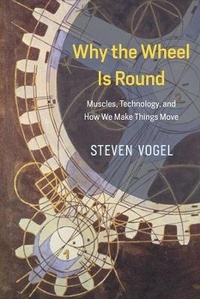
Why the Wheel Is Round
Muscles, Technology, and How We Make Things Move
Published on 24. October 2016
Book
Hardback
344 pages
978-0-226-38103-9 (ISBN)
Description
There is no part of our bodies that fully rotates be it a wrist or ankle or arm in a shoulder socket, we are made to twist only so far. And yet, there is no more fundamental human invention than the wheel a rotational mechanism that accomplishes what our physical form cannot. Throughout history, humans have developed technologies powered by human strength, complementing the physical abilities we have while overcoming our weaknesses. Providing a unique history of the wheel and other rotational devices, like cranks, cranes, carts, and capstans, Why the Wheel Is Round examines the contraptions and tricks we have devised in order to more efficiently move and move through the physical world. Steven Vogel combines his engineering expertise with his remarkable curiosity about how things work to explore how wheels and other mechanisms were, until very recently, powered by the push and pull of the muscles and skeletal systems of humans and other animals. Why the Wheel Is Round explores all manner of treadwheels, hand-spikes, gears, and more, as well as how these technologies diversified into such things as hand-held drills and hurdy-gurdies.
Surprisingly, a number of these devices can be built out of everyday components and materials, and Vogel's accessible and expansive book includes instructions and models so that inspired readers can even attempt to make their own muscle-powered technologies, like trebuchets and ballista. Appealing to anyone fascinated by the history of mechanics and technology as well as to hobbyists with home workshops, Why the Wheel Is Round offers a captivating exploration of our common technological heritage based on the simple concept of rotation. From our leg muscles powering the gears of a bicycle to our hands manipulating a mouse on a roller ball, it will be impossible to overlook the amazing feats of innovation behind our daily devices.
Surprisingly, a number of these devices can be built out of everyday components and materials, and Vogel's accessible and expansive book includes instructions and models so that inspired readers can even attempt to make their own muscle-powered technologies, like trebuchets and ballista. Appealing to anyone fascinated by the history of mechanics and technology as well as to hobbyists with home workshops, Why the Wheel Is Round offers a captivating exploration of our common technological heritage based on the simple concept of rotation. From our leg muscles powering the gears of a bicycle to our hands manipulating a mouse on a roller ball, it will be impossible to overlook the amazing feats of innovation behind our daily devices.
More details
Language
English
Place of publication
Chicago
United States
Publishing group
The University of Chicago Press
Target group
Professional and scholarly
Dimensions
Height: 24 mm
Width: 15 mm
Thickness: 3 mm
Weight
595 gr
ISBN-13
978-0-226-38103-9 (9780226381039)
Copyright in bibliographic data and cover images is held by Nielsen Book Services Limited or by the publishers or by their respective licensors: all rights reserved.
Schweitzer Classification
Other editions
Additional editions
E-Book
12/2022
University of Chicago Press
€19.25
Available for download
Person
Steven Vogel (1940 2015) was James B. Duke Professor Emeritus of biology at Duke University. His books include Cats' Paws and Catapults, Glimpses of Creatures in Their Physical Worlds, and The Life of a Leaf, the latter also published by the University of Chicago Press.