

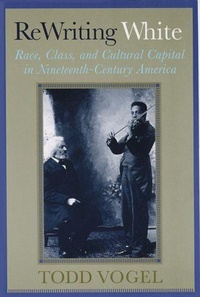
Rewriting White
Race, Class, and Cultural Capital in Nineteenth-Century America
Published on 29. July 2004
Book
Paperback/Softback
224 pages
978-0-8135-3432-9 (ISBN)
Description
What did it mean for people of color in nineteenth-century America to speak or write "white"? More specifically, how many and what kinds of meaning could such "white" writing carry? In ReWriting White, Todd Vogel looks at how America has racialized language and aesthetic achievement. To make his point, he showcases the surprisingly complex interactions between four nineteenth-century writers of color and the "standard white English" they adapted for their own moral, political, and social ends. The African American, Native American, and Chinese American writers Vogel discusses delivered their messages in a manner that simultaneously demonstrated their command of the dominant discourse of their times-using styles and addressing forums considered above their station-and fashioned a subversive meaning in the very act of that demonstration.
The close readings and meticulous archival research in ReWriting White upend our conventional expectations, enrich our understanding of the dynamics of hegemony and cultural struggle, and contribute to the efforts of other cutting-edge contemporary scholars to chip away at the walls of racial segregation that have for too long defined and defaced the landscape of American literary and cultural studies.
The close readings and meticulous archival research in ReWriting White upend our conventional expectations, enrich our understanding of the dynamics of hegemony and cultural struggle, and contribute to the efforts of other cutting-edge contemporary scholars to chip away at the walls of racial segregation that have for too long defined and defaced the landscape of American literary and cultural studies.
Reviews / Votes
I came across Rewriting White: Race, Class and Cultural Capital in 19th Century America by Todd Vogel, a cultural historian. There, I found Mr. Fowler's beliefs about black people's language skills and allegedly inborn talents for working as waiters and nurses. That wasn't all - Mr. Fowler also correlated coarse hair with "coarseness in the fibers of the brain, together with coarse, harsh feelings" - but it was enough to disabuse me of any notion that phrenology was going to add some amusing historical tidbits to my review. - Pete Wells (New York Times - Times Insider)More details
Edition
None edition
Language
English
Place of publication
New Brunswick NJ
United States
Target group
College/higher education
Professional and scholarly
Product notice
Paperback (trade)
Unsewn / adhesive bound
Illustrations
19 images
Dimensions
Height: 229 mm
Width: 153 mm
Thickness: 15 mm
Weight
345 gr
ISBN-13
978-0-8135-3432-9 (9780813534329)
Copyright in bibliographic data and cover images is held by Nielsen Book Services Limited or by the publishers or by their respective licensors: all rights reserved.
Schweitzer Classification
Person
Todd Vogel, a visiting professor of English and American studies at Trinity College, Connecticut, is the editor of The Black Press: New Literary and Historical Essays. He has written for Business Week, the Washington Post, the Boston Globe, and the Dallas Morning News.
Content
List of Illustrations
Acknowledgments
Introduction: Recasting the Plot
Part I - Antebellum Revisions - Public Virtue
1. Speaking to the Whiteness of the Brain
2. William Apess's Theater and a "Native" American History
Part II - Postbellum Revisions - The Virtue Within
3. Sharpening the Pen: Racial and Aesthetic Transformation
4. Anna Julia Cooper and the Black Orator
5. Edith Eaton Plays the Chinese Water Lily
Conclusion
Notes
Selected Bibliography
Index
Acknowledgments
Introduction: Recasting the Plot
Part I - Antebellum Revisions - Public Virtue
1. Speaking to the Whiteness of the Brain
2. William Apess's Theater and a "Native" American History
Part II - Postbellum Revisions - The Virtue Within
3. Sharpening the Pen: Racial and Aesthetic Transformation
4. Anna Julia Cooper and the Black Orator
5. Edith Eaton Plays the Chinese Water Lily
Conclusion
Notes
Selected Bibliography
Index