

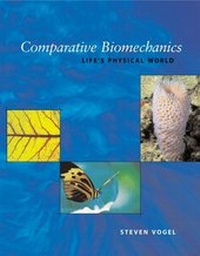
Comparative Biomechanics
Life's Physical World
Published on 24. August 2003
Book
Hardback
592 pages
978-0-691-11297-8 (ISBN)
Description
Why do you shift from walking to running at a particular speed? How can we predict transition speeds for animals of different sizes? Why must the flexible elastic of arterial walls behave differently than a rubber tube or balloon? How do leaves manage to expose a broad expanse of surface while suffering only a small fraction of the drag of flags in high winds? The field of biomechanics - how living things move and work - hasn't seen a new general textbook in more than two decades. Here a leading investigator and teacher lays out the key concepts of biomechanics using examples drawn from throughout the plant and animal kingdoms. Up-to-date and comprehensive, this is also the only book to give thorough coverage to both major subfields of biomechanics: fluid and solid mechanics. Steven Vogel explains how biomechanics makes use of models and methods drawn from physics and mechanical engineering to investigate a wide range of general questions - from how animals swim and fly and the modes of terrestrial locomotion to the way organisms respond to wind and water currents and the operation of circulatory and suspension-feeding systems.
He looks also at the relationships between the properties of biological materials - spider silk, jellyfish jelly, muscle, and more - and their various structural and functional roles. While written primarily for biology majors and graduate students in biology, this text will be useful for physical scientists and engineers seeking a sense of the state of the art of biomechanics and a guide to its rather scattered literature. For a still wider audience, it establishes the basic biological context for such applied areas as ergonomics, orthopedics, mechanical prosthetics, kinesiology, sports medicine, and biomimetics.
He looks also at the relationships between the properties of biological materials - spider silk, jellyfish jelly, muscle, and more - and their various structural and functional roles. While written primarily for biology majors and graduate students in biology, this text will be useful for physical scientists and engineers seeking a sense of the state of the art of biomechanics and a guide to its rather scattered literature. For a still wider audience, it establishes the basic biological context for such applied areas as ergonomics, orthopedics, mechanical prosthetics, kinesiology, sports medicine, and biomimetics.
Reviews / Votes
Personal anecdotes connect the material to the happenings of everyday life, creating a book that will be well received and remembered by students. Nearly every example is accessible to common experience and easy to comprehend... Excellent, clean line diagrams illustrate nearly every important concept. Each chapter begins with an eclectic and often amusing quotation drawn or paraphrased from the experiences of the author. This typifies the familiar style brought forward in this important and timely work, which will surely become the book of choice for courses in comparative biomechanics. Choice A delightful and comprehensive textbook that is perfect for undergraduates and those of us who need a refresher... Throughout the book, Vogel introduces the formulae and principles that matter in a cleat manner, and illustrates them with a dizzying array of biological and physical examples... [T]his book is tremendous fun to read. Vogel writes with an effervescent sense of delight in his subject. The text is laced with wit and humor, and sprinkled with eclectic examples of nature's many marvels. None of the fun, however, diminishes the clarity. -- Daniel E. Lieberman Nature I tried skim-reading Steven Vogel's Comparative Biomechanics ... but was compromised: the volume has so many little gems scattered throughout that my eye got caught by the glitter and couldn't escape. In earlier books, Vogel introduced biomechanics piecemeal. Now he has written an integrated textbook on the subject. -- Julian F. V. Vincent Science [Vogel] is that rare animal, a biologist who is at once fluent in mathematics, conversant with physics and physical chemistry, and an accomplished practical engineer. More than that, the quality of Vogel's writing allows him to convey complex ideas clearly and make them so accessible that his books are hard to put down. -- H.C. Bennet-Clark Bioscience Science books are generally read for three reasons: it is assigned, it provides an introduction to an unfamiliar field, or because it is a truly enjoyable read. Great science books meet all three... With Comparative Biomechanics, Vogel has now produced a book that meets all three criteria of a great science book. -- Scott Turner Quarterly Review of BiologyMore details
Language
English
Place of publication
New Jersey
United States
Target group
Professional and scholarly
College/higher education
Product notice
Trade binding
Illustrations
234 line illus. 33 tables.
Dimensions
Height: 254 mm
Width: 203 mm
Weight
1531 gr
ISBN-13
978-0-691-11297-8 (9780691112978)
Copyright in bibliographic data and cover images is held by Nielsen Book Services Limited or by the publishers or by their respective licensors: all rights reserved.
Schweitzer Classification
Other editions
New editions
Book
06/2013
2nd Edition
Princeton University Press
€121.50
Shipment within 10-20 days
Person
Steven Vogel is James B. Duke Professor of Biology at Duke University. He is the author of "Vital Circuits, Cats' Paws and Catapults" and, from Princeton, "Life in Moving Fluids" and the prize-winning "Life's Devices".