

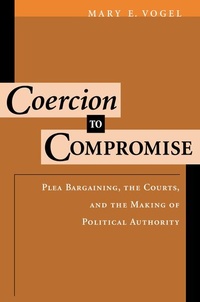
Coercion to Compromise
Plea Bargaining, the Courts, and the Making of Political Authority
Published on 29. November 2007
Book
Paperback/Softback
448 pages
978-0-19-510175-1 (ISBN)
Description
This book examines the origins of the controversial practice of plea bargaining, a procedure that appears to reward the guilty. Contrary to popular perception of plea bargainingas as an innovation or corruption of the post-World War II years, this study shows the practice to have emerged early in the American Republic. Vogel argues that plea bargaining arose in the 1830's as part of a process of political stabilization and an effort to legitimate the democratic institutions of self-rule that were crucial to Whig efforts to reconsolidate the political power of Boston's social and economic elite. At this time local political institutions were spare and fragmentary, and the courts, she argues, stepped forward as agents of the state to promote social order. Plea bargaining drew conflicts into the courts while maintaining elite discretion over sentencing policy. She argues that plea bargaining should be seen as part of a larger repertoire of techniques in the Anglo-American legal tradition through which law might be used as a vehicle of rule. In this context, plea bargaining provided a unique match between the needs of elites to maximize flexibility in criminal sanction and an emerging liberal ideology.
Reviews / Votes
"A magnificent achievement. Coercion to Compromise is a comprehensive, yet subtle and theoretically rich history of the origins of plea bargaining in the nineteenth-century Massachusetts courts. An important book, [it] will reward its readers tenfold."--Susan Silbey, author of The Common Place of Law"Plea bargaining has long been a controversial practice, symbolizing either unwarranted leniency for offenders and the deliberate subversion of formal legal authority, or an emphasis on efficiency at the expense of justice. Mary Vogel explores its distinctively American origins in the context of social and political change in early nineteenth-century America in a book which raises the analysis of the criminal process to a new level of theoretical
sophistication."--Dr. Keith Hawkins, author of Law as Last Resort
"Coercion to Compromise is a powerful, important book. [Vogel] not only enlarges our understanding of the foundations of American criminal justice, but also illuminates the source of critical failures underlying plea bargaining in our own time. This is a pathbreaking work using the methods of social science and history to provide an authoritative and original analysis of previously uncharted terrain."--Frank Munger, author of Rights of
Inclusion
"This ambitious and compelling study provides a novel explanation for the emergence of plea bargaining in the American judiciary system. Vogel has written a social history of the first order and in the process sheds light on the limitations of plea bargaining in the contemporary context."--Kitty Calavita, coauthor of Big Money Crime
"A magnificent achievement. Coercion to Compromise is a comprehensive, yet subtle and theoretically rich history of the origins of plea bargaining in the nineteenth-century Massachusetts courts. An important book, [it] will reward its readers tenfold."--Susan Silbey, author of The Common Place of Law
"Plea bargaining has long been a controversial practice, symbolizing either unwarranted leniency for offenders and the deliberate subversion of formal legal authority, or an emphasis on efficiency at the expense of justice. Mary Vogel explores its distinctively American origins in the context of social and political change in early nineteenth-century America in a book which raises the analysis of the criminal process to a new level of theoretical
sophistication."--Dr. Keith Hawkins, author of Law as Last Resort
"Coercion to Compromise is a powerful, important book. [Vogel] not only enlarges our understanding of the foundations of American criminal justice, but also illuminates the source of critical failures underlying plea bargaining in our own time. This is a pathbreaking work using the methods of social science and history to provide an authoritative and original analysis of previously uncharted terrain."--Frank Munger, author of Rights of
Inclusion
"This ambitious and compelling study provides a novel explanation for the emergence of plea bargaining in the American judiciary system. Vogel has written a social history of the first order and in the process sheds light on the limitations of plea bargaining in the contemporary context."--Kitty Calavita, coauthor of Big Money Crime
More details
Series
Language
English
Place of publication
New York
United States
Target group
Professional and scholarly
Illustrations
halftones and tables
Dimensions
Height: 155 mm
Width: 229 mm
Thickness: 30 mm
Weight
641 gr
ISBN-13
978-0-19-510175-1 (9780195101751)
Copyright in bibliographic data and cover images is held by Nielsen Book Services Limited or by the publishers or by their respective licensors: all rights reserved.
Schweitzer Classification
Other editions
Additional editions
Mary E. Vogel
Coercion to Compromise
Plea Bargaining, the Courts, and the Making of Political Authority
Book
11/2007
Oxford University Press Inc
€89.50
Shipment within 15-20 days
Person
Dr. Mary E. Vogel is Reader at King's College London School of Law having received her doctorate from Harvard University and taught previously at the University of Michigan and the University of California at Santa Barbara.
Content
1: Plea Bargaining: A Distinctly American Practice
2: Liberty and the Republican Citizen: Rise of the Rule of Law
3: Social Order and the Law: Marxian and Weberian Views
4: Contours of Bargaining: Patterns of Plea and Confession
5: Episodic Leniency in Britain and America
6: The Emergence of Plea Bargaining
Notes
Bibliography
Index
2: Liberty and the Republican Citizen: Rise of the Rule of Law
3: Social Order and the Law: Marxian and Weberian Views
4: Contours of Bargaining: Patterns of Plea and Confession
5: Episodic Leniency in Britain and America
6: The Emergence of Plea Bargaining
Notes
Bibliography
Index