

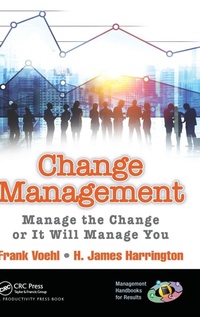
Change Management
Manage the Change or It Will Manage You
1st Edition
Published on 13. November 2017
Book
Hardback
424 pages
978-1-138-46395-0 (ISBN)
Description
Change Management: Manage Change or It Will Manage You represents a substantial core guidance effort for Change Management practitioners. Organizations currently contend with increasingly higher levels of knowledge-driven competition. Many attempt to meet the challenge by investing in expensive knowledge-driven change management systems. Such systems are useless, and sometimes even harmful, for making strategic decisions because they do not distinguish between what is strategically relevant and what is not.
This Management-for-Results Handbook focuses on identifying and managing the specific, critical knowledge assets that your organization needs to disrupt your competitors, including tacit experience of key employees, a deep understanding of customers needs, valuable patents and copyrights, shared industry practices, and customer- and supplier-generated innovations. The authors present two aspects of Change Management: (1) traditional Change Management as it impacts the project management team's activities and (2) a suggested new approach to Change Management directed at changing the culture. The focus is to prepare the people impacted by the project and change activities to accept and adapt to the new/changed working conditions.
The first half of the book deals with traditional Change Management, which covers the topics of remembering, understanding, and applying. The second half presents the authors new approach to changing the culture, which deals with analyzing, evaluating, and creating.
This Management-for-Results Handbook focuses on identifying and managing the specific, critical knowledge assets that your organization needs to disrupt your competitors, including tacit experience of key employees, a deep understanding of customers needs, valuable patents and copyrights, shared industry practices, and customer- and supplier-generated innovations. The authors present two aspects of Change Management: (1) traditional Change Management as it impacts the project management team's activities and (2) a suggested new approach to Change Management directed at changing the culture. The focus is to prepare the people impacted by the project and change activities to accept and adapt to the new/changed working conditions.
The first half of the book deals with traditional Change Management, which covers the topics of remembering, understanding, and applying. The second half presents the authors new approach to changing the culture, which deals with analyzing, evaluating, and creating.
More details
Series
Language
English
Place of publication
London
United Kingdom
Publishing group
Taylor & Francis Ltd
Target group
Professional and scholarly
Professional Practice & Development
Dimensions
Height: 240 mm
Width: 161 mm
Thickness: 27 mm
Weight
798 gr
ISBN-13
978-1-138-46395-0 (9781138463950)
Copyright in bibliographic data and cover images is held by Nielsen Book Services Limited or by the publishers or by their respective licensors: all rights reserved.
Schweitzer Classification
Other editions
Additional editions
E-Book
11/2017
1st Edition
Productivity Press
€61.99
Available for download
E-Book
11/2017
1st Edition
Productivity Press
€61.99
Available for download
Book
02/2016
1st Edition
Apple Academic Press Inc.
€74.55
Article not available for order
Persons
Frank Voehl, H. James Harrington
Content
Prologue, Acknowledgments, About the Authors, Section I.?Remembering, Chapter 1. Introduction to Change Management, Chapter 2. The Philosophy and Evolution of Change Management, Chapter 3. Making the Case for Change Readiness, Section II.?Understanding, Chapter 4. Dirty Dozen Most Popular Models, Chapter 5. Sustainable Change Life Cycle, Chapter 6. Facilitated OCM Workshops, Chapter 7. Culture Change Management (CCM), Section III.?Applying, Chapter 8. Applying Methods for Deployment, Chapter 9. Initiatives' Prioritization, Chapter 10. The Iterative Development Approach, Section IV. Analyzing and Evaluating, Chapter 11. Gathering, Analyzing, and Prioritizing Requirements, Chapter 12. Using Estimates and Time Boxes, Section V: Creating, Chapter 13. Modeling and Simulation, Chapter 14. Measurement and Appraisal, Chapter 15. Risk Management Considerations, Chapter 16. Deploying and Implementing CCM, Bibliography, Index