

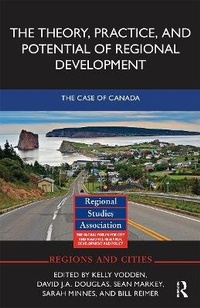
The Theory, Practice and Potential of Regional Development
The Case of Canada
1st Edition
Published on 18. December 2020
Book
Paperback/Softback
240 pages
978-0-367-67141-9 (ISBN)
Description
Canadian regional development today involves multiple actors operating within nested scales from local to national and even international levels. Recent approaches to making sense of this complexity have drawn on concepts such as multi-level governance, relational assets, integration, innovation, and learning regions. These new regionalist concepts have become increasingly global in their formation and application, yet there has been little critical analysis of Canadian regional development policies and programs or the theories and concepts upon which many contemporary regional development strategies are implicitly based.
This volume offers the results of five years of cutting-edge empirical and theoretical analysis of changes in Canadian regional development and the potential of new approaches for improving the well-being of Canadian communities and regions, with an emphasis on rural regions. It situates the Canadian approach within comparative experiences and debates, offering the opportunity for broader lessons to be learnt.
This book will be of interest to policy-makers and practitioners across Canada, and in other jurisdictions where lessons from the Canadian experience may be applicable. At the same time, the volume contributes to and updates regional development theories and concepts that are taught in our universities and colleges, and upon which future research and analysis will build.
This volume offers the results of five years of cutting-edge empirical and theoretical analysis of changes in Canadian regional development and the potential of new approaches for improving the well-being of Canadian communities and regions, with an emphasis on rural regions. It situates the Canadian approach within comparative experiences and debates, offering the opportunity for broader lessons to be learnt.
This book will be of interest to policy-makers and practitioners across Canada, and in other jurisdictions where lessons from the Canadian experience may be applicable. At the same time, the volume contributes to and updates regional development theories and concepts that are taught in our universities and colleges, and upon which future research and analysis will build.
More details
Series
Language
English
Place of publication
London
United Kingdom
Publishing group
Taylor & Francis Ltd
Target group
College/higher education
Professional and scholarly
Postgraduate and Undergraduate
Dimensions
Height: 234 mm
Width: 156 mm
Weight
470 gr
ISBN-13
978-0-367-67141-9 (9780367671419)
Copyright in bibliographic data and cover images is held by Nielsen Book Services Limited or by the publishers or by their respective licensors: all rights reserved.
Schweitzer Classification
Other editions
Additional editions
Kelly Vodden | David Douglas | Sean Markey
The Theory, Practice and Potential of Regional Development
The Case of Canada
E-Book
07/2019
1st Edition
Routledge
€61.99
Available for download
Kelly Vodden | David Douglas | Sean Markey
The Theory, Practice and Potential of Regional Development
The Case of Canada
E-Book
07/2019
1st Edition
Routledge
€61.99
Available for download
Kelly Vodden | David Douglas | Sean Markey
The Theory, Practice and Potential of Regional Development
The Case of Canada
Book
03/2019
1st Edition
Routledge
€206.50
Shipment within 15-20 days
Persons
Kelly Vodden is Associate Vice-President (Grenfell) Research and Graduate Studies and Professor (Research) with the Environmental Policy Institute at Grenfell Campus, Memorial University, Corner Brook, Canada.
David J.A. Douglas is a Professor Emeritus at the University of Guelph, Canada, and has extensive experience in rural development across most Canadian regions, the EU, and other contexts (e.g., Indonesia, Iran, Ukraine, Pakistan).
Sean Markey is a Professor, and registered professional planner, with the School of Resource and Environmental Management at Simon Fraser University, Canada.
Sarah Minnes is a Research Associate and registered planner, with the School of Environment and Sustainability, University of Saskatchewan, Saskatoon, Canada.
Bill Reimer is a Professor Emeritus at Concordia University in Montreal, Canada. From 1997 to 2008, he directed a Canadian research project on the New Rural Economy which included 13 universities, 35 partners, and 32 rural communities from all parts of Canada.
David J.A. Douglas is a Professor Emeritus at the University of Guelph, Canada, and has extensive experience in rural development across most Canadian regions, the EU, and other contexts (e.g., Indonesia, Iran, Ukraine, Pakistan).
Sean Markey is a Professor, and registered professional planner, with the School of Resource and Environmental Management at Simon Fraser University, Canada.
Sarah Minnes is a Research Associate and registered planner, with the School of Environment and Sustainability, University of Saskatchewan, Saskatoon, Canada.
Bill Reimer is a Professor Emeritus at Concordia University in Montreal, Canada. From 1997 to 2008, he directed a Canadian research project on the New Rural Economy which included 13 universities, 35 partners, and 32 rural communities from all parts of Canada.
Content
Chapter 1 Introduction Sarah Minnes and Kelly Vodden Chapter 2 Regional Development in Canada: Eras and Evolution Sarah-Patricia Breen, Sean Markey, and Bill Reimer Chapter 3 What is New Regionalism? Jen Daniels, David J.A. Douglas, Kelly Vodden, and Sean Markey Chapter 4 Project Approach: Critical Reflections on Methodology and Process Sarah-Patricia Breen and Kelly Vodden Chapter 5 Searching for Multi-Level Collaborative Governance Ryan Gibson Chapter 6 Identity and Commitment to Place: How Regions "Become" in Rural Canada Sean Markey, Sarah-Patricia Breen, Kelly Vodden, and Jen Daniels Chapter 7 "Integrated" Regional Development Policy and Planning David J.A. Douglas Chapter 8 Rural-Urban Interactions and Interdependence Bill Reimer, Joshua Barrett, Kelly Vodden, and Luc Bisson Chapter 9 Learning, Knowledge Flows, and Innovation in Canadian Regions Heather M. Hall and Kelly Vodden Chapter 10 Conclusions: Implications for Policy and Practice Kelly Vodden, David J.A. Douglas, Sarah Minnes, Sean Markey, Bill Reimer, and Sarah-Patricia Breen Index