

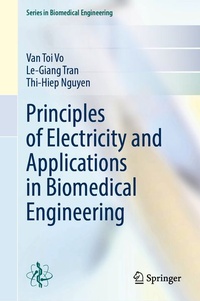
Principles of Electricity and Applications in Biomedical Engineering
Description
This book is a comprehensive textbook designed to introduce the fundamental principles of electricity and their critical applications in biomedical engineering for students and researchers in both the medical and engineering domains. Spanning ten chapters, the book meticulously covers essential topics such as voltage, current, resistors, capacitors, and inductors, providing a solid foundation for understanding complex electrical systems. The chapters include key areas such as the analysis of resistive and alternating circuits, operational amplifiers, and electrical safety. Each chapter is thoughtfully structured with biomedical engineering application perspectives, offering real-world examples that highlight the integration of electrical engineering principles in medical applications. From recording electrical signals in the human visual system to employing Kirchhoff's voltage law in ECG studies, these examples illuminate the practical significance of electricity in advancing healthcare technologies.
Readers will find expert insights into the use of maximum power transfer theorem in temperature sensing, the voltage clamp technique in neurology, and the role of capacitors and resistors in neural engineering models. This book not only clarifies complex theories but also demonstrates their practical relevance, making it a must-read for anyone interested in the intersection of electricity and biomedical innovation.
Ideal for students enrolled in biomedical engineering and neural engineering courses, as well as professionals seeking to enhance their understanding of electrical applications in medicine, this textbook serves as a vital resource for acquiring the foundational knowledge necessary to advance in the field.
More details
Persons
Professor Van Toi Vo earned his Ph.D. from the École Polytechnique Fédérale de Lausanne (EPFL), Switzerland. He pursued postdoctoral research at the Health Sciences and Technology Division jointly administered by Harvard University and the Massachusetts Institute of Technology (MIT). His academic career includes faculty appointments at Tufts University, a visiting professorship at the University of Pennsylvania, and leadership as Executive Director of the Vietnam Education Foundation in the United States.
Professor Vo played a pivotal role in founding the Eye Research Institute in Sion, Switzerland, and was instrumental in establishing the Department of Biomedical Engineering at Tufts University. He later replicated this achievement at the International University under Vietnam National University, Ho Chi Minh City, contributing significantly to the development of biomedical engineering education in Vietnam.
His research spans a wide array of topics, including the design and application of medical devices, the human visual system, ophthalmology, and telemedicine. He is a prolific contributor to the scientific community, with numerous publications, books, and patented inventions to his name.
Among many awards, in 2022 he received the Honorary Life member from the International Federation for Medical and Biological Engineering (IFMBE) for his leadership in developing Biomedical Engineering in Vietnam and founding the BME Society there.
Professor Vo has been instrumental in establishing of the biennial International Conference on the Development of Biomedical Engineering in Vietnam, which emphasizes translational healthcare technologies tailored for Low- and Middle-Income Countries. These conferences are regularly endorsed by IFMBE, with proceedings published by Springer. The 11th one occurs in 2026.
Dr. Tr?n Lê Giang received a B.S. degree in Biomedical Engineering from the International University (IU), Vietnam National University, Ho Chi Minh City (VNU-HCM), in 2014, and M.S. and Ph.D. degrees in Biomedical Engineering and Biomaterials from Seoul National University of Science and Technology in 2017 and 2021, respectively. For his Ph.D. research, he focused on sensors and microneedle technologies for biomedical applications, particularly microfabrication techniques for building miniaturized sensors. His work also covers drug delivery, including the development of biodegradable polymeric microneedles to enhance transdermal drug delivery.
After graduation, he worked as a postdoctoral researcher at Seoul National University of Science and Technology, where he developed a biocompatible pressure sensor embedded in a smart guidewire for cardiac surgery.
He has been a lecturer at IU, VNU-HCM since 2022. He teaches Principles of Electrical Engineering, Applied Informatics, Biosignal Processing, Introduction to Biomedical Engineering, and Information Technology in Healthcare Systems.
Associate Professor Nguy?n Th? Hi?p earned her Ph.D. from SoonChunHyang University in South Korea in 2012. She returned to Vietnam shortly after graduation to establish the Tissue Engineering and Regenerative Medicine Lab at the School of Biomedical Engineering, IU, VNU-HCM, and to pursue her research interests in biomaterials fabrication.
Dr. Hi?p has published over 90 articles indexed in ISI and Scopus, 15 domestic papers, 3 book chapters, 80 international conference papers, and holds 3 granted patents. Her interdisciplinary research focuses on the design and preparation of biomaterials for biological, medical, and pharmaceutical applications, integrating materials science, pharmaceutical science, cell therapy, and both basic and clinical medicine. This includes the study of electrical characteristics of biological materials for wound healing.
Currently, Dr. Hi?p is the Dean of the School of Biomedical Engineering at International University, VNU-HCM. She has received numerous awards, including the National Fellowship Award from L'Oréal-UNESCO for Women in Science (2016), the ASEAN-U.S. Science Prize for Women (2017), and the L'Oréal-UNESCO International Rising Talent award (2018). She was also named among the Top 100 most outstanding scientists in Asia by Asian Scientist magazine in 2019.
Content
Chapter 1. Generalities.- Chapter 2. Foundation of Electricity.- Chapter 3. Resistor and Resistance.- Chapter 4. Basic Resistive Circuits.- Chapter 5. Standard Methods to Analyze Resistive Circuits.- Chapter 6. Operational Amplifier.- Chapter 7. Capacitor and Capacitance.- Chapter 8. Inductor and Inductance.- Chapter 9. Alternating Circuit.- Chapter 10. Electrical Safety.