

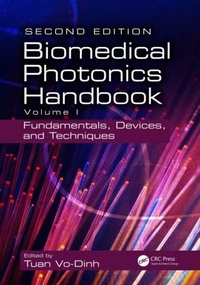
Biomedical Photonics Handbook
Fundamentals, Devices, and Techniques
2nd Edition
Published on 29. July 2014
Book
Hardback
852 pages
978-1-4200-8512-9 (ISBN)
Description
Shaped by Quantum Theory, Technology, and the Genomics Revolution
The integration of photonics, electronics, biomaterials, and nanotechnology holds great promise for the future of medicine. This topic has recently experienced an explosive growth due to the noninvasive or minimally invasive nature and the cost-effectiveness of photonic modalities in medical diagnostics and therapy. The second edition of the Biomedical Photonics Handbook presents recent fundamental developments as well as important applications of biomedical photonics of interest to scientists, engineers, manufacturers, teachers, students, and clinical providers. The first volume, Fundamentals, Devices, and Techniques, focuses on the fundamentals of biophotonics, optical techniques, and devices.
Represents the Collective Work of over 150 Scientists, Engineers, and Clinicians
Designed to display the most recent advances in instrumentation and methods, as well as clinical applications in important areas of biomedical photonics to a broad audience, this three-volume handbook provides an inclusive forum that serves as an authoritative reference source for a broad audience involved in the research, teaching, learning, and practice of medical technologies.
What's New in This Edition:
A wide variety of photonic biochemical sensing technologies has already been developed for clinical monitoring of physiological parameters, such as blood pressure, blood chemistry, pH, temperature, and the presence of pathological organisms or biochemical species of clinical importance. Advanced photonic detection technologies integrating the latest knowledge of genomics, proteomics, and metabolomics allow sensing of early disease states, thus revolutionizing the medicine of the future.
The integration of photonics, electronics, biomaterials, and nanotechnology holds great promise for the future of medicine. This topic has recently experienced an explosive growth due to the noninvasive or minimally invasive nature and the cost-effectiveness of photonic modalities in medical diagnostics and therapy. The second edition of the Biomedical Photonics Handbook presents recent fundamental developments as well as important applications of biomedical photonics of interest to scientists, engineers, manufacturers, teachers, students, and clinical providers. The first volume, Fundamentals, Devices, and Techniques, focuses on the fundamentals of biophotonics, optical techniques, and devices.
Represents the Collective Work of over 150 Scientists, Engineers, and Clinicians
Designed to display the most recent advances in instrumentation and methods, as well as clinical applications in important areas of biomedical photonics to a broad audience, this three-volume handbook provides an inclusive forum that serves as an authoritative reference source for a broad audience involved in the research, teaching, learning, and practice of medical technologies.
What's New in This Edition:
A wide variety of photonic biochemical sensing technologies has already been developed for clinical monitoring of physiological parameters, such as blood pressure, blood chemistry, pH, temperature, and the presence of pathological organisms or biochemical species of clinical importance. Advanced photonic detection technologies integrating the latest knowledge of genomics, proteomics, and metabolomics allow sensing of early disease states, thus revolutionizing the medicine of the future.
More details
Edition
2nd edition
Language
English
Place of publication
Bosa Roca
United States
Publishing group
Taylor & Francis Inc
Target group
Professional and scholarly
Academic and Professional Practice & Development
Illustrations
170 b/w images and 32 color images
Dimensions
Height: 254 mm
Width: 178 mm
Weight
1540 gr
ISBN-13
978-1-4200-8512-9 (9781420085129)
Copyright in bibliographic data and cover images is held by Nielsen Book Services Limited or by the publishers or by their respective licensors: all rights reserved.
Schweitzer Classification
Other editions
Additional editions
Book
10/2019
2nd Edition
CRC Press
€167.80
Shipment within 15-20 days
E-Book
07/2014
2nd Edition
CRC Press
€92.49
Available for download
E-Book
07/2014
2nd Edition
CRC Press
€92.49
Available for download
Person
Tuan Vo-Dinh is the R. Eugene and Susie E. Goodson Distinguished Professor of biomedical engineering, professor of chemistry, and director of the Fitzpatrick Institute for Photonics at Duke University. He received a B.S. in physics in 1970 from EPFL (Ecole Polytechnique Federal de Lausanne) in Lausanne and a Ph.D. in physical chemistry in 1975 from ETH (Swiss Federal Institute of Technology) in Zurich, Switzerland. Dr. Vo-Dinh has authored over 350 publications in peer-reviewed scientific journals. He is the author of a textbook on spectroscopy and editor of 6 books. He has received numerous awards and holds over 37 U.S. and international patents.
Content
Photonics and Tissue Optics. Optical Properties of Tissues. Light-Tissue Interactions. Theoretical Models and Algorithms in Optical Diffusion Tomography. Basic Instrumentation. Basic Instrumentation in Photonics. Optical Fibers and Waveguides for Medical Applications. Fiberoptics Probe Design. Laser and Optical Radiation Safety in Biophotonics. Photonic Detection and Imaging Techniques. Biological Imaging Spectroscopy. Lifetime-Based Imaging. Confocal Microscopy. Two-Photon Excitation Fluorescence Microscopy. Laser Doppler Perfusion Monitoring and Imaging. Light Scatter Spectroscopy and Imaging of Cellular and Subcellular Events. Tissue Viability Imaging. Photothermal Detection and Tracking of Individual Non-fluorescent Nanosystems. Thermal Imaging. Multidimensional fluorescence imaging of biological tissue. Speckle Correlometry. Spectroscopic Data in Biological and Biomedical Analysis