

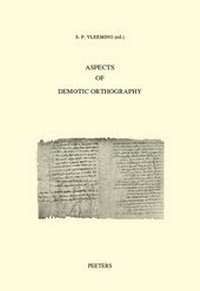
Aspects of Demotic Orthography
Acts of an International Colloquium held in Trier, 8 November 2010
1st Edition
Published on 26. April 2013
Book
Paperback/Softback
198 pages
978-90-429-2901-2 (ISBN)
Unfortunately, price unknown
Available (delivery time upon request)
Not available
Description
While mankind's fascination with the scripts of ancient Egypt has been a
constant across the centuries, their study as part of modern Egyptology
is only as old as the decipherment of the hieroglyphs by Champollion,
now nearly two centuries ago. Although we feel confident that, at least
in theory, we thoroughly understand these scripts, practical
difficulties in reading the cursive variants of hieratic and demotic
remain. These are often such that they constantly bring to mind the
sometimes abstruse associations by which the ancient scribes arrived at
the various orthographies they invented for writing the complex lingual
structures. Demotic is a particularly interesting case in point, as it
belongs to the multi-layered textual world of the Graeco-Roman period,
where hieroglyphs, hieratic and demotic are usually found in
complementary use, but also occasionally in competition with each other.
In their variety, the studies presented in these Acts bear witness to
the rich texture of the script by investigating several parameters by
which it may be measured, including the reading of individual signs and
grammatical categories such as verbal morphology. Indices of words and
signs discussed, as well as a full bibliography of studies in monographs
and articles relating to the topic, complete the volume.
constant across the centuries, their study as part of modern Egyptology
is only as old as the decipherment of the hieroglyphs by Champollion,
now nearly two centuries ago. Although we feel confident that, at least
in theory, we thoroughly understand these scripts, practical
difficulties in reading the cursive variants of hieratic and demotic
remain. These are often such that they constantly bring to mind the
sometimes abstruse associations by which the ancient scribes arrived at
the various orthographies they invented for writing the complex lingual
structures. Demotic is a particularly interesting case in point, as it
belongs to the multi-layered textual world of the Graeco-Roman period,
where hieroglyphs, hieratic and demotic are usually found in
complementary use, but also occasionally in competition with each other.
In their variety, the studies presented in these Acts bear witness to
the rich texture of the script by investigating several parameters by
which it may be measured, including the reading of individual signs and
grammatical categories such as verbal morphology. Indices of words and
signs discussed, as well as a full bibliography of studies in monographs
and articles relating to the topic, complete the volume.
More details
Series
Language
English
Place of publication
Leuven
Belgium
Target group
Professional and scholarly
ISBN-13
978-90-429-2901-2 (9789042929012)
Copyright in bibliographic data and cover images is held by Nielsen Book Services Limited or by the publishers or by their respective licensors: all rights reserved.
Schweitzer Classification