

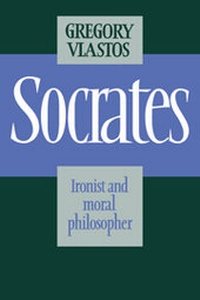
Socrates
Ironist and Moral Philosopher
Published on 11. April 1991
Book
Hardback
346 pages
978-0-521-30733-8 (ISBN)
Description
This long-awaited study of the most enigmatic figure of Greek philosophy reclaims Socrates' ground-breaking originality. Written by a leading historian of Greek thought, it argues for a Socrates who, though long overshadowed by his successors Plato and Aristotle, marked the true turning point in Greek philosophy, religion and ethics. The quest for the historical figure focuses on the Socrates of Plato's earlier dialogues, setting him in sharp contrast to that other Socrates of later dialogues, where he is used as a mouthpiece for Plato's often anti-Socratic doctrine. At the heart of the book is the paradoxical nature of Socratic thought. But the paradoxes are explained, not explained away. The book highlights the tensions in the Socratic search for the answer to the question 'How should we live?' Conceived as a divine mandate, the search is carried out through elenctic argument, and dominated by an uncompromising rationalism. The magnetic quality of Socrates' personality is allowed to emerge throughout the book. Clearly and forcefully written, philosophically sophisticated but entirely accessible to non-specialists, this book will be of major importance and interest to all those studying ancient philosophy and the history of Western thought.
More details
Language
English
Place of publication
Cambridge
United Kingdom
Target group
College/higher education
Professional and scholarly
Dimensions
Height: 237 mm
Width: 160 mm
Thickness: 25 mm
Weight
628 gr
ISBN-13
978-0-521-30733-8 (9780521307338)
Copyright in bibliographic data and cover images is held by Nielsen Book Services Limited or by the publishers or by their respective licensors: all rights reserved.
Schweitzer Classification
Other editions
New editions
Book
04/1991
Cambridge University Press
€64.60
Shipment within 15-20 days
Content
List of additional notes; Introduction; 1. Socratic irony; 2. Socrates contra Socrates in Plato; 3. The evidence of Aristotle and Xenophon; 4. Elenchus and mathematics; 5. Does Socrates cheat?; 6. Socratic piety; 7. Socrates' rejection of retaliation; 8. Happiness and virtue in Socrates' moral theory; Epilogue: Felix Socrates; Additional notes; Bibliography; Index of passages cited; Index of names in Plato and Xenophon; Index of modern scholars; Index of Greek words.