

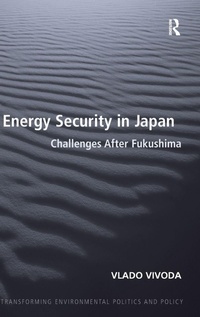
Energy Security in Japan
Challenges After Fukushima
1st Edition
Published on 16. April 2014
Book
Hardback
248 pages
978-1-4094-5530-1 (ISBN)
Description
For a country already uneasy about energy security, the 2011 earthquake and tsunami, which caused a nuclear catastrophe at the Fukushima nuclear power plant, turned pre-existing Japanese concern about the availability of energy into outright anxiety. The subsequent closure of many nuclear reactors meant Japan needed to replace lost power quickly and so had no choice but to secure additional fossil fuels, undermining Japanese diversification policy and increasing global and regional competition for energy. This switch has been at a cost to the already weak Japanese economy whilst the increase in fossil fuel consumption has caused a significant increase in greenhouse gas emissions. In this book Vlado Vivoda examines the drastically changed environment following the disaster in order to analyse Japan's energy security challenges and evaluate Tokyo's energy policy options. Looking at how the disaster exacerbated Japan's existing energy security challenges, Vivoda considers the best policy options for Japan to enhance national energy security in the future, exploring the main impediments to change and how they might be overcome.
Reviews / Votes
'Vlado Vivoda has written a brilliant book about the complexities of Japan's energy market. Through a masterful exposition of the literature, Vivoda demonstrates that there are no easy answers after the Fukushima nuclear crisis. Each power source comes with strengths and weaknesses in a resource-poor and institutionally constrained political economy. It is the responsibility of well-informed citizens to understand these trade-offs in cross-national and historical context. Anyone interested in the topic of Japan's energy market transformations would do well to read this insightful work.' Paul J. Scalise, University of Tokyo, Japan 'A comprehensive energy policy review is underway in Japan in the aftermath of the Fukushima nuclear accident. This timely book offers a valuable insight into energy policy debates in Japan, based on a comprehensive analysis of its energy policy on such aspects as history, institutional framework, the role of relevant stakeholders and the unique energy security vulnerability.' Ken Koyama, Institute of Energy Economics, JapanMore details
Series
Language
English
Place of publication
London
United Kingdom
Publishing group
Taylor & Francis Ltd
Target group
College/higher education
Dimensions
Height: 240 mm
Width: 161 mm
Thickness: 18 mm
Weight
543 gr
ISBN-13
978-1-4094-5530-1 (9781409455301)
Copyright in bibliographic data and cover images is held by Nielsen Book Services Limited or by the publishers or by their respective licensors: all rights reserved.
Schweitzer Classification
Other editions
Additional editions
Book
09/2016
1st Edition
Routledge
€84.10
Shipment within 10-20 days
E-Book
04/2016
Routledge
€77.99
Available for download
E-Book
04/2016
Routledge
€77.99
Available for download
Person
Dr Vlado Vivoda is ARC Fellow at Griffith Asia Institute, Griffith University, in Brisbane, Australia. Since completing his Ph.D. in 2008 he published extensively on energy-related topics. Vlado has delivered numerous seminars and lectures at high profile events and universities such as University College London. Most recently, Vlado has participated in an Australian parliamentary inquiry and an energy security workshop organized by the Asian Development Bank, Vlado's current research focus is on the political economy of energy and on energy security in the Asia-Pacific region.
Content
Series Editors' Preface; Acknowledgments; Acknowledgements List of Abbreviations; Introduction; Chapter 1 Interests, Institutions and Ideas; Chapter 2 The Evolution of Energy Security and Energy Policy in Japan; Chapter 3 Oil; Chapter 4 Natural Gas; Chapter 5 Coal; Chapter 6 Nuclear Energy; Chapter 7 Renewable Energy; Chapter 8 Electricity; Chapter 101 Conclusion;