

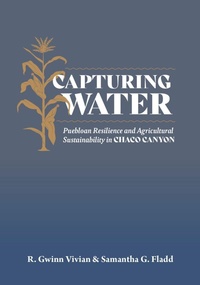
Capturing Water
Puebloan Resilience and Agricultural Sustainability in Chaco Canyon
Published on 29. May 2026
Book
Hardback
408 pages
978-1-64769-221-6 (ISBN)
Description
An esteemed archaeologist's lifetime of work on water use in Chaco Canyon
The ability of the inhabitants of Chaco Canyon to sustain themselves through farming in an arid environment has long been a topic of debate among scholars. Building upon the work of his father, Gordon, R. Gwinn Vivian dedicated his lifetime of archaeological work to investigating water management and practices at Chaco. These efforts provide compelling evidence of the extensive use of canal irrigation systems and other water management techniques employed by the Ancestral Puebloan people by the ninth century and continuing through recent periods by Navajo farmers.
Rich with archaeological data, ethnographic evidence, maps, and photographs, this volume challenges long-standing assumptions about Chaco Canyon's agricultural potential. By highlighting the adaptability and ingenuity of the canyon's early inhabitants, the book offers a fresh perspective on the role of water management in the development of Chaco Canyon as a sociopolitical center in the northern Southwest.
The ability of the inhabitants of Chaco Canyon to sustain themselves through farming in an arid environment has long been a topic of debate among scholars. Building upon the work of his father, Gordon, R. Gwinn Vivian dedicated his lifetime of archaeological work to investigating water management and practices at Chaco. These efforts provide compelling evidence of the extensive use of canal irrigation systems and other water management techniques employed by the Ancestral Puebloan people by the ninth century and continuing through recent periods by Navajo farmers.
Rich with archaeological data, ethnographic evidence, maps, and photographs, this volume challenges long-standing assumptions about Chaco Canyon's agricultural potential. By highlighting the adaptability and ingenuity of the canyon's early inhabitants, the book offers a fresh perspective on the role of water management in the development of Chaco Canyon as a sociopolitical center in the northern Southwest.
Reviews / Votes
"This volume on Chacoan water control systems documents unpublished research by Gordon Vivian, followed by that of Gwinn Vivian and associates, and is updated by more recent projects carried out by numerous colleagues. It is a significant contribution that will aid our understanding of the complexity of Ancestral Puebloan social organization through time."-Frances Joan Mathien, University of New Mexico and volunteer, Chaco Culture National Historical ParkMore details
Language
English
Place of publication
Salt Lake City
United States
Target group
Professional and scholarly
Product notice
sewn/stitched
Cloth over boards
Illustrations
66 b&w illus., 19 tables
Dimensions
Height: 254 mm
Width: 178 mm
Thickness: 30 mm
Weight
454 gr
ISBN-13
978-1-64769-221-6 (9781647692216)
Copyright in bibliographic data and cover images is held by Nielsen Book Services Limited or by the publishers or by their respective licensors: all rights reserved.
Schweitzer Classification
Persons
R. Gwinn Vivian was curator emeritus at the Arizona State Museum in Tucson. His extensive works on Chaco Canyon include The Chacoan Prehistory of the San Juan Basin; Wooden Ritual Artifacts from Chaco Canyon, New Mexico; and TheChaco Handbook: An Encyclopedic Guide.
Samantha G. Fladd is assistant professor of anthropology and director of the Museum of Anthropology at Washington State University. Her work has appeared in several edited collections, including The Continuous Path: Pueblo Movement and the Archaeology of Becoming, and Birds of the Sun: Macaws and People in the U.S. Southwest and Mexican Northwest.
Samantha G. Fladd is assistant professor of anthropology and director of the Museum of Anthropology at Washington State University. Her work has appeared in several edited collections, including The Continuous Path: Pueblo Movement and the Archaeology of Becoming, and Birds of the Sun: Macaws and People in the U.S. Southwest and Mexican Northwest.