

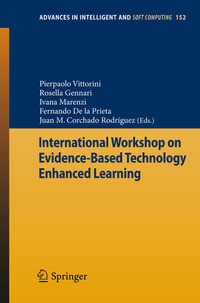
International Workshop on Evidence-Based Technology Enhanced Learning
1st Edition
Published on 14. March 2012
Book
Paperback/Softback
X, 142 pages
978-3-642-28800-5 (ISBN)
Description
Research on Technology Enhanced Learning (TEL) investigates how information and communication technologies can be designed in order to support pedagogical activities. The workshop proceedings collects contributions concerning evidence based TEL systems, like their design following EBD principles as well as studies or best practices that educators, education stakeholders or psychologists used to diagnose or improve their students' learning skills, including students with specific difficulties.
The international ebTEL'12 workshop wants to be a forum in which TEL researchers and practitioners alike can discuss ideas, projects, and lessons related to ebTEL. The workshop takes place in Salamanca, Spain, on March 28th-30th 2012.
More details
Series
Language
English
Place of publication
Berlin
Germany
Publishing group
Springer Berlin
Target group
Professional and scholarly
Research
Illustrations
X, 142 p.
Dimensions
Height: 235 mm
Width: 155 mm
Thickness: 9 mm
Weight
242 gr
ISBN-13
978-3-642-28800-5 (9783642288005)
DOI
10.1007/978-3-642-28801-2
Schweitzer Classification
Other editions
Additional editions
Pierpaolo Vittorini | Rosella Gennari | Ivana Marenzi
International Workshop on Evidence-Based Technology Enhanced Learning
E-Book
03/2012
1st Edition
Springer
€149.79
Available for download
Content
From the content: Concept maps & patterns for designing learning scenarios based on digital-ink technologies.- Online Social Networks Impact in Secondary Education.- Learning to read/type a second language in a chatbot enhanced environment.- Learning about Literature on the Web in a German School.- Towards WebAnalytics: Higher Education TEL tools handling access and information extraction in textually complex websites.- Understanding Computer Architecture with Visual Simulations: What Educational Value?.- Adapting with Evidence: the Adaptive Model and the Stimulation Plan of TERENCE.