

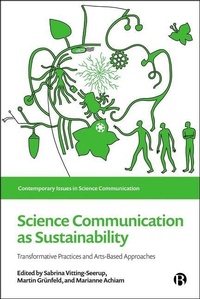
Science Communication as Sustainability
Transformative Practices and Arts-Based Approaches
1st Edition
Will be published approx. on 15. October 2026
Book
Hardback
176 pages
978-1-5292-4724-4 (ISBN)
Description
Urgent crises such as climate change, biodiversity loss and global pandemics demand new ways of communicating knowledge.
This book reimagines science communication, not just as a way to communicate about sustainability, but as a sustainable practice. Challenging traditional communication models rooted in neutrality and control, it explores a transformative approach that is participatory, performative, and ethically engaged. Through arts-based methods, the chapters cultivate a mindset focused on deep relationality and radical imagination.
Blending critique and imagination, this is an invitation to scientists, communicators, and artists seeking to collaborate across disciplines to reshape science communication and transform our collective futures.
This book reimagines science communication, not just as a way to communicate about sustainability, but as a sustainable practice. Challenging traditional communication models rooted in neutrality and control, it explores a transformative approach that is participatory, performative, and ethically engaged. Through arts-based methods, the chapters cultivate a mindset focused on deep relationality and radical imagination.
Blending critique and imagination, this is an invitation to scientists, communicators, and artists seeking to collaborate across disciplines to reshape science communication and transform our collective futures.
Reviews / Votes
'This book unfolds a speculative terrain where art practice and science entangle, inviting readers to navigate these knowledge systems and to reconsider how sustainability is collectively constructed.' Hannah Star Rogers, author of Art, Science, and the Politics of Knowledge 'This book shows why integrating science and art, humans and non-humans in science communication is essential for challenging Western science's assumptions of universality and neutrality and for legitimizing diverse ways of being in the world.' Martha Marandino, Universidade de Sao Paulo 'This is an innovative and welcome contribution to science communication studies and practices,' Massimiano Bucchi, Universita di TrentoMore details
Series
Edition
First Edition
Language
English
Place of publication
Bristol
United Kingdom
Target group
Professional and scholarly
Product notice
Unsewn / adhesive bound
Cloth over boards
Illustrations
18 s/w Abbildungen, 1 s/w Tabelle
1 Tables, black and white; 18 Illustrations, black and white
Dimensions
Height: 234 mm
Width: 156 mm
ISBN-13
978-1-5292-4724-4 (9781529247244)
Copyright in bibliographic data and cover images is held by Nielsen Book Services Limited or by the publishers or by their respective licensors: all rights reserved.
Schweitzer Classification
Persons
Sabrina Vitting-Seerup is Assistant Professor in the Department of Science Education, University of Copenhagen.
Marianne Achiam is Associate Professor in the Department of Science Education, University of Copenhagen.
Martin Gruenfeld is Assistant Professor in the Department of Science Education, University of Copenhagen.
Marianne Achiam is Associate Professor in the Department of Science Education, University of Copenhagen.
Martin Gruenfeld is Assistant Professor in the Department of Science Education, University of Copenhagen.
Content
Foreword (Sarah Davies)
Chapter 1: We need this book - an introduction (Marianne Achiam, Martin Gruenfeld, & Sabrina Vitting-Seerup)
Chapter 2: We need to terroirize science communication for it to be sustainable - a situated, embodied, and relational practice (Martin Gruenfeld, Marianne Achiam, Jacob Thorek Jensen, & Sabrina Vitting-Seerup)
Chapter 3: We need to imagine sustainable futures - breaking with modernity (Marianne Achiam)
Chapter 4: We need to honour emotions - encoding pathos to make science communication work as sustainability (Sabrina Vitting-Seerup)
Chapter 5: We need to welcome other perspectives - inviting interference (Martin Gruenfeld with Maria Braender, Sofie Louise Dam, Adam Dickinson, & Alison Pouliot)
Chapter 6: We need to make things together - multiplicity, kindness, and transparency in co-curation processes (Louise Whiteley)
Chapter 7: We need to pay attention to the past - rethinking science communication by thinking with history (Jacob Thorek Jensen)
Chapter 8: We need to listen to the messy and unseen - on the potential of sound to make ecological relations (Martin Gruenfeld)
Chapter 9: Implications for science communication as sustainability (Sabrina Vitting-Seerup, Jacob Thorek Jensen, & Marianne Achiam)
Chapter 1: We need this book - an introduction (Marianne Achiam, Martin Gruenfeld, & Sabrina Vitting-Seerup)
Chapter 2: We need to terroirize science communication for it to be sustainable - a situated, embodied, and relational practice (Martin Gruenfeld, Marianne Achiam, Jacob Thorek Jensen, & Sabrina Vitting-Seerup)
Chapter 3: We need to imagine sustainable futures - breaking with modernity (Marianne Achiam)
Chapter 4: We need to honour emotions - encoding pathos to make science communication work as sustainability (Sabrina Vitting-Seerup)
Chapter 5: We need to welcome other perspectives - inviting interference (Martin Gruenfeld with Maria Braender, Sofie Louise Dam, Adam Dickinson, & Alison Pouliot)
Chapter 6: We need to make things together - multiplicity, kindness, and transparency in co-curation processes (Louise Whiteley)
Chapter 7: We need to pay attention to the past - rethinking science communication by thinking with history (Jacob Thorek Jensen)
Chapter 8: We need to listen to the messy and unseen - on the potential of sound to make ecological relations (Martin Gruenfeld)
Chapter 9: Implications for science communication as sustainability (Sabrina Vitting-Seerup, Jacob Thorek Jensen, & Marianne Achiam)