

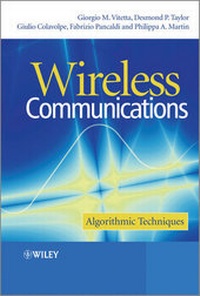
Wireless Communications
Algorithmic Techniques
Published on 3. May 2013
Book
Hardback
744 pages
978-0-470-51239-5 (ISBN)
Description
This book introduces the theoretical elements at the basis of various classes of algorithms commonly employed in the physical layer (and, in part, in MAC layer) of wireless communications systems. It focuses on single user systems, so ignoring multiple access techniques. Moreover, emphasis is put on single-input single-output (SISO) systems, although some relevant topics about multiple-input multiple-output (MIMO) systems are also illustrated.
* Comprehensive wireless specific guide to algorithmic techniques
* Provides a detailed analysis of channel equalization and channel coding for wireless applications
* Unique conceptual approach focusing in single user systems
* Covers algebraic decoding, modulation techniques, channel coding and channel equalisation
More details
Other editions
Additional editions
Giorgio Vitetta | Desmond P. Taylor | Giulio Colavolpe
Wireless Communications
Algorithmic Techniques
E-Book
03/2013
Wiley
€106.99
Available for download
Giorgio Vitetta | Desmond P. Taylor | Giulio Colavolpe
Wireless Communications
Algorithmic Techniques
E-Book
03/2013
Wiley
€106.99
Available for download
Persons
Giorgio M. Vitetta is a Full Professor of Telecommunications at the Department of Information Engineering of the University of Modena and Reggio Emilia. He received the Dr. Ing. Degree in Electronic Engineering (cum Laude) in 1990 and the Ph. D. degree in 1994, both from the University of Pisa, Italy.
Desmond Taylor is the Tait Professor of Communications at the University of Canterbury. He gained his PhD in Electrical Engineering from McMaster University in Canada. He specializes in Digital Communication Systems. He is the director of journals for the IEEE Communications Society.
Philippa Martin is a lecturer in Electrical Engineering at the University of Canterbury. Her research interests include coded modulation, error correction coding and decoding, reduced complexity decoding algorithms, iterative processing, space-time coding, detection and decoding, and combined equalization and decoding.
Fabrizio Pancaldi received his Dr. Ing. Degree in Electronic Engineering (cum laude) and a Ph. D. degree in 2006, both from the University of Modena and Reggio Emilia, Italy. He is currently a Research Fellow and lectures in Telecommunication Networks.
Desmond Taylor is the Tait Professor of Communications at the University of Canterbury. He gained his PhD in Electrical Engineering from McMaster University in Canada. He specializes in Digital Communication Systems. He is the director of journals for the IEEE Communications Society.
Philippa Martin is a lecturer in Electrical Engineering at the University of Canterbury. Her research interests include coded modulation, error correction coding and decoding, reduced complexity decoding algorithms, iterative processing, space-time coding, detection and decoding, and combined equalization and decoding.
Fabrizio Pancaldi received his Dr. Ing. Degree in Electronic Engineering (cum laude) and a Ph. D. degree in 2006, both from the University of Modena and Reggio Emilia, Italy. He is currently a Research Fellow and lectures in Telecommunication Networks.
Content
Preface xi
List of Acronyms xiii
1 Introduction 1
1.1 Structure of a Digital Communication System 3
1.2 Plan of the Book 7
1.3 Further Reading 8
Part I MODULATION AND DETECTION
2 Wireless Channels 11
2.1 Introduction 11
2.2 Mathematical Description of SISO Wireless Channels 16
2.3 Mathematical Description and Modeling of MIMO Wireless Channels 44
2.4 Historical Notes 57
2.5 Further Reading 64
3 Digital Modulation Techniques 65
3.1 Introduction 65
3.2 General Structure of a Digital Modulator 65
3.3 Representation of Digital Modulated Waveforms on an Orthonormal Basis 68
3.4 Bandwidth of Digital Modulations 70
3.5 Passband PAM 74
3.6 Continuous Phase Modulation 86
3.7 OFDM 116
3.8 Lattice-Based Multidimensional Modulations 137
3.9 Spectral Properties of a Digital Modulation at the Output of a Wireless Channel 146
3.10 Historical Notes 149
3.11 Further Reading 154
4 Detection of Digital Signals over Wireless Channels: Decision Rules 155
4.1 Introduction 155
4.2 Wireless Digital Communication Systems: Modeling, Receiver Architecture and Discretization of the Received Signal 156
4.3 Optimum Detection in a Vector Communication System 159
4.4 Mathematical Models for the Receiver Vector 168
4.5 Decision Strategies in the Presence of Channel Parameters: Optimal Metrics and Performance Bounds 188
4.6 Expectation-Maximization Techniques for Data Detection 207
4.7 Historical Notes 214
4.8 Further Reading 216
5 Data-Aided Algorithms for Channel Estimation 217
5.1 Channel Estimation Techniques 218
5.2 Cram´er-Rao Bounds for Data-Aided Channel Estimation 228
5.3 Data-Aided CIR Estimation Algorithms in PATs 235
5.4 Extensions to MIMO Channels 244
5.5 Historical Notes 245
5.6 Further Reading 247
6 Detection of Digital Signals over Wireless Channels: Channel Equalization Algorithms 249
6.1 Introduction 249
6.2 Channel Equalization of Single-Carrier Modulations: Known CIR 250
6.3 Channel Equalization of Multicarrier Modulations: Known CIR 286
6.4 Channel Equalization of Single Carrier Modulations: Statistically Known CIR 292
6.5 Channel Equalization of Multicarrier Modulations: Statistically Known CIR 301
6.6 Joint Channel and Data Estimation: Single-Carrier Modulations 302
6.7 Joint Channel and Data Estimation: Multicarrier Modulations 307
6.8 Extensions to the MIMO Systems 311
6.9 Historical Notes 315
6.10 Further Reading 319
Part II INFORMATION THEORY AND CODING SCHEMES
7 Elements of Information Theory 323
7.1 Introduction 323
7.2 Capacity for Discrete Sources and Channels 323
7.3 Capacity of MIMO Fading Channels 330
7.4 Historical Notes 337
7.5 Further Reading 338
8 An Introduction to Channel Coding Techniques 339
8.1 Basic Principles 339
8.2 Interleaving 341
8.3 Taxonomy of Channel Codes 343
8.4 Taxonomy of Coded Modulations 344
8.5 Organization of the Following Chapters 346
8.6 Historical Notes 346
8.7 Further Reading 347
9 Classical Coding Schemes 349
9.1 Block Codes 349
9.2 Convolutional Codes 390
9.3 Classical Concatenated Coding 432
9.4 Historical Notes 435
9.5 Further Reading 439
10 Modern Coding Schemes 441
10.1 Introduction 441
10.2 Concatenated Convolutional Codes 442
10.3 Concatenated Block Codes 445
10.4 Other Modern Concatenated Coding Schemes 446
10.5 Iterative Decoding Techniques for Concatenated Codes 448
10.6 Low-Density Parity Check Codes 468
10.7 Decoding Techniques for LDPC Codes 478
10.8 Codes on Graphs 494
10.9 Historical Notes 501
10.10 Further Reading 503
11 Signal Space Codes 505
11.1 Introduction 505
11.2 Trellis Coding with Expanded Signal Sets 505
11.3 Bit-Interleaved Coded Modulation 520
11.4 Modulation Codes Based on Multilevel Coding 524
11.5 Space-Time Coding 531
11.6 Historical Notes 565
11.7 Further Reading 566
12 Combined Equalization and Decoding 567
12.1 Introduction 567
12.2 Noniterative Techniques 568
12.3 Algorithms for Combined Equalization and Decoding 571
12.4 Extension to MIMO 586
12.5 Historical Notes 588
12.6 Further Reading 590
Appendix A Fourier Transforms 591
Appendix B Power Spectral Density of Random Processes 593
B.1 Power Spectral Density of a Wide-Sense Stationary Random Process 593
B.2 Power Spectral Density of a Wide-Sense Cyclostationary Random Process 594
B.3 Power Spectral Density of a Bandpass Random Process 595
Appendix C Matrix Theory 597
Appendix D Signal Spaces 601
D.1 Representation of Deterministic Signals 601
D.2 Representation of Random Signals via Orthonormal Bases 606
Appendix E Groups, Finite Fields and Vector Spaces 609
E.1 Groups 609
E.2 Fields 611
E.3 Vector Spaces 622
Appendix F Error Function and Related Functions 625
References 629
Index 713