

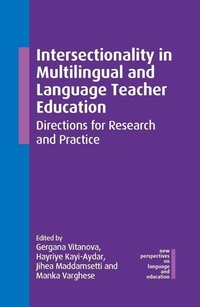
Intersectionality in Multilingual and Language Teacher Education
Directions for Research and Practice
Will be published approx. on 15. September 2026
Book
Hardback
214 pages
978-1-80041-995-7 (ISBN)
Description
Outstanding original application of intersectionality to language teacher education and multilingual classrooms.
This book showcases the construct of intersectionality and how it applies to the multiple dimensions of language and multilingual teacher identities. The chapters illustrate how intersectionality affects teachers' potential for agency and their pedagogical practices.
By highlighting intersectionality's role in teacher education, the book seeks to understand how all forms of oppressive social practices play out in classrooms and educational contexts, and how an intersectional lens can suggest ways in which to counter these in multilingual classrooms and language teaching.
The chapters use a range of methodologies to explore theoretical, empirical and pedagogical implications of an intersectional analysis of language teaching. The book's insights can and should be used to effect change that benefits everyone in the language classroom and the wider educational community.
This book showcases the construct of intersectionality and how it applies to the multiple dimensions of language and multilingual teacher identities. The chapters illustrate how intersectionality affects teachers' potential for agency and their pedagogical practices.
By highlighting intersectionality's role in teacher education, the book seeks to understand how all forms of oppressive social practices play out in classrooms and educational contexts, and how an intersectional lens can suggest ways in which to counter these in multilingual classrooms and language teaching.
The chapters use a range of methodologies to explore theoretical, empirical and pedagogical implications of an intersectional analysis of language teaching. The book's insights can and should be used to effect change that benefits everyone in the language classroom and the wider educational community.
Reviews / Votes
Curated by an expert team of scholars in identity and language teacher education, this volume synthesizes and advances the scholarship of intersectionality in our field. The chapters provide a wonderful array of examples that will be a meaningful resource for researchers, teacher educators, and language teachers who seek to center intersectionality in their work. * Francis Troyan, The Ohio State University, USA * This book demonstrates convincingly and powerfully why it is essential to explore the full range of language teachers' intersecting identities and how they are affected by systems of oppression and privilege. I will recommend this book to anyone interested in researching language teachers. * Elizabeth R. Miller, University of North Carolina at Charlotte, USA * Employing intersectionality as a critical framework, this collection examines how colonial legacies continue to shape ELT educators' identities and practices. Through clear and engaging chapters, it encourages readers to identify harmful practices and move toward educational equity grounded in intersectionality and epistemic justice. * Gloria Park, Indiana University of Pennsylvania, USA *More details
Series
Language
English
Place of publication
Bristol
United Kingdom
Target group
College/higher education
Dimensions
Height: 234 mm
Width: 156 mm
Thickness: 16 mm
ISBN-13
978-1-80041-995-7 (9781800419957)
Copyright in bibliographic data and cover images is held by Nielsen Book Services Limited or by the publishers or by their respective licensors: all rights reserved.
Schweitzer Classification
Persons
Gergana Vitanova is a Professor in the Department of Modern Languages and Literatures, University of Central Florida, USA.
Hayriye Kayi-Aydar is a Professor in the Department of English at the University of Arizona, USA.
Jihea Maddamsetti is an Associate Professor in the Department of Teaching and Learning, Old Dominion University, USA.
Manka Varghese is a Professor in the College of Education, University of Washington, USA.
Hayriye Kayi-Aydar is a Professor in the Department of English at the University of Arizona, USA.
Jihea Maddamsetti is an Associate Professor in the Department of Teaching and Learning, Old Dominion University, USA.
Manka Varghese is a Professor in the College of Education, University of Washington, USA.
Content
Chapter 1. Gergana Vitanova, Hayriye Kayi-Aydar, Jihea Maddamsetti and Manka Varghese: Introduction
Chapter 2. Ayesha Rabadi-Raol: Intersectional Justice: Rethinking Language and Literacy in Early Childhood Teaching and Teacher Education
Chapter 3. Daniela Silva: Implementing Racial Literacy to Foster Teacher Candidates' Understanding of Intersectionality in English Language Teaching
Chapter 4. Zhaoyu Wang and Seongryeong Yu: The Mediating Power of Intersectionality: Examining Language Teacher Professional Development Through a Vygotskian Lens
Chapter 5. Yuzuko Nagashima and Luke Lawrence: Recontextualizing Intersectionality for the ELT Field: A New Approach to Making Use of Intersectionality in Language Teaching and Education Research
Chapter 6. Bedrettin Yazan: Intersectionality of Language Teacher Identity in Teacher Candidates' Critical Autoethnographic Narratives
Chapter 7. Rashi Jain: "...Running [into] Writer's Block": Transnational Loss, Chronic Illnesses, and Reimagined Home
Chapter 8. Yasmine Romero: To Build an Intersectional Framework: Dialoguing Across Language and Writing Studies
Chapter 9. Sabrina Wesley-Nero: Exploring Intersectionality and Teacher Identity to Advance Anti-Racism in Dual Language Education
Chapter 10. Nelly Patino-Cabrera and Rachel Snyder Bhansari: "Mi voz no se escucha": The Work Experiences of Latine Teachers in DLBE Schools
Chapter 11. Dunja Radojkovic: Intersectionality in Intercultural Teacher Development: Serbian Teachers of English in the Middle East
Peter I. De Costa: Afterword
Chapter 2. Ayesha Rabadi-Raol: Intersectional Justice: Rethinking Language and Literacy in Early Childhood Teaching and Teacher Education
Chapter 3. Daniela Silva: Implementing Racial Literacy to Foster Teacher Candidates' Understanding of Intersectionality in English Language Teaching
Chapter 4. Zhaoyu Wang and Seongryeong Yu: The Mediating Power of Intersectionality: Examining Language Teacher Professional Development Through a Vygotskian Lens
Chapter 5. Yuzuko Nagashima and Luke Lawrence: Recontextualizing Intersectionality for the ELT Field: A New Approach to Making Use of Intersectionality in Language Teaching and Education Research
Chapter 6. Bedrettin Yazan: Intersectionality of Language Teacher Identity in Teacher Candidates' Critical Autoethnographic Narratives
Chapter 7. Rashi Jain: "...Running [into] Writer's Block": Transnational Loss, Chronic Illnesses, and Reimagined Home
Chapter 8. Yasmine Romero: To Build an Intersectional Framework: Dialoguing Across Language and Writing Studies
Chapter 9. Sabrina Wesley-Nero: Exploring Intersectionality and Teacher Identity to Advance Anti-Racism in Dual Language Education
Chapter 10. Nelly Patino-Cabrera and Rachel Snyder Bhansari: "Mi voz no se escucha": The Work Experiences of Latine Teachers in DLBE Schools
Chapter 11. Dunja Radojkovic: Intersectionality in Intercultural Teacher Development: Serbian Teachers of English in the Middle East
Peter I. De Costa: Afterword