

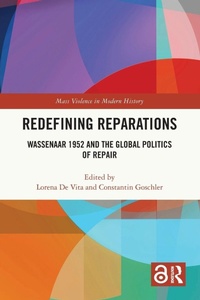
Redefining Reparations
Wassenaar 1952 and the Global Politics of Repair
1st Edition
Will be published approx. on 20. July 2026
Book
Paperback/Softback
282 pages
978-1-032-45465-8 (ISBN)
Description
This edited volume offers a new interpretation of the historically momentous 1952 Wassenaar negotiations between representatives of the Federal Republic of Germany, Israel, and the Jewish Claims Conference to negotiate reparations, compensation, and restitution in the aftermath of the Holocaust.
Wassenaar 1952 marked the first time that reparations were the subject of negotiations between representatives of victims and perpetrators following mass human rights violations and genocide. The reparations program that Germany established after the Holocaust eventually became a point of reference for many calling for reparations to deal with the aftermath of other atrocities - from colonialism to slavery - in contexts as diverse as Namibia, the United States, and beyond. Combining perspectives from history, anthropology, international relations, and transitional justice, this volume reassesses the course and global legacy of these negotiations.
The book's holistic and nuanced intervention in the study of the politics of repair makes it essential reading for students of history, law, transitional justice, and political science interested in the complex topic of reparations.
The Introduction of this book is freely available as a downloadable Open Access PDF at http://www.taylorfrancis.com under a Creative Commons Attribution-Non Commercial-No Derivatives (CC BY-NC-ND) 4.0 license.
Wassenaar 1952 marked the first time that reparations were the subject of negotiations between representatives of victims and perpetrators following mass human rights violations and genocide. The reparations program that Germany established after the Holocaust eventually became a point of reference for many calling for reparations to deal with the aftermath of other atrocities - from colonialism to slavery - in contexts as diverse as Namibia, the United States, and beyond. Combining perspectives from history, anthropology, international relations, and transitional justice, this volume reassesses the course and global legacy of these negotiations.
The book's holistic and nuanced intervention in the study of the politics of repair makes it essential reading for students of history, law, transitional justice, and political science interested in the complex topic of reparations.
The Introduction of this book is freely available as a downloadable Open Access PDF at http://www.taylorfrancis.com under a Creative Commons Attribution-Non Commercial-No Derivatives (CC BY-NC-ND) 4.0 license.
Reviews / Votes
"What was Wassenaar? This collection of papers by a diverse array of scholars shows that the gathering of representatives of the Federal Republic of Germany, Israel, and the Jewish Claims Conference gave new meaning to the idea of 'reparations.' Varied views are brought to bear on the innovation that took place during the negotiations in the Dutch town that led to an unprecedented agreement compensating for the wrongs done to Jews by the Third Reich. This volume is indispensable for anyone who wants to experience being 'present at the creation' of post-Holocaust reparations politics."John Torpey, Graduate Center, City University of New York, USA
More details
Series
Language
English
Place of publication
London
United Kingdom
Publishing group
Taylor & Francis Ltd
Target group
College/higher education
Postgraduate
Illustrations
5 s/w Abbildungen, 5 s/w Photographien bzw. Rasterbilder
5 Halftones, black and white; 5 Illustrations, black and white
Dimensions
Height: 234 mm
Width: 156 mm
ISBN-13
978-1-032-45465-8 (9781032454658)
Copyright in bibliographic data and cover images is held by Nielsen Book Services Limited or by the publishers or by their respective licensors: all rights reserved.
Schweitzer Classification
Other editions
Additional editions
Lorena De Vita | Constantin Goschler
Redefining Reparations
Wassenaar 1952 and the Global Politics of Repair
E-Book
03/2025
1st Edition
Routledge
€52.49
Available for download
Lorena De Vita | Constantin Goschler
Redefining Reparations
Wassenaar 1952 and the Global Politics of Repair
Book
03/2025
1st Edition
Routledge
€193.50
Shipment within 10-20 days
Lorena De Vita | Constantin Goschler
Redefining Reparations
Wassenaar 1952 and the Global Politics of Repair
E-Book
03/2025
1st Edition
Routledge
€52.49
Available for download
Persons
Lorena De Vita is Associate Professor of International Relations in Historical Perspective at Utrecht University, where she leads the Wording Repair research project, funded by the Dutch National Research Council (NWO) and the Alfred Landecker Foundation Lecturer Programme. De Vita is the author of Israelpolitik: German-Israeli Relations 1949-69 (2020).
Constantin Goschler is Professor of Modern History at the Ruhr University Bochum. His publications include Schuld und Schulden: Die Politik der Wiedergutmachung fuer NS-Verfolgte seit 1945 (2008) and Compensation in Practice: The Foundation "Remembrance, Responsibility and Future" and the Legacy of Forced Labour during the Third Reich (ed.) (2017).
Constantin Goschler is Professor of Modern History at the Ruhr University Bochum. His publications include Schuld und Schulden: Die Politik der Wiedergutmachung fuer NS-Verfolgte seit 1945 (2008) and Compensation in Practice: The Foundation "Remembrance, Responsibility and Future" and the Legacy of Forced Labour during the Third Reich (ed.) (2017).
Content
Introduction: Wassenaar, 1952: Redefining Reparations Part I: Actors and Agency 1. German Reparations and the Jewish World: Creating the Claims Conference 2. Who Was (Not) Invited to Wassenaar?: The Delegations to the 1952 German-Jewish Reparations Negotiations 3. The International Side of the Story: Why West Germany Came to Pay Reparations to Israel in 1952 4. Wiedergutmachung as a Claim to the Rehabilitation of Political Subjectivity and Social Agency Part II: Meanings and Practices 5. The Factory That Wiped Out the Past: Chorzow and the Reparative Imagination 6. 1952 as a Turning Point in the History of the Restitution of Property Rights in Western Europe 7. The Forgotten Lessons of Negotiated Redress: Wassenaar, the Struggle for Reparations, and Human Rights 8. Three Generations, One Wiedergutmachung Part III: Echoes and Resonances 9. Holocaust Reparations: Scrutinizing "the Model" in Transitional Justice 10. Considering Compensation for Palestinian Refugees: Arab and International Efforts in the 1950s 11. The History and Current Status of German Reparations to Namibia 12. Holocaust Redress: Its Effect on Slave Redress and Post-Conflict Justice