

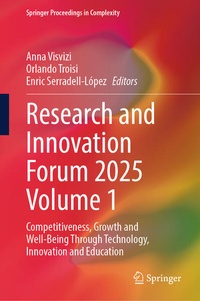
Research and Innovation Forum 2025 Volume 1
Description
This book features research presented and discussed during the Research and Innovation Forum (Rii Forum) 2025. As such, this book offers a unique insight into emerging topics, issues and developments pertinent to the fields of technology, innovation and education and their social impact.
Papers included in this book apply inter- and multi-disciplinary approaches to query such issues as technology-enhanced teaching and learning, smart cities, information systems, cognitive computing and social networking. What brings these threads of the discussion together is the question of how advances in computer science-which are otherwise largely incomprehensible to researchers from other fields-can be effectively translated and capitalized on so as to make them beneficial for society as a whole.
In this context, Rii Forum and Rii Forum proceedings offer an essential venue where diverse stakeholders, including academics, the think tank sector and decision-makers, can engage in a meaningful dialogue with a view to improving the applicability of advances in computer science.
More details
Other editions
Additional editions
Content
Industry 5.0. and its innovation dynamics: modelling and explaining its potential.-Velocity Inequalities in Digital Public Service Ecosystem: David against Goliath in the Agri Food Value Chain?.- Exploring the Role of Digital Literacy in Enhancing Entrepreneurial Success and Innovation within Ecosystems.- The Dark Side of the Metaverse: Managing Human Resource Management challenges in Virtual Environments.- Integrating Model Driven Development within Agile Methods: Insights from a Systematic Literature Review.- Implementing DEA with Gaussian AHP and Pearson Correction for Efficiency Benchmarking in a Food Retail Chain.- Systematic Literature Reviews (SLRs) in Business, Management and Economics: Trends, Gaps, and Methodological Rigor.- Why Artificial Intelligence Needs Sociology?.- The (Dis)Illusion of the Web3 Decentralization for Global Governance in the Age of GenAI.- Digital Human: the new frontier of Artificial Intelligence for Customer Experience.- Dynamic Capabilities in AI Powered Business Ecosystems: An Outline of an Emerging Research Agenda.- Acceptance of Generative AI in the Creative Industry: The Role of Brand Recognition, Trust, and Experience Moderation in AI Adoption.- Beyond imagination: Design Thinking, creativity and the power of AI.- Redesigning skills for the twin transition: a path toward sustainable innovation.- Building the Next Generation of Entrepreneurs: The Role of Group Projects and Experiential Education in Nurturing Entrepreneurial Mindset and Skills.- University Education and Entrepreneurial Intention: The Role of University Climate and Entrepreneurship Education.- The Contribution of Hungarian Universities to the UN Sustainable Development Goals: A Comparative Analysis of State run, Church affiliated, and Model Transition Institutions (2019 2023).- Redefining Architecture Pedagogy for GenAI Enhanced Classrooms: Impacts on Student Engagement and Learning Outcomes.- Reaching the Parts Others Cannot: Embedding Further Education in the UK Innovation Ecosystem for Inclusive Growth and Place Based Innovation.- Smart Transition in Historical Small Towns: First Insights from a Digital Material Flow Assessment in the Italian Case Study of Taurasi.- TOWARDS A FRAMEWORK FOR PROMOTING WALKABILITY IN TAHLIA STREET, JEDDAH CITY.- Towards Touristic Based Development for Al Tayseer Area in Makkah City.- Humanizing cities through urban design: urban design principles and policy making considerations.- Private Equity in U.S. Healthcare.- Digital Revolution in Pharmaceutical Industry: A Network Analysis of Industry 5.0 Technologies.- Interpretable Machine Learning for Metastasis Prediction in Paragangliomas and Pheochromocytomas.- Enhancing Precision Medicine in Non Small Cell Lung Cancer Diagnosis through Artificial Intelligence.- Detection of gait alterations using mobile device sensors and machine learning.