

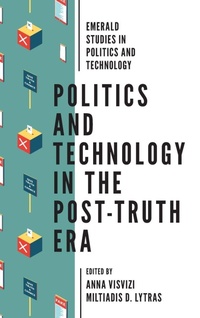
Politics and Technology in the Post-Truth Era
Published on 7. May 2019
Book
Hardback
320 pages
978-1-78756-984-3 (ISBN)
Description
Advances in information and communication technology (ICT) have directly impacted the way in which politics operates today. Bringing together research on Europe, the US, South America, the Middle East, Asia and Africa, this book examines the relationship between ICT and politics in a global perspective. Technological innovations such as big data, data mining, sentiment analysis, cognitive computing, artificial intelligence, virtual reality, augmented reality, social media and blockchain technology are reshaping the way ICT intersects with politics and in this collection contributors examine these developments, demonstrating their impact on the political landscape. Chapters examine topics such as cyberwarfare and propaganda, post-Soviet space, Snowden, US national security, e-government, GDPR, democratization in Africa and internet freedom.
Providing an overview of new research on the emerging relationship between the promise and potential inherent in ICT and its impact on politics, this edited collection will prove an invaluable text for students, researchers and practitioners working in the fields of Politics, International Relations and Computer Science.
Providing an overview of new research on the emerging relationship between the promise and potential inherent in ICT and its impact on politics, this edited collection will prove an invaluable text for students, researchers and practitioners working in the fields of Politics, International Relations and Computer Science.
Reviews / Votes
Contributed by information management, computer science, and other researchers working in academia, politics, and the think-tank sector around the world, the 19 essays in this volume consider issues related to the impact of information and communication technologies on politics. They examine the impact of the internet in promoting democracy in processes of regime transition in Tunisia, Egypt, Angola, and Zimbabwe; the patterns of political content diffusion in social networks; social media and public engagement in Belarus; the use of advanced computational techniques like text mining and sentiment analysis in social media to understand the relationship between political status and economic development in Taiwan; the impact of social media and disruptive technologies on political campaigns; the compliance of open data in politics in terms of General Data Protection Regulation requirements in the European Union; how cyberintelligence and cyberterrorism impact national security, surveillance, and privacy in the US, as well as citizens' opinions about privacy and security, using the case of Edward Snowden; and information security risks in Russian propaganda. Other chapters discuss information and communication technology to fight corruption and promote participatory democracy in Romania; the role of virtual currencies in modern societies; the link between information and communication technology and digital diplomacy in the Western Balkan countries; the role of information and communication technology in enhancing citizens' involvement in day-to-day policymaking in Brazil and Saudi Arabia; the politics behind large information systems projects; and the relationship between trade in information and communication technology, the international economy, and politics. -- Annotation (c)2019 * (protoview.com) *More details
Series
Language
English
Place of publication
Bingley
United Kingdom
Target group
Professional and scholarly
Dimensions
Height: 235 mm
Width: 157 mm
Thickness: 22 mm
Weight
616 gr
ISBN-13
978-1-78756-984-3 (9781787569843)
Copyright in bibliographic data and cover images is held by Nielsen Book Services Limited or by the publishers or by their respective licensors: all rights reserved.
Schweitzer Classification
Other editions
Additional editions
Anna Visvizi | Miltiadis Lytras
Politics and Technology in the Post-Truth Era
E-Book
05/2019
1st Edition
Emerald Publishing Limited
€79.99
Available for download
Persons
Anna Visvizi is Associate Professor at Deree College - The American College of Greece and Visiting Researcher at Effat University, Saudi Arabia. Her research focuses on the intersection of politics, economics and ICT.
Miltiadis D. Lytras is Research Professor at Deree College - The American College of Greece and Visiting Researcher at Effat University, Saudi Arabia. His work focuses on bringing together advances in ICT and knowledge management to advance socio-economic sustainability and citizens' wellbeing.
Miltiadis D. Lytras is Research Professor at Deree College - The American College of Greece and Visiting Researcher at Effat University, Saudi Arabia. His work focuses on bringing together advances in ICT and knowledge management to advance socio-economic sustainability and citizens' wellbeing.
Content
Chapter 1. Introduction- Politics & ICT: mechanisms, dynamics, implications; Anna Visvizi, Miltiadis Lytras Chapter 2. From the Freedom of the Press to the Freedom of the Internet: A New Public Sphere in the Making? Claudia Toriz Ramos
Chapter 3. Diffusion patterns of political content over social networks; Marcal Mora-Cantallops, Zhengqi Yan and Salvador Sanchez-Alonso
Chapter 4. Contemporary politics and society: social media and public engagement in Belarus; Victor Shadurski, Galina Malishevskaya
Chapter 5. Modeling Public Mood and Emotion: Blog and News Sentiment and Politico-Economic Phenomena; Mu-Yen Chen, Min-Hsuan Fan, Ting-Hsuan Chen, Ren-Pao Heish
Chapter 6. Political Campaigns, Social Media & Analytics: the case of the GDPR; Nick Dimisianos
Chapter 7. Assessing Compliance of Open Data in Politics with European Data Protection Regulation; Francesco Ciclosi, Paolo Ceravolo, Ernesto Damiani, Donato De Ieso
Chapter 8. ICT, politics and cyber intelligence: revisiting the case of Snowden; Emanuel Boussios
Chapter 9. Government Surveillance, National Security, and the American Rights: Using Sentiment Analysis to Extract Citizen Opinions; Lily Popova Zhuhadar, Mark Ciampa
Chapter 10. Information security risks in the context of Russian propaganda in the CEE; Aleksandra Kuczynska-Zonik, Agata Tatarenko
Chapter 11. The ICT and its uses: fighting corruption and promoting participatory democracy: the case of Romania; Cristina Matiuta
Chapter 12. Virtual Currencies in modern societies: challenges and opportunities; Higinio Mora, Francisco A. Pujol Lopez, Julio Cesar Mendoza Tello, Mario R. Morales
Chapter 13. Digital Diplomacy in Practice: A Case Study of the Western Balkan Countries; Gorazd Justinek, Sabina Carli, Ingrid Omahna
Chapter 14. Social media and the Brazilian politics: a close look at the different perspectives and "The Brazil I Want" initiative; Cleber Pinelli Teixeira, Jonatas Castro dos Santos, Reisla D'Almeida Rodrigues, Sean Wolfgand Matsui Siqueira, Renata Araujo
Chapter 15. Evaluation of the national Open Government Data (OGD) portal of Saudi Arabia; Saxena Stuti
Chapter 16. E-Government Strategy and Its Impact on Economic and Social Development in Saudi Arabia; Husseain Alhashimi
Chapter 17. Romancing Top Management: The Politics of Top Management Support in Large Information System Projects; Gloria H.W. Liu, Cecil E.H Chua
Chapter 18. International trade on the ICT market; Katarzyna Zukrowska
Chapter 19. Conclusion- ICT and politics: looking ahead; Anna Visvizi,
Miltiadis Lytras
Chapter 3. Diffusion patterns of political content over social networks; Marcal Mora-Cantallops, Zhengqi Yan and Salvador Sanchez-Alonso
Chapter 4. Contemporary politics and society: social media and public engagement in Belarus; Victor Shadurski, Galina Malishevskaya
Chapter 5. Modeling Public Mood and Emotion: Blog and News Sentiment and Politico-Economic Phenomena; Mu-Yen Chen, Min-Hsuan Fan, Ting-Hsuan Chen, Ren-Pao Heish
Chapter 6. Political Campaigns, Social Media & Analytics: the case of the GDPR; Nick Dimisianos
Chapter 7. Assessing Compliance of Open Data in Politics with European Data Protection Regulation; Francesco Ciclosi, Paolo Ceravolo, Ernesto Damiani, Donato De Ieso
Chapter 8. ICT, politics and cyber intelligence: revisiting the case of Snowden; Emanuel Boussios
Chapter 9. Government Surveillance, National Security, and the American Rights: Using Sentiment Analysis to Extract Citizen Opinions; Lily Popova Zhuhadar, Mark Ciampa
Chapter 10. Information security risks in the context of Russian propaganda in the CEE; Aleksandra Kuczynska-Zonik, Agata Tatarenko
Chapter 11. The ICT and its uses: fighting corruption and promoting participatory democracy: the case of Romania; Cristina Matiuta
Chapter 12. Virtual Currencies in modern societies: challenges and opportunities; Higinio Mora, Francisco A. Pujol Lopez, Julio Cesar Mendoza Tello, Mario R. Morales
Chapter 13. Digital Diplomacy in Practice: A Case Study of the Western Balkan Countries; Gorazd Justinek, Sabina Carli, Ingrid Omahna
Chapter 14. Social media and the Brazilian politics: a close look at the different perspectives and "The Brazil I Want" initiative; Cleber Pinelli Teixeira, Jonatas Castro dos Santos, Reisla D'Almeida Rodrigues, Sean Wolfgand Matsui Siqueira, Renata Araujo
Chapter 15. Evaluation of the national Open Government Data (OGD) portal of Saudi Arabia; Saxena Stuti
Chapter 16. E-Government Strategy and Its Impact on Economic and Social Development in Saudi Arabia; Husseain Alhashimi
Chapter 17. Romancing Top Management: The Politics of Top Management Support in Large Information System Projects; Gloria H.W. Liu, Cecil E.H Chua
Chapter 18. International trade on the ICT market; Katarzyna Zukrowska
Chapter 19. Conclusion- ICT and politics: looking ahead; Anna Visvizi,
Miltiadis Lytras