

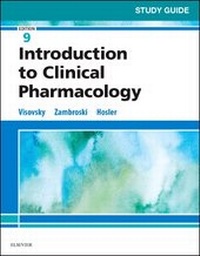
Study Guide for Introduction to Clinical Pharmacology
9th Edition
Published on 22. May 2018
Book
Paperback/Softback
176 pages
978-0-323-52912-9 (ISBN)
Description
Corresponding to the chapters in Introduction to Clinical Pharmacology, 9th Edition, this study guide reinforces your understanding of nursing pharmacology and medication safety. A rich variety of learning activities include a math review, dosage calculation exercises, and research and critical thinking exercises that emphasize clinical decision-making and prioritization.
NCLEX (R)-style questions give you practice on pharmacology questions found in the certification exam.
Mastering Medications section includes patient scenarios and critical thinking questions to help you apply content to safe medication practice.
Dosage calculation questions reinforce mathematical knowledge and encourage safe medication administration practice.
NEW! Updated questions and activities reflect the new content and emphases in Introduction to Clinical Pharmacology, 9th Edition.
NCLEX (R)-style questions give you practice on pharmacology questions found in the certification exam.
Mastering Medications section includes patient scenarios and critical thinking questions to help you apply content to safe medication practice.
Dosage calculation questions reinforce mathematical knowledge and encourage safe medication administration practice.
NEW! Updated questions and activities reflect the new content and emphases in Introduction to Clinical Pharmacology, 9th Edition.
More details
Edition
9th edition
Language
English
Place of publication
St Louis
United States
Publishing group
Elsevier - Health Sciences Division
Target group
Professional and scholarly
College/higher education
Illustrations
Illustrated
Dimensions
Height: 276 mm
Width: 216 mm
Weight
160 gr
ISBN-13
978-0-323-52912-9 (9780323529129)
Copyright in bibliographic data and cover images is held by Nielsen Book Services Limited or by the publishers or by their respective licensors: all rights reserved.
Schweitzer Classification
Other editions
New editions
Constance G. Visovsky | Cheryl H. Zambroski | Shirley M. Hosler
Study Guide for Introduction to Clinical Pharmacology
Book
07/2021
10th Edition
Mosby
€39.60
Article exhausted; check for reprint
Previous edition
Marilyn Winterton Edmunds
Study Guide for Introduction to Clinical Pharmacology
Book
01/2015
8th Edition
Mosby
€28.46
Article exhausted; check for reprint
Persons
Content
Unit I: General Principles 1. Pharmacology and the Nursing Process in LPN Practice 2. Legal, Regulatory, and Ethical Aspects of Drug Administration 3. Principles of Pharmacology
Unit II: Principals of Medication Administration 4. Drug Calculation: Preparing and Administering Drugs
Unit III: Drug Categories 5. Anti-infective Drugs: Antibacterial, Antitubercular, and Antifungal Agents 6. Antivirals and Antiretrovirals 7. Drugs for Allergy and Respiratory Problems 8. Drugs Affecting the Renal/Urinary and Cardiovascular Systems 9. Drugs Therapy for Central Nervous System Problems 10. Drugs Therapy For Mental Health and Behavioral Problems 11. Drugs for Pain Management 12. Anti-inflammatory, Anti-arthritis, and Antigout Drugs 13. Drugs for Gastrointestinal Problems 14. Drugs Affecting the Hematologic System 15. Drugs for Immunization and Immunomodulation 16. Hormones and Drugs for Osteoporosis 17. Drug Therapy for Diabetes 18. Drugs for Eye and Ear Problems 19. Over-the-Counter Drugs, Herbal and Alternative Drugs, and Vitamins and Minerals
Unit II: Principals of Medication Administration 4. Drug Calculation: Preparing and Administering Drugs
Unit III: Drug Categories 5. Anti-infective Drugs: Antibacterial, Antitubercular, and Antifungal Agents 6. Antivirals and Antiretrovirals 7. Drugs for Allergy and Respiratory Problems 8. Drugs Affecting the Renal/Urinary and Cardiovascular Systems 9. Drugs Therapy for Central Nervous System Problems 10. Drugs Therapy For Mental Health and Behavioral Problems 11. Drugs for Pain Management 12. Anti-inflammatory, Anti-arthritis, and Antigout Drugs 13. Drugs for Gastrointestinal Problems 14. Drugs Affecting the Hematologic System 15. Drugs for Immunization and Immunomodulation 16. Hormones and Drugs for Osteoporosis 17. Drug Therapy for Diabetes 18. Drugs for Eye and Ear Problems 19. Over-the-Counter Drugs, Herbal and Alternative Drugs, and Vitamins and Minerals