

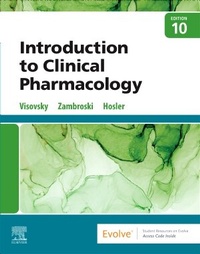
Introduction to Clinical Pharmacology
10th Edition
Published on 30. June 2021
Book
Paperback/Softback
416 pages
978-0-323-75535-1 (ISBN)
Description
Emphasizing safe and effective drug administration, Introduction to Clinical Pharmacology, 10th Edition, helps you understand the principles of pharmacology and prevent medication errors. It promotes safety by showing how drugs and drug classes work, so you can understand why drugs are given, as well as the adverse effects and drug interactions that may occur. A thorough nursing process section with each drug class outlines the nurse's role when administering drugs. The updated Get Ready for the Next Generation NCLEX (R) Examination! feature offers case studies with Next Generation NCLEX-format questions to help you prepare for the new licensure examination.
Ideal scope of content and readability for LPN/LVN programs includes basic, need-to-know pharmacology content.
Safety Alert boxes highlight important nursing considerations for safe medication administration and monitoring.
Lifespan Considerations boxes for children and older adults draw attention to information that would be especially important when giving a specific drug to patients of those age groups.
A focus on understanding drug classes helps students understand the actions and uses of drug classes and provides a framework for safe, effective practice as new drugs are introduced to the market.
Video clips on medication administration procedures provide students with a visual reference for safe medication administration.
Key terms with phonetic pronunciations and text page references help improve students' terminology and language skills before they enter clinical practice.
Essential content is highlighted throughout the text, as in all of Elsevier's LPN Threads textbooks, with features such as Top Tips for Safety, Memory Joggers, and Lifespan Considerations boxes.
NEW! Get Ready for the Next Generation NCLEX (R) Examination! section includes key points, review questions, and case studies with Next Generation NCLEX-format questions to prepare students for the new licensure examination
NEW! Reorganized chapters break up lengthy content and more logically present pharmacological content by body system or major disorder
UPDATED! Coverage of newly approved and updated pharmaceutical treatments and drugs prepares students for practice
Ideal scope of content and readability for LPN/LVN programs includes basic, need-to-know pharmacology content.
Safety Alert boxes highlight important nursing considerations for safe medication administration and monitoring.
Lifespan Considerations boxes for children and older adults draw attention to information that would be especially important when giving a specific drug to patients of those age groups.
A focus on understanding drug classes helps students understand the actions and uses of drug classes and provides a framework for safe, effective practice as new drugs are introduced to the market.
Video clips on medication administration procedures provide students with a visual reference for safe medication administration.
Key terms with phonetic pronunciations and text page references help improve students' terminology and language skills before they enter clinical practice.
Essential content is highlighted throughout the text, as in all of Elsevier's LPN Threads textbooks, with features such as Top Tips for Safety, Memory Joggers, and Lifespan Considerations boxes.
NEW! Get Ready for the Next Generation NCLEX (R) Examination! section includes key points, review questions, and case studies with Next Generation NCLEX-format questions to prepare students for the new licensure examination
NEW! Reorganized chapters break up lengthy content and more logically present pharmacological content by body system or major disorder
UPDATED! Coverage of newly approved and updated pharmaceutical treatments and drugs prepares students for practice
More details
Edition
10th edition
Language
English
Place of publication
St Louis
United States
Publishing group
Elsevier - Health Sciences Division
Target group
College/higher education
Illustrations
Approx. 135 illustrations (135 in full color); Illustrations
Dimensions
Height: 276 mm
Width: 216 mm
Weight
910 gr
ISBN-13
978-0-323-75535-1 (9780323755351)
Copyright in bibliographic data and cover images is held by Nielsen Book Services Limited or by the publishers or by their respective licensors: all rights reserved.
Schweitzer Classification
Other editions
New editions
Constance G. Visovsky | Cheryl H. Zambroski | Shirley M. Hosler
Introduction to Clinical Pharmacology
Book
03/2024
11th Edition
Churchill Livingstone
€92.99
Shipment within 15-20 days
Additional editions
Rn Visovsky | Rn Zambroski | Bsn Hosler RN
Introduction to Clinical Pharmacology - E-Book
E-Book
01/2021
10th Edition
Mosby
€69.99
Available for download
Previous edition
Constance G. Visovsky | Cheryl H. Zambroski | Shirley Hosler
Introduction to Clinical Pharmacology
Book
03/2018
9th Edition
Mosby
€80.59
Article exhausted; check for reprint
Persons
Shirley M. Hosler formerly, Nursing Instructor, School of Nursing, National American University, USA.
Author
Professor and Lewis and Leona Hughes Endowed Chair in Nursing Science, College of Nursing, University of South Florida, Tampa, Florida, USA
Associate Professor, College of Nursing, University of South Florida, Tampa, Florida, USA
Formerly, Nursing Instructor, School of Nursing, National American University, USA
Content
Unit I. General Principles
1. Pharmacology and the Nursing Process in LPN Practice
2. Legal, Regulatory, and Ethical Aspects of Drug Administration
3. Principles of Pharmacology
Unit II. Principals of Medication Administration
4. Drug Calculation: Preparing and Administering Drugs
Unit III. Drug Categories
5. Drugs for Bacterial Infections
6. Drugs for Tuberculosis, Fungal and Parasitic Infections
7. Drugs for Viral and Retroviral Infections
8. Drugs for Allergy and Respiratory Problems
9. Drugs Affecting the Renal/Urinary and Cardiovascular Systems
10. Drugs for Central Nervous System Problems
11. Drugs for Mental Health
12. Drugs for Pain Management
13. Drugs for Inflammation, Arthritis and Gout
14. Drugs for Gastrointestinal Problems
15. Drugs Affecting the Hematologic System
16. Drugs for Immunization and Immunomodulation
17. Drugs for Osteoporosis and Hormonal Problems
18. Drug Therapy for Diabetes
19. Drugs for Eye and Ear Problems
20. Over-the-Counter Drug Therapy
1. Pharmacology and the Nursing Process in LPN Practice
2. Legal, Regulatory, and Ethical Aspects of Drug Administration
3. Principles of Pharmacology
Unit II. Principals of Medication Administration
4. Drug Calculation: Preparing and Administering Drugs
Unit III. Drug Categories
5. Drugs for Bacterial Infections
6. Drugs for Tuberculosis, Fungal and Parasitic Infections
7. Drugs for Viral and Retroviral Infections
8. Drugs for Allergy and Respiratory Problems
9. Drugs Affecting the Renal/Urinary and Cardiovascular Systems
10. Drugs for Central Nervous System Problems
11. Drugs for Mental Health
12. Drugs for Pain Management
13. Drugs for Inflammation, Arthritis and Gout
14. Drugs for Gastrointestinal Problems
15. Drugs Affecting the Hematologic System
16. Drugs for Immunization and Immunomodulation
17. Drugs for Osteoporosis and Hormonal Problems
18. Drug Therapy for Diabetes
19. Drugs for Eye and Ear Problems
20. Over-the-Counter Drug Therapy