

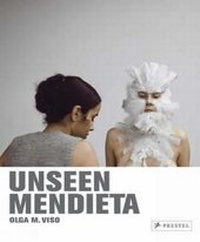
Unseen Mendieta
The Unpublished Works of Ana Mendieta
Published on 1. September 2008
Book
Hardback
304 pages
978-3-7913-3966-5 (ISBN)
Description
Unseen Mendieta zeigt eine umfangreiche Auswahl bisher unveröffentlichter Werke der früh verstorbenen Perfomance-Künstlerin Ana Mendieta. Sie wurde in den 70er Jahren vor allem durch ihre Silueta-Serie berühmt - Arbeiten, bei denen sie mit ihrem eigenen Körper oder dessen Silhouette eine vergängliche Synthese mit der Natur zelebrierte. Umfassende Fotostrecken und begleitende Essays dokumentieren sowohl die Entstehungsprozesse ihrer Werke als auch deren schöpferische und spirituelle Spannweite im Kontext ihrer Zeit.
More details
Persons
OLGA VISO served as director of the Hirshhorn Museum and Sculpture Garden in Washington, D.C. before being named director of the Walker Art Center in Minneapolis in 2008. She is the author of several books on contemporary Latin American art. She lives in Minneapolis, MN.B
Content
Resisting the terminology that she felt the art world establishment tried to impose on her, Mendieta developed her own vocabulary to describe her approach to art-making. She used the term "earth-body work" to describe her performance-based actions in the landscape, which she documented on Super 8 mm film and in 35 mm still photography. Such terms recognized the hybrid nature of her practice after 1974- her particular fusion of performance/body art and land/earth art. Although Mendieta's mature work was "performative" (it was time-based and ephemeral), the artist did not consider her art to be "performance" in a strict sense; she did not require an audience or public platform for the work to be activated or completed. Indeed, Mendieta was not drawn to the improvisational energy of live performance, nor was she interested in the kind of audience interaction it afforded. She had experimented with live performance as a graduate student at the University of Iowa in the early 1970s and preferred to execute her sculptural tableaux and actions in nature and in private. She would document these performance-based works using film and would then share that documentation with audiences.
The language Mendieta evolved to describe her art also recognized the syncretic nature of her practice, one that freely borrowed archetypal symbols from a variety of cultures as well as her own mixed heritage as a Cuban American. The artist was especially interested in Amerindian and Afro-Cuban traditions and the indigenous cultures of Mexico, a country she viewed as a surrogate homeland before her return to Cuba in 1981 after eighteen years of exile. Mendieta felt strongly that these cultural references and free appropriations placed
her work outside of both modern and emergent postmodern traditions. She stated in 1984, "My works do not belong to the modernist tradition.Nor is [my art] akin to the commercially historical-self-conscious assertions of what is called post-modernism." Despite Mendieta's attempts to clarify her art and identity, her work and contributions to late-twentieth-century art were often misunderstood. The tragic circumstances surrounding Mendieta's untimely death at age thirty-six helped perpetuate misperceptions of her work during the following decades.
On September 8, 1985, Mendieta fell from a window of an apartment on the thirty-fourth floor of a high-rise building in New York City that she shared with her husband, the well-known American sculptor Carl Andre. In the years following her death, Andre was tried for her murder and ultimately acquitted, but the incident polarized the American art world (and the New York art community in particular) for well over a decade. The characterization of the artist in the media as an aggressive feminist Latina who anticipated her own death, through her body-oriented art and fascination with "occult" rituals, reflected the myriad power imbalances then operative in the art world -imbalances between men and women, whites and minorities, "first-" and "third-world" nations, established and emerging artists, privileged individuals and the disenfranchised -which were especially pronounced in the United States during the years of Ronald Reagan's presidency. The scandal around Mendieta's death also erupted during a period in contemporary culture dominated by discussions about center versus periphery, early debates about multiculturalism, and growing awareness of an emerging global
culture. Through the 1990s, aspects of Mendieta's life and her art were frequently made to serve the personal, political, and social agendas of others-Andre's defense attorneys, factions of the New York art world, women's groups and feminist coalitions, and art and cultural historians. In this charged critical landscape, the integrity of Mendieta's art, her evolution as an artist, and her place within a broader context of art than that defined under the rubrics of feminism and multiculturalism, remained relatively unexplored.
A complete picture of Mendieta's production as an artist was obscured until the late 1990s not only by an unfavorable critical climate, but also by limited access to the full range of Mendieta's visual production because of the need to organize her archive and preserve original photographic materials. The sudden death of Mendieta, who had no formal gallery representation, had left a devastated family uncertain of how to manage her estate and legacy. The archive of her work comprised thousands of 35 mm slides, eighty-one Super 8 film reels, hundreds of printed photographs, black-and-white negatives, and contact sheets, as well as loose drawings, sketchbooks, and correspondence, in a state of relative disarray. Mendieta was, after all, an emerging artist who was establishing her career. Consumed by the trial of Carl Andre, the Mendieta family did not begin to comprehensively assess the contents of the archive until after Galerie Lelong in New York assumed representation of the estate in 1991. At that point, scholars began to investigate Mendieta's legacy, and a growing number of Mendieta's works were made available to the public through exhibition, publication, and the production of a posthumous photographic edition of twenty images of Siluetas made by the artist in Iowa and Mexico in the 1970s. For well over a decade after Mendieta's death, her art was known and understood primarily through these photographic prints and a selection of drawings and sculptures presented in a survey exhibition organized by the New Museum of Contemporary Art, New York, in 1988.
It was not until the mid-1990s that works created at the University of Iowa in the early 1970s by the artist, including photographs and short films of live actions and studio performances, were seen. The avid interest of scholars researching Mendieta, including the American art historian Julia P. Herzberg and Spanish curator Gloria Moure, led Galerie Lelong to provide greater access to the archive by organizing the artist's inventory of 35 mm slides in 1998-99. Complete rolls of date-stamped slides made by the artist between 1971 and 1983 were gathered and put in chronological order, revealing the artist's working process and method of recording, selecting, and editing the image documentation of her time-based actions in the studio, architectural settings, and in nature.
The language Mendieta evolved to describe her art also recognized the syncretic nature of her practice, one that freely borrowed archetypal symbols from a variety of cultures as well as her own mixed heritage as a Cuban American. The artist was especially interested in Amerindian and Afro-Cuban traditions and the indigenous cultures of Mexico, a country she viewed as a surrogate homeland before her return to Cuba in 1981 after eighteen years of exile. Mendieta felt strongly that these cultural references and free appropriations placed
her work outside of both modern and emergent postmodern traditions. She stated in 1984, "My works do not belong to the modernist tradition.Nor is [my art] akin to the commercially historical-self-conscious assertions of what is called post-modernism." Despite Mendieta's attempts to clarify her art and identity, her work and contributions to late-twentieth-century art were often misunderstood. The tragic circumstances surrounding Mendieta's untimely death at age thirty-six helped perpetuate misperceptions of her work during the following decades.
On September 8, 1985, Mendieta fell from a window of an apartment on the thirty-fourth floor of a high-rise building in New York City that she shared with her husband, the well-known American sculptor Carl Andre. In the years following her death, Andre was tried for her murder and ultimately acquitted, but the incident polarized the American art world (and the New York art community in particular) for well over a decade. The characterization of the artist in the media as an aggressive feminist Latina who anticipated her own death, through her body-oriented art and fascination with "occult" rituals, reflected the myriad power imbalances then operative in the art world -imbalances between men and women, whites and minorities, "first-" and "third-world" nations, established and emerging artists, privileged individuals and the disenfranchised -which were especially pronounced in the United States during the years of Ronald Reagan's presidency. The scandal around Mendieta's death also erupted during a period in contemporary culture dominated by discussions about center versus periphery, early debates about multiculturalism, and growing awareness of an emerging global
culture. Through the 1990s, aspects of Mendieta's life and her art were frequently made to serve the personal, political, and social agendas of others-Andre's defense attorneys, factions of the New York art world, women's groups and feminist coalitions, and art and cultural historians. In this charged critical landscape, the integrity of Mendieta's art, her evolution as an artist, and her place within a broader context of art than that defined under the rubrics of feminism and multiculturalism, remained relatively unexplored.
A complete picture of Mendieta's production as an artist was obscured until the late 1990s not only by an unfavorable critical climate, but also by limited access to the full range of Mendieta's visual production because of the need to organize her archive and preserve original photographic materials. The sudden death of Mendieta, who had no formal gallery representation, had left a devastated family uncertain of how to manage her estate and legacy. The archive of her work comprised thousands of 35 mm slides, eighty-one Super 8 film reels, hundreds of printed photographs, black-and-white negatives, and contact sheets, as well as loose drawings, sketchbooks, and correspondence, in a state of relative disarray. Mendieta was, after all, an emerging artist who was establishing her career. Consumed by the trial of Carl Andre, the Mendieta family did not begin to comprehensively assess the contents of the archive until after Galerie Lelong in New York assumed representation of the estate in 1991. At that point, scholars began to investigate Mendieta's legacy, and a growing number of Mendieta's works were made available to the public through exhibition, publication, and the production of a posthumous photographic edition of twenty images of Siluetas made by the artist in Iowa and Mexico in the 1970s. For well over a decade after Mendieta's death, her art was known and understood primarily through these photographic prints and a selection of drawings and sculptures presented in a survey exhibition organized by the New Museum of Contemporary Art, New York, in 1988.
It was not until the mid-1990s that works created at the University of Iowa in the early 1970s by the artist, including photographs and short films of live actions and studio performances, were seen. The avid interest of scholars researching Mendieta, including the American art historian Julia P. Herzberg and Spanish curator Gloria Moure, led Galerie Lelong to provide greater access to the archive by organizing the artist's inventory of 35 mm slides in 1998-99. Complete rolls of date-stamped slides made by the artist between 1971 and 1983 were gathered and put in chronological order, revealing the artist's working process and method of recording, selecting, and editing the image documentation of her time-based actions in the studio, architectural settings, and in nature.