

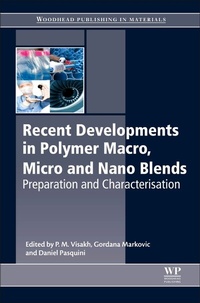
Recent Developments in Polymer Macro, Micro and Nano Blends
Preparation and Characterisation
Published on 15. September 2016
Book
Hardback
342 pages
978-0-08-100408-1 (ISBN)
Description
Recent Developments in Polymer Macro, Micro and Nano Blends: Preparation and Characterisation discusses the various types of techniques that are currently used for the characterization of polymer-based macro, micro, and nano blends. It summarizes recent technical research accomplishments, emphasizing a broad range of characterization methods.
In addition, the book discusses preparation methods and applications for various types of polymer-based macro, micro, and nano blends. Chapters include thermoplastic-based polymer & nano blends, applications of rubber based and thermoplastic blends, micro/nanostructures polymer blends containing block copolymers, advances in polymer-inorganic hybrids as membrane materials, synthesis of polymer/inorganic hybrids through heterophase polymerizations, nanoporous polymer foams from nanostructured polymer blends, and natural polymeric biodegradable nano blends for protein delivery.
In addition, the book discusses preparation methods and applications for various types of polymer-based macro, micro, and nano blends. Chapters include thermoplastic-based polymer & nano blends, applications of rubber based and thermoplastic blends, micro/nanostructures polymer blends containing block copolymers, advances in polymer-inorganic hybrids as membrane materials, synthesis of polymer/inorganic hybrids through heterophase polymerizations, nanoporous polymer foams from nanostructured polymer blends, and natural polymeric biodegradable nano blends for protein delivery.
More details
Language
English
Place of publication
Cambridge
United Kingdom
Publishing group
Elsevier Science & Technology
Target group
Professional and scholarly
academics, researchers, scientists and engineers working in field of polymer-based blends
Dimensions
Height: 229 mm
Width: 152 mm
Weight
690 gr
ISBN-13
978-0-08-100408-1 (9780081004081)
Copyright in bibliographic data and cover images is held by Nielsen Book Services Limited or by the publishers or by their respective licensors: all rights reserved.
Schweitzer Classification
Persons
Dr. Visakh P.M. is a Postdoctoral Researcher at the Faculty of Electronic Engineering, Department of Physical Electronics, TUSUR University, Tomsk, Russia. He obtained his PhD, MPhil and MSc degrees at the School of Chemical Sciences, Mahatma Gandhi University, Kottayam, Kerala, India. He has been invited as a visiting researcher at universities and institutes in 12 different countries, and has presented at numerous international conferences. Dr. Visakh has published several edited books, as well as contributing over 30 book chapters, and acts as guest editor for 4 international journals. His areas of research include polymer science, polymer nanocomposites, material science, bio-nanocomposites, rubber-based nanocomposites, fire retardant polymers, liquid crystalline polymers, and silicon sensors. Gordana Markovic has been employed as a quality engineer at the "Tigar Technical Rubber" factory in Pirot, Serbia since 1990. In 2010 she became a Senior Researcher. She has published 138 publications, 2 book chapters, and 12 reviews and has presented at more than 20 conferences. Her research interests include: rubber, polymer nanocomposites and polymer blends. Dr. Pasquini graduated in Chemistry from the Federal University of Uberlandia in 1998. He earned his master's degree in Physicochemical Sciences in 2000 and his PhD in Physicochemical Sciences in 2004 from the University of Sao Paulo, Brazil. He completed a PhD internship in 2003 and a postdoctoral fellowship in 2005 at the Ecole Francaise de Papeterie et des Industries Graphiques in Grenoble, France. From 2004 to 2008, Dr. Pasquini served as the coordinator of the Research and Development Group in Paints at AW Faber-Castell SA. He was an Assistant Researcher at the University of Aveiro's CICECO - Center for Research in Ceramic and Composite Materials between 2008 and 2009. Currently, he is a Professor at the Chemistry Institute of the Federal University of Uberlandia, Brazil, where he has coordinated the Postgraduate Program in Biofuels.
Dr. Pasquini is actively involved in projects related to the valorization and chemical modification of plant macromolecules, as well as the development of new materials derived from renewable sources. His research focuses on applications such as polymer materials, composites, nanocomposites, nanofibers, spherical nanoparticles, and membranes.
Dr. Pasquini is actively involved in projects related to the valorization and chemical modification of plant macromolecules, as well as the development of new materials derived from renewable sources. His research focuses on applications such as polymer materials, composites, nanocomposites, nanofibers, spherical nanoparticles, and membranes.
Content
1. Polymer Blends: State of Art
2. Thermoplastic Based Nano Blends: Preparation and Characterizations
3. Hybrid Composites Using Natural Polymer Blends and Carbon Nanostructures: Preparation, Characterization and Applications
4. Applications of Rubber Based Blends
5. Applications of Thermoplastic Based Blends
6. Micro/Nanostructures Polymer Blends Containing Block Copolymers
7. Advances in Polymer-Inorganic Hybrids as Membrane Materials
8. Synthesis of Polymer/Inorganic Hybrids through Heterophase Polymerizations
9. Nanoporous Polymer Foams from Nanostructured Polymer Blends: Preparation, Characterization, and Properties
10. Natural Polymeric Biodegradable Nano Blend For Protein Delivery
2. Thermoplastic Based Nano Blends: Preparation and Characterizations
3. Hybrid Composites Using Natural Polymer Blends and Carbon Nanostructures: Preparation, Characterization and Applications
4. Applications of Rubber Based Blends
5. Applications of Thermoplastic Based Blends
6. Micro/Nanostructures Polymer Blends Containing Block Copolymers
7. Advances in Polymer-Inorganic Hybrids as Membrane Materials
8. Synthesis of Polymer/Inorganic Hybrids through Heterophase Polymerizations
9. Nanoporous Polymer Foams from Nanostructured Polymer Blends: Preparation, Characterization, and Properties
10. Natural Polymeric Biodegradable Nano Blend For Protein Delivery