

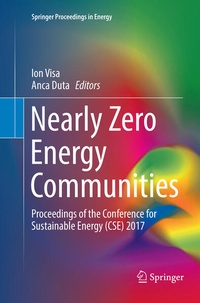
Nearly Zero Energy Communities
Proceedings of the Conference for Sustainable Energy (CSE) 2017
Published on 11. August 2018
Book
Paperback/Softback
XIII, 732 pages
978-3-319-87498-2 (ISBN)
Description
This book addresses the main challenges in implementing the concepts that aim to replace the regular fossil-fuels based energy pattern with the novel energy pattern relying on renewable energy. As the built environment is one major energy consumer, well known and exploited by each community member, the challenges addressing the built environment has to be solved with the consistent contribution of the community inhabitants and its administration. The transition phase, which already is under implementation, is represented by the Nearly Zero Energy Communities (nZEC). From the research topics towards the large scale implementation, the nZEC concept is analyzed in this book, starting with the specific issues of the sustainable built environment, beyond the Nearly Zero Energy Buildings towards a more integrated view on the community (Chapter1) and followed by various implementation concepts for renewable heating & cooling (Chapter 2), for renewable electrical energy production at communitylevel (Chapter 3) and for sustainable water use and reuse (Chapter 4). As the topic is still new, specific instruments supporting education and training (Chapter 5) are needed, aiming to provide the knowledge that can drive the communities in the near future and is expected to increase the acceptance towards renewable energy implemented at community level.
The sub-chapters of this book are the proceedings of the 5 th edition of the Conference for Sustainable Energy, during 19-21 October 2017, organized by the R&D Centre Renewable Energy Systems and Recycling, in the R&D Institute of the Transilvania University of Brasov.
This event was organized under the patronage of the International Federation for the Science of Machines and Mechanisms (IFToMM) - the Technical Committee Sustainable Energy Systems, of the European Sustainable Energy Alliance (ESEIA) and of the Romanian Academy of Technical Sciences.More details
Series
Edition
Softcover reprint of the original 1st ed. 2018
Language
English
Place of publication
Cham
Switzerland
Publishing group
Springer International Publishing
Target group
Professional and scholarly
Illustrations
440 s/w Abbildungen
XIII, 732 p. 440 illus.
Dimensions
Height: 235 mm
Width: 155 mm
Thickness: 40 mm
Weight
1112 gr
ISBN-13
978-3-319-87498-2 (9783319874982)
DOI
10.1007/978-3-319-63215-5
Schweitzer Classification
Other editions
Additional editions
Ion Visa | Anca Duta
Nearly Zero Energy Communities
Proceedings of the Conference for Sustainable Energy (CSE) 2017
Book
09/2017
Springer
€213.99
Shipment within 10-15 days
Content
Content structure
1.
Nearly zero energy buildings and communities (Renewables based energy mixes in sustainable communities: sustainable energy mix design; implementation schemes; energy management; renewables share in the community energy mix; lifecycle assessment of renewables implemented in the built environment);
2. Solar heating and cooling in buildings and communities (Solar-thermal coatings; key-components; solar-thermal systems; architectural integration; tracking; recycling solar-thermal collectors)
3. Solar power in buildings and communities (Photovoltaic novel materials; photovoltaic modules, stings, arrays, platforms; photovoltaics tracking; photovoltaics recycling)
4. Solar energy for water re-use (Photocatalytic materials; photocatalytic technologies for water and wastewater treatment; photocatalytic coatings for indoor comfort; photocatalytic equipment;)
2. Solar heating and cooling in buildings and communities (Solar-thermal coatings; key-components; solar-thermal systems; architectural integration; tracking; recycling solar-thermal collectors)
3. Solar power in buildings and communities (Photovoltaic novel materials; photovoltaic modules, stings, arrays, platforms; photovoltaics tracking; photovoltaics recycling)
4. Solar energy for water re-use (Photocatalytic materials; photocatalytic technologies for water and wastewater treatment; photocatalytic coatings for indoor comfort; photocatalytic equipment;)
5. Policies, education and training on sustainability