

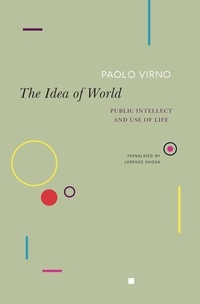
The Idea of World
Public Intellect and Use of Life
Published on 6. December 2022
Book
Paperback/Softback
172 pages
978-0-85742-989-6 (ISBN)
Description
A philosophical exploration of what capitalistic societies truly mean for the individual.
A short vade mecum for unrepentant materialism, The Idea of World collects three essays by Italian philosopher Paulo Virno that are intricately wrapped around one another. The first essay, "Mundanity," tries to clarify what the term "world," as referred to as the perceptual and historical context of our existence, means-both with and against Kant and Wittgenstein. How should we understand expressions such as "worldly people," "the course of the world," or "getting by in this world"? The second, "Virtuosity and Revolution," is a minor political treatise. Virno puts forward a set of concepts capable of confronting the magnetic storm that has knocked out the compasses that every reflection on the public sphere has relied on since the seventeenth century. The third, "The Use of Life", is the shorthand delineation of a research program on the notion of use. What exactly are we doing when we use a hammer, a time span, or an ironic sentence? And, above all, what does the use of the self-of one's own life, which lies at the basis of all uses-amount to in human existence?
Presenting his ideas in three distinct vignettes, Virno examines how the philosophy of language, anthropology, and political theory are inextricably linked.
A short vade mecum for unrepentant materialism, The Idea of World collects three essays by Italian philosopher Paulo Virno that are intricately wrapped around one another. The first essay, "Mundanity," tries to clarify what the term "world," as referred to as the perceptual and historical context of our existence, means-both with and against Kant and Wittgenstein. How should we understand expressions such as "worldly people," "the course of the world," or "getting by in this world"? The second, "Virtuosity and Revolution," is a minor political treatise. Virno puts forward a set of concepts capable of confronting the magnetic storm that has knocked out the compasses that every reflection on the public sphere has relied on since the seventeenth century. The third, "The Use of Life", is the shorthand delineation of a research program on the notion of use. What exactly are we doing when we use a hammer, a time span, or an ironic sentence? And, above all, what does the use of the self-of one's own life, which lies at the basis of all uses-amount to in human existence?
Presenting his ideas in three distinct vignettes, Virno examines how the philosophy of language, anthropology, and political theory are inextricably linked.
More details
Series
Language
English
Place of publication
Greenford
United Kingdom
Target group
Professional and scholarly
Dimensions
Height: 228 mm
Width: 152 mm
Thickness: 23 mm
Weight
234 gr
ISBN-13
978-0-85742-989-6 (9780857429896)
Copyright in bibliographic data and cover images is held by Nielsen Book Services Limited or by the publishers or by their respective licensors: all rights reserved.
Schweitzer Classification
Persons
Paolo Virno teaches philosophy of language at the University of Rome. His most recent works available in English include Convention and Materialism, An Essay on Negation, and When the Word Becomes Flesh. Lorenzo Chiesa is a lecturer in philosophy at Newcastle University and professor at the European Graduate School.
Content
Mundanity: Sensible Context and Public Sphere
1. Wonder and Safety
1.1 The Miracle according to Wittgenstein
1.2 Existence of the World, Existence of Language
1.3 The Sublime according to Kant
1.4 Magnitude and Power
1.5 Iconoclasm
1.6 Sublime Tractatus
2. The Emotional Root of Cosmology
2.1 The Unconditioned Principle
2.2 'The Unattainability of Nature'
2.3 The World in the Last Day
2.4 Totality or Context?
3. Raw Nature
3.1 Boredom and Happiness
3.2 Sensible Context
3.3 Father and Son
3.4 The Insertion of Language
3.5 Chiasm
3.6 'Such Indolent Modesty'
4. Public Sphere
4.1 The Nameless Threat
4.2 Dread and Shelter
4.3 The Uncanny
4.4 Do It Again!
4.5 Common Places and the Public Character of the Mind
4.6 The Space of the Intellect
Virtuosity and Revolution: The Political Theory of Exodus
1. Action, Labour, Intellect
2. Activity without Work
3. Public Intellect: The Virtuosos' Score
4. Exodus
5. The Virtue of Intemperance
6. In Praise of the Multitude
7. The Right to Resistance
8. The Expected Unforeseen
The Use of Life
1. Touch
2. Prepositions
3. Wax Tablet
4. What the Human Being Can Do of Himself
5. The Clumsy Animal
6. Having
7. Institutional Phenomena
8. The Pronoun 'We'
9. Limits and Crisis of Use
10. The Care of the Self
11. On Stage
12. Estrangement Effect
13. Wittgenstein's Director's Notes
1. Wonder and Safety
1.1 The Miracle according to Wittgenstein
1.2 Existence of the World, Existence of Language
1.3 The Sublime according to Kant
1.4 Magnitude and Power
1.5 Iconoclasm
1.6 Sublime Tractatus
2. The Emotional Root of Cosmology
2.1 The Unconditioned Principle
2.2 'The Unattainability of Nature'
2.3 The World in the Last Day
2.4 Totality or Context?
3. Raw Nature
3.1 Boredom and Happiness
3.2 Sensible Context
3.3 Father and Son
3.4 The Insertion of Language
3.5 Chiasm
3.6 'Such Indolent Modesty'
4. Public Sphere
4.1 The Nameless Threat
4.2 Dread and Shelter
4.3 The Uncanny
4.4 Do It Again!
4.5 Common Places and the Public Character of the Mind
4.6 The Space of the Intellect
Virtuosity and Revolution: The Political Theory of Exodus
1. Action, Labour, Intellect
2. Activity without Work
3. Public Intellect: The Virtuosos' Score
4. Exodus
5. The Virtue of Intemperance
6. In Praise of the Multitude
7. The Right to Resistance
8. The Expected Unforeseen
The Use of Life
1. Touch
2. Prepositions
3. Wax Tablet
4. What the Human Being Can Do of Himself
5. The Clumsy Animal
6. Having
7. Institutional Phenomena
8. The Pronoun 'We'
9. Limits and Crisis of Use
10. The Care of the Self
11. On Stage
12. Estrangement Effect
13. Wittgenstein's Director's Notes