

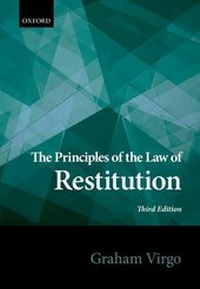
The Principles of the Law of Restitution
3rd Edition
Published on 13. August 2015
Book
Hardback
816 pages
978-0-19-872638-8 (ISBN)
Description
The third edition of The Principles of the Law of Restitution brings this widely cited and influential volume fully up to date. It has been substantially rewritten to reflect the significant changes in the law of restitution and the expansion in the theoretical and critical commentary on the subject.
Following important decisions of the Supreme Court and other courts, large-scale changes have been made to the chapters on enrichment, at the expense of the claimant, mistake, claims against public authorities, and change of position. Additionally, this edition contains a new chapter on the operation of juridical bars on restitutionary claims. References to developments in other jurisdictions have been expanded for this edition, reflecting the significance of these changes and how they assist in the interpretation of English law and provide a basis for criticising that law. Further, in the light of leading cases and the contributions of restitutionary scholars around the world, the author's views on specific controversial debates about the ambit, function, and interpretation of the subject have changed, sometimes radically.
One significant aspect of the book remains unchanged: the book continues to focus on the identification and analysis of the principles which underpin the law of restitution as a whole, but with reference to its three distinct parts: unjust enrichment, restitution for wrongs, and the vindication of property rights. This approach provides the reader with a peerless guide to the law of restitution.
Following important decisions of the Supreme Court and other courts, large-scale changes have been made to the chapters on enrichment, at the expense of the claimant, mistake, claims against public authorities, and change of position. Additionally, this edition contains a new chapter on the operation of juridical bars on restitutionary claims. References to developments in other jurisdictions have been expanded for this edition, reflecting the significance of these changes and how they assist in the interpretation of English law and provide a basis for criticising that law. Further, in the light of leading cases and the contributions of restitutionary scholars around the world, the author's views on specific controversial debates about the ambit, function, and interpretation of the subject have changed, sometimes radically.
One significant aspect of the book remains unchanged: the book continues to focus on the identification and analysis of the principles which underpin the law of restitution as a whole, but with reference to its three distinct parts: unjust enrichment, restitution for wrongs, and the vindication of property rights. This approach provides the reader with a peerless guide to the law of restitution.
Reviews / Votes
Review from previous edition ...a fine addition to the corpus of restitution literature, a book well worth owning and recommending to those studying restitution for the first time. * Duncan Sheehan, Restitution Law Review * ...in terms of user-friendliness it cannot be faulted...no detail is left unaccounted for... * James Couser, Lloyd's Maritime and Commercial Law Quarterly *More details
Edition
3rd Revised edition
Language
English
Place of publication
Oxford
United Kingdom
Target group
College/higher education
Professional and scholarly
Edition type
Revised edition
Dimensions
Height: 251 mm
Width: 181 mm
Thickness: 51 mm
Weight
1522 gr
ISBN-13
978-0-19-872638-8 (9780198726388)
Schweitzer Classification
Other editions
Additional editions
Graham Virgo
The Principles of the Law of Restitution
Book
08/2016
3rd Edition
Oxford University Press
€94.24
Shipment within 15-20 days
Graham Virgo
The Principles of the Law of Restitution
E-Book
08/2015
3rd Edition
OUP eBook
€46.99
Available for download
Graham Virgo
The Principles of the Law of Restitution
E-Book
08/2015
3rd Edition
OUP eBook
€52.49
Available for download
Person
Graham Virgo is Professor in English Private Law and Pro-Vice Chancellor for Education at the University of Cambridge, and Fellow of Downing College, Cambridge. He is also a Bencher of Lincoln's Inn. After graduating from Downing College in 1987, and studying for the BCL at Oxford, he lectured in criminal law, taxation, Equity and restitution. His main research interests are the law of restitution, criminal law, and Equity. He is a recipient of The Pilkington Teaching Prize of Cambridge University in Law (2002), recognized for Outstanding Teaching in Law and was nominated in 2013 for the OUP Law Teacher of the Year award. He is author of The Principles of Equity and Trusts (2012) and co-author of Equity & Trusts: Text, Cases, and Materials (with Paul S Davies, 2013).
Content
1. The Essence Of Restitution ; 2. Themes And Controversies ; Part II Unjust Enrichment ; 3. The Principle Of Unjust Enrichment ; 4. Enrichment ; 5. At The Expense Of The Claimant ; 6. Principles Underlying The Recognition Of The Grounds Of Restitution ; 7. Lawful Bases ; 8. Ignorance ; 9. Mistake ; 10. Compulsion ; 11. Exploitation ; 12. Necessity ; 13. Failure Of Basis ; 14. Incapacity ; 15. Restitution From Public Authorities ; Part III Restitution For Wrongs ; 16. General Principles ; 17. Restitution For Torts ; 18. Restitution For Breach Of Contract ; 19. Restitution For Equitable Wrongdoing ; 20. Criminal Offences ; Part IV Proprietary Restitutionary Claims ; 21. Establishing Proprietary Restitutionary Claims ; 22. Restitutionary Claims And Remedies To Vindicate Property Rights ; 23. The Defence Of Bona Fide Purchase ; Part V General Defences To Restitutionary Claims ; 24. Fundamental Principles ; 25. Defences Arising From Changes In The Defendants Circumstances ; 26. Passing On And Mitigation Of Loss ; 27. Illegality ; 28. Incapacity ; 29. Limitation Periods And Laches