

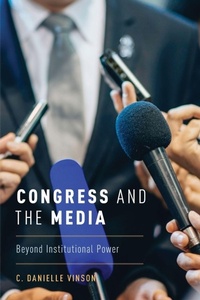
Congress and the Media
Beyond Institutional Power
Published on 23. March 2017
Book
Paperback/Softback
256 pages
978-0-19-063225-0 (ISBN)
Description
Over the last four decades, members of Congress have increasingly embraced media relations as a way to influence national policymaking and politics. In 1977, nearly half of congressional members had no press secretary. Today, media relations is a central component of most congressional offices, and more of that communications effort is directed toward national media, not just the local press. Arguing that members of Congress turn to the media to enhance their formal powers or to compensate for their lack of power, Congress and the Media explains why congressional members go public and when they are likely to succeed in getting coverage. Vinson uses content analysis of national newspaper and television coverage of congressional members over time and members' messages on social media as well as case studies to examine how members in different political circumstances use the media to try to influence policymaking and how this has changed over time. She finds that members' institutional position, the political context, increasing partisan polarization, and journalists' evolving notions of what is newsworthy all affect which congressional members are interested in and successful in gaining media coverage of their messages and what they hope to accomplish by going public. Ultimately, Congress and the Media suggests that going public can be a way for members of Congress to move beyond their institutional powers, but the strategy is not equally available to all members nor effective for all goals.
Reviews / Votes
"Danielle Vinson's outstanding new book, Congress and the Media, demonstrates that going public through the media is an increasingly vital way in which members of Congress-particularly those with less power-seek to influence the direction of public policy. In a period of centralized congressional power, a free media helps insure that minority voices are heard-and can matter!"--Lawrence C. Dodd, Manning J. Dauer Eminent Scholar in Political Science,University of Florida
"In Congress and the Media, Danielle Vinson expertly blends content analysis, case studies, and personal interviews to produce the best general treatment of 'going public' on Capitol Hill in many years. The book is a must-read for legislative scholars and a worthy addition to courses about the national legislature."--C. Lawrence Evans, Professor of Government and Public Policy, William & Mary
More details
Language
English
Place of publication
New York
United States
Target group
Professional and scholarly
Dimensions
Height: 234 mm
Width: 156 mm
Thickness: 15 mm
Weight
442 gr
ISBN-13
978-0-19-063225-0 (9780190632250)
Copyright in bibliographic data and cover images is held by Nielsen Book Services Limited or by the publishers or by their respective licensors: all rights reserved.
Schweitzer Classification
Other editions
Additional editions
Book
03/2017
Oxford University Press Inc
€195.40
Shipment within 15-20 days
E-Book
02/2017
1st Edition
OUP eBook
€15.49
Available for download
E-Book
02/2017
1st Edition
OUP eBook
€18.99
Available for download
Person
Danielle C. Vinson is Professor of Political Science, Furman University.
Content
List of Illustrations
Acknowledgements
1 Introduction: Congress Goes Public
2 Four Decades of Going Public in Congress
3 Why Congressional Members Go Public
4 New Paths to Influence: Broadcast and New Media
5 Congress Responds to the President: the Case of Social Security Reform
Co-authored with Megan L. Remmel
6 Overcoming Institutional Weakness: the Congressional Black Caucus Goes Public
7 A Tale of Two Senators: Adapting Public Strategies to Different Goals
8 The Possibilities and Limits of Going Public in Congress
Appendix
References
Index
Acknowledgements
1 Introduction: Congress Goes Public
2 Four Decades of Going Public in Congress
3 Why Congressional Members Go Public
4 New Paths to Influence: Broadcast and New Media
5 Congress Responds to the President: the Case of Social Security Reform
Co-authored with Megan L. Remmel
6 Overcoming Institutional Weakness: the Congressional Black Caucus Goes Public
7 A Tale of Two Senators: Adapting Public Strategies to Different Goals
8 The Possibilities and Limits of Going Public in Congress
Appendix
References
Index