


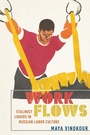
Work Flows
Stalinist Liquids in Russian Labor Culture
Published on 15. February 2024
Book
Hardback
324 pages
978-1-5017-7367-9 (ISBN)
Description
Work Flows investigates the emergence of "flow" as a crucial metaphor within Russian labor culture since 1870. Maya Vinokour frames concern with fluid channeling as immanent to vertical power structures-whether that verticality derives from the state, as in Stalin's Soviet Union and present-day Russia, or from the proliferation of corporate monopolies, as in the contemporary Anglo-American West. Originating in pre-revolutionary bio-utopianism, the Russian rhetoric of liquids and flow reached an apotheosis during Stalin's First Five-Year Plan and re-emerged in post-Soviet "managed democracy" and Western neoliberalism.
The literary, philosophical, and official texts that Work Flows examines give voice to the Stalinist ambition of reforging not merely individual bodies, but space and time themselves. By mobilizing the understudied thematic of fluidity, Vinokour offers insight into the nexus of philosophy, literature, and science that underpinned Stalinism and remains influential today. Work Flows demonstrates that Stalinism is not a historical phenomenon restricted to the period 1922-1953, but a symptom of modernity as it emerged in the twentieth century. Stalinism's legacy extends far beyond the bounds of the former Soviet Union, emerging in seemingly disparate settings like post-Soviet Russia and Silicon Valley.
The literary, philosophical, and official texts that Work Flows examines give voice to the Stalinist ambition of reforging not merely individual bodies, but space and time themselves. By mobilizing the understudied thematic of fluidity, Vinokour offers insight into the nexus of philosophy, literature, and science that underpinned Stalinism and remains influential today. Work Flows demonstrates that Stalinism is not a historical phenomenon restricted to the period 1922-1953, but a symptom of modernity as it emerged in the twentieth century. Stalinism's legacy extends far beyond the bounds of the former Soviet Union, emerging in seemingly disparate settings like post-Soviet Russia and Silicon Valley.
More details
Series
Language
English
Place of publication
United States
Publishing group
Cornell University Press
Product notice
Paper over boards
Illustrations
7 b&w halftones - 7 Halftones, black and white
Dimensions
Height: 229 mm
Width: 152 mm
Weight
907 gr
ISBN-13
978-1-5017-7367-9 (9781501773679)
Copyright in bibliographic data and cover images is held by Nielsen Book Services Limited or by the publishers or by their respective licensors: all rights reserved.
Schweitzer Classification
Other editions
Additional editions
E-Book
02/2024
Northern Illinois University Press
€42.49
Available for download
Person
Maya Vinokour is Assistant Professor in the Department of Russian and Slavic Studies at New York University. Her interests include Stalinism and Nazism, late-Soviet science fiction, post-Soviet media, and the global New.
Content
Introduction. Flow: Resource Management in the Twentieth Century
1. Self-Discipline and Liquid Channeling in Prerevolutionary Russian Utopianism
2. Energetic Flows in Fedorov, Gorky, and Bogdanov
3. The Organic Turn: Labor, Technology, and the Body in Early SovietCulture
4. Apotheoses of the Organic Turn
5. Liquids in Socialist Realism I: Reactionary Romanticism
6. Liquids in Socialist Realism II: Three Case Studies
7. And Quietly Flows Platonov
8. 'I Am a Stream of Bright Joy': Daniil Kharms and the LiquidLanguage of Stalinism
After the Future: Stalinist Liquids in Neoliberalism
1. Self-Discipline and Liquid Channeling in Prerevolutionary Russian Utopianism
2. Energetic Flows in Fedorov, Gorky, and Bogdanov
3. The Organic Turn: Labor, Technology, and the Body in Early SovietCulture
4. Apotheoses of the Organic Turn
5. Liquids in Socialist Realism I: Reactionary Romanticism
6. Liquids in Socialist Realism II: Three Case Studies
7. And Quietly Flows Platonov
8. 'I Am a Stream of Bright Joy': Daniil Kharms and the LiquidLanguage of Stalinism
After the Future: Stalinist Liquids in Neoliberalism